Results by title
4 books match the query 'Donham, Donald L.'
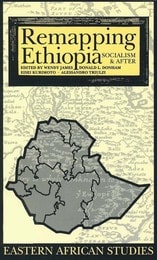
Remapping Ethiopia
Socialism & AfterWendy James
Ohio University Press, 2002
Governance everywhere is concerned with spatial relationships. Modern states “map” local communities, making them legible for the purposes of control. Ethiopia has gone through several stages of “mapping” in its imperial, revolutionary, and postrevolutionary phases.
In 1986 The Southern Marches of Imperial Ethiopia, a cross-disciplinary collection edited by Don Donham and Wendy James, opened up the study of center/periphery relations in the Ethiopian empire until the fall of the monarchy in 1974. This new volume examines similar themes, taking the story forward through the major changes effected by the socialist regime from the revolution of 1974 to its overthrow in 1991, and then into the current period that has been marked by moves toward local democracy and political devolution.
Topics include the changing fortunes of new and historic towns and cities, the impact of the Mengistu regime’s policies of villagization and resettlement, local aspects of the struggle against Mengistu and its aftermath, and the fate of border regions. Special attention is given to developments since 1991: to new local institutions and forms of autonomy, the links between the international diasporas of Ethiopia and the fortunes of their home areas. The collection draws on the work of established scholars as well as a new generation of Ethiopian and international researchers in the disciplines of anthropology, political science, history, and geography.
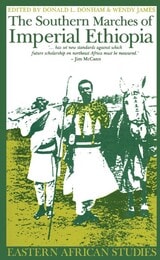
Southern Marches of Imperial Ethiopia
Essays in History and Social AnthropologyDonald L. Donham
Ohio University Press, 2002
This pioneering book, first published to wide acclaim in 1986, traces the way the Ethiopian center and the peripheral regions of the country affected each other. It looks specifically at the expansion of the highland Ethiopian state into the western and southern lowlands from the 1890s up to 1974.
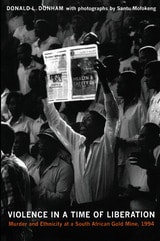
Violence in a Time of Liberation
Murder and Ethnicity at a South African Gold Mine, 1994Donald L. Donham
Duke University Press, 2011
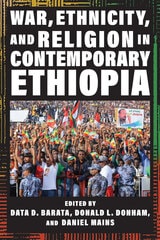
War, Ethnicity, and Religion in Contemporary Ethiopia
Edited by Data D. Barata, Donald L. Donham, and Daniel Mains
University of Wisconsin Press, 2027
Since the downfall of the governing coalition in 2018, Ethiopia has been transformed by a series of intense civil conflicts. Ethnic tensions, an exploding population of young people who lack economic opportunities, increasingly tense religiosity, and the legacy of Cold War policies and ideologies are all dynamics found not only in Ethiopia but much more widely in the developing world today. Yet the distinctive combination of these social, cultural, and historical forces in Ethiopia helps shine a light on the country’s unique past, its unsettled present, and its uncertain future. This interdisciplinary collection of essays explores the social and political causes of these conflicts as well as their profoundly violent effects.