Results by title
3 books match the query 'Downfall'

Lines in the Sand
Congressional Redistricting in Texas and the Downfall of Tom DeLayBy Steve Bickerstaff
University of Texas Press, 2007
The events of 2003 in Texas were important to the political history of this country. Congressman Tom DeLay led a Republican effort to gerrymander the state's thirty-two congressional districts to defeat all ten of the Anglo Democratic incumbents and to elect more Republicans; Democratic state lawmakers fled the state in an effort to defeat the plan. The Lone Star State uproar attracted attention worldwide. The Republicans won this showdown, gaining six additional seats from Texas and protecting the one endangered Republican incumbent. Some of the methods used by DeLay to achieve this result, however, led to his criminal indictment and ultimately to his downfall.
With its eye-opening research, readable style, and insightful commentary, Lines in the Sand provides a front-line account of what happened in 2003, often through the personal stories of members of both parties and of the minority activist groups caught in a political vortex. Law professor Steve Bickerstaff provides much-needed historical perspective and also probes the aftermath of the 2003 redistricting, including the criminal prosecutions of DeLay and his associates and the events that led to DeLay's eventual resignation from the U.S. House of Representatives. As a result, Bickerstaff graphically shows a dark underside of American politics—the ruthless use of public institutional power for partisan gain.

Pathologies
The Downfall of Johan van Vere de WithJacob Isräel de Haan
Seagull Books, 2024
At the start of the twentieth century, Jewish anti-Zionist Jacob Israël de Haan led an eventful life as a poet, journalist, teacher, and lawyer in the Netherlands. His autobiographical novella Pipelines caused a storm of controversy in 1904 with its portrayal of a subject that was considered scandalous at the time—a romantic relationship between two young men. He lost his teaching job, and the entire print run was pulped.
In his iconic 1908 novel Pathologies, he once again openly and radically explored the topic of homosexuality. The story centers around adolescent Johan, who lives a secluded life with his father and their elderly housekeeper in a large house. For a while, Johan has been plagued by erotic fantasies about his classmates. When, to make matters worse, he finds himself feeling attracted to his father—first in a dream, and then in real life—he grows desperate. Johan moves out, finding room and board with an older married couple in Haarlem, where he meets René, a young confident artist. Johan falls head-over-heels in love, and the two men enter a sadomasochistic relationship that soon begins to spiral out of control.
Johan is one of world literature’s most tragic, troubled young heroes, at par with Goethe’s Werther and Dostoevsky’s Raskolnikov. His struggle to come to terms with his fantasies and desires—rife with taboos that continue to resonate today—forms the beating heart of this daring novel. Written in De Haan’s precise, lyrical prose, Pathologies has lost none of its force more than a century after it was first published.
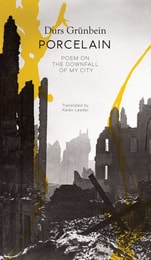
Porcelain
Poem on the Downfall of My CityDurs Grünbein
Seagull Books, 2020
Porcelain is a book-length cycle of forty-nine poems written over the course of more than a decade that together serve as a lament for Durs Grünbein’s hometown, Dresden, which was destroyed in the Allied firebombing of February 1945. The book is at once a history and “declaration of love” to the famed “Venice on the Elbe,” so catastrophically razed by British bombs; a musical fusion of eyewitness accounts, family memories, and stories, of monuments and relics; the story of the city’s destiny as seen through a prism of biographical enigmas, its intimate relation to the “white gold” porcelain that made its fortune and reflections on the power and limits of poetry. Musical, fractured, ironic, and elegiac, Porcelain is controversial, too, in setting itself against what Grünbein calls the “myth” of the Germans as innocent victims of a war crime. At the same time, it never loses sight of the horror deliberately visited on an unwitting civilian population, nor the devastation that looms so large in the German memory. Published for the first time in English, on the seventy-fifth year anniversary of the firebombing, this edition contains new images, notes, Grünbein’s own reflections, and an additional canto—an extraordinary act of poetic kintsugi for the fractured remains of Dresden’s memory.