Results by title
2 books match the query 'Dramatic'
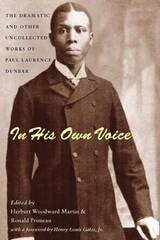
In His Own Voice
The Dramatic and Other Uncollected Works of Paul Laurence DunbarPaul Laurence Dunbar
Ohio University Press, 2002
Paul Laurence Dunbar, introduced to the American public by William Dean Howells, was the first native-born African American poet to achieve national and international fame. While there have been many valuable editions of his works over time, gaps have developed when manuscripts were lost or access to uncollected works became difficult. In His Own Voice brings together previously upublished and uncollected short stories, essays, and poems. This volume also establishes Dunbar’s reputation as a dramatist who mastered standard English conventions and used dialect in musical comedy for ironic effects. In His Own Voice collects more than seventy-five works in six genres. Featured are the previously unpublished play Herrick and two one-act plays, largely ignored for a century, that demonstrate Dunbar’s subversion of the minstrel tradition. This generous expansion of the canon also includes a short story never before published. Herbert Woodward Martin, renowned for his live portrayal of Dunbar, and Ronald Primeau provide a literary and historical context for this previously untreated material, firmly securing the reputation of an important American voice.
[more]
Shaw's Daughters
Dramatic and Narrative Constructions of GenderJ. Ellen Gainor
University of Michigan Press, 1992
This book provides a vital intervention in theater history by systematically deconstructing the long-held assumption that George Bernard Shaw was an exceptionally progressive, early feminist playwright. Examining three central character tropes, Gainor introduces previously unexamined reviews and essays written by Shaw’s female contemporaries, revealing a distinct resistance to his depictions of women. She argues that Shaw’s "unwomanly women" were not truly liberated; rather, Shaw anchored his concepts of female equality strictly in masculine attributes, striping his independent female characters of their sexuality to make them fit patriarchal molds. By situating his dramaturgy firmly within the dominant social, psychological, and medical ideologies of the late Victorian and Edwardian eras, the book proves that Shaw’s gender constructions were deeply bound to the traditional constraints of his time.
[more]