Results by title
3 books match the query 'Drazin, Charles'
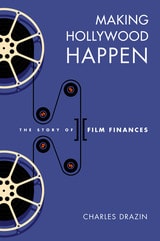
Making Hollywood Happen
Seventy Years of Film FinancesCharles Drazin
University of Wisconsin Press, 2022
Filmmaking is a business—someone has to pay the bills. For much of the industry’s history, that role was shouldered by the studios. The rise of independent filmmakers then led to the rise of independent financiers. But what happens if bad weather closes down a production or a director’s vision pays no heed to the limitations of time and money?
Enter Film Finances. The company was founded in London in 1950 to insure against the risk that a film would exceed its original budget or not be completed on time. Its pioneering development of the “completion guarantee”—the financial instrument that provides the essential security for investors to support independent filmmaking—ultimately led to the creation of many thousands of films, including some of the most celebrated ever made: Moulin Rouge (1953), Dr. No (1962), The Outsiders (1982), Pulp Fiction (1994), Slumdog Millionaire (2008), La La Land (2016), and more.
Film Finances’s role in filmmaking was little known outside the industry until 2012, when it opened its historical archive to scholars. Drawing on these previously private documents as well as interviews with its executives, Making Hollywood Happen tells the company’s story through seven decades of postwar cinema history and chronicles the growth of the international independent film industry. Focusing on a business that has operated at the meeting point between money and art for more than seventy years, this lavishly illustrated book goes to the heart of how the movie business works.
[more]
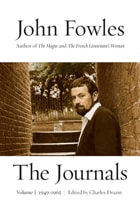
The Journals
Volume 1: 1949-1965John Fowles
Northwestern University Press, 2008
John Fowles gained international recognition in 1963 with his first published novel, The Collector, but his labor on what may be his greatest literary undertaking, his journals, commenced over a decade earlier. Fowles, whose works include The Maggot, The French Lieutenant's Woman, and The Ebony Tower, is among the most inventive and influential English novelists of the twentieth century.
The first volume begins in 1949 with Fowles' final year at Oxford. It reveals his intellectual maturation, chronicling his experiences as a university lecturer in France and as a schoolteacher on the Greek island of Spetsai. Simultaneously candid and eloquent, Fowles' journals also expose the deep connection between his personal and scholarly lives as Fowles struggled to win literary acclaim. From his affair with Elizabeth, the married woman who would become his first wife, to his passion for film, ornithology, travel, and book collecting, the journals present a portrait of a man eager to experience life.
The second and final volume opens in 1966, as Fowles, already an international success, navigates his newfound fame and wealth. With absolute honesty, his journals map his inner turmoil over his growing celebrity and his hesitance to take on the role of a public figure. Fowles recounts his move from London to a secluded house on England's Dorset coast, where discontented with society's voracious materialism he led an increasingly isolated life.
Great works in their own right, Fowles' journals elucidate the private thoughts that gave rise to some of the greatest writing of our time.
[more]

The Journals
Volume 2: 1966-1990John Fowles
Northwestern University Press, 2009
John Fowles gained international recognition in 1963 with his first published novel, The Collector, but his labor on what may be his greatest literary undertaking, his journals, commenced over a decade earlier. Fowles, whose works include The Maggot, The French Lieutenant's Woman, and The Ebony Tower, is among the most inventive and influential English novelists of the twentieth century.
The first volume begins in 1949 with Fowles' final year at Oxford. It reveals his intellectual maturation, chronicling his experiences as a university lecturer in France and as a schoolteacher on the Greek island of Spetsai. Simultaneously candid and eloquent, Fowles' journals also expose the deep connection between his personal and scholarly lives as Fowles struggled to win literary acclaim. From his affair with Elizabeth, the married woman who would become his first wife, to his passion for film, ornithology, travel, and book collecting, the journals present a portrait of a man eager to experience life.
The second and final volume opens in 1966, as Fowles, already an international success, navigates his newfound fame and wealth. With absolute honesty, his journals map his inner turmoil over his growing celebrity and his hesitance to take on the role of a public figure. Fowles recounts his move from London to a secluded house on England's Dorset coast, where discontented with society's voracious materialism he led an increasingly isolated life.
Great works in their own right, Fowles' journals elucidate the private thoughts that gave rise to some of the greatest writing of our time.
[more]