Results by title
14 books match the query 'Dreaming'
Amid the Fall, Dreaming of Eden
Du Bois, King, Malcolm X, and Emancipatory CompositionBradford T. Stull
Southern Illinois University Press, 1999
Whom, or what, does composition—defined here as an intentional process of study, either oral or written—serve? Bradford T. Stull contends that composition would do well to articulate, in theory and practice, what could be called "emancipatory composition." He argues that emancipatory composition is radically theopolitical: it roots itself in the foundational theological and political language of the American experience while it subverts this language in order to emancipate the oppressed and, thereby, the oppressors.
To articulate this vision, Stull looks to those who compose from an oppressed place, finding in the works of W. E. B. Du Bois, Martin Luther King Jr., and Malcolm X radical theopolitical practices that can serve as a model for emancipatory composition. While Stull acknowledges that there are many sites of oppression, he focuses on what Du Bois has called the problem of the twentieth century: the color line, positing that the unique and foundational nature of the color line provides a fecund place in which, from which, a theory and practice of emancipatory composition might be elucidated.
By focusing on four key theopolitical tropes—The Fall, The Orient, Africa, and Eden—that inform the work of Du Bois, King, and Malcolm X, Stull discovers the ways in which these civil rights leaders root themselves in the vocabulary of the American experience in order to subvert it so that they might promote emancipation for African Americans, and thus all Americans.
In drawing on the work of Paulo Freire, Kenneth Burke, Edward Said, Christopher Miller, Ernst Bloch, and others, Stull also locates this study within the larger cultural context. By reading Du Bois, King, and Malcolm X together in a way that they have never before been read, Stull presents a new vision of composition practice to the African American studies community and a reading of African American emancipatory composition to the rhetoric and composition community, thus extending the question of emancipatory composition into new territory.

Dreaming a Paradise
Migrations and the Story of Buland MasjidChitvan Gill
Seagull Books, 2023
In Dreaming a Paradise, Chitvan Gill draws on years of research and photographic reportage to unveil the tales of individuals driven to escape poverty, violence, and despair in search of happiness and a place to call home. At the heart of this book lies Buland Masjid, an unauthorized colony on the Yamuna riverbank in Delhi, India, which thrives with restless industry even under the unyielding grip of poverty. The women and men of this colony recycle scrap, repair machines, manufacture clothes, run schools, and sell delicious food, breathing new energy into a once-desolate economy. However, beneath the surface lies a tale of urban planning gone awry, reflecting the comprehensive failure of those in power. Delving into the lives of those cast aside and walled off from India’s vast wealth, this book highlights the huge divide between modern India’s haves and have-nots, and the inherent contradictions in a nation grappling with its identity.
In a compelling exploration of humanity’s journey, Dreaming a Paradise reveals the triumphs, tragedies, hopes, and hardships of resilient souls seeking their own patch of heaven amidst chaos. From the eternal cycles of loss and discovery, we witness the formation of civilizations and the timeless yearning that defines the human condition.
Dreaming and Historical Consciousness in Island Greece
Charles Stewart
University of Chicago Press, 2017
Charles Stewart tells the story of the inhabitants of Kóronos, on the Greek island of Naxos, who, in the 1830s, began experiencing dreams in which the Virgin Mary instructed them to search for buried Christian icons nearby and build a church to house the ones they found. Miraculously, they dug and found several icons and human remains, and at night the ancient owners of them would speak to them in dreams. The inhabitants built the church and in the years since have experienced further waves of dreams and startling prophesies that shaped their understanding of the past and future and often put them at odds with state authorities. Today, Kóronos is the site of one of the largest annual pilgrimages in the Mediterranean. Telling this fascinating story, Stewart draws on his long-term fieldwork and original historical sources to explore dreaming as a mediator of historical change, while widening the understanding of historical consciousness and history itself.

Dreaming in Books
The Making of the Bibliographic Imagination in the Romantic AgeAndrew Piper
University of Chicago Press, 2009
At the turn of the nineteenth century, publishing houses in London, New York, Paris, Stuttgart, and Berlin produced books in ever greater numbers. But it was not just the advent of mass printing that created the era’s “bookish” culture. According to Andrew Piper, romantic writing and romantic writers played a crucial role in adjusting readers to this increasingly international and overflowing literary environment. Learning how to use and to want books occurred through more than the technological, commercial, or legal conditions that made the growing proliferation of books possible; the making of such bibliographic fantasies was importantly a product of the symbolic operations contained within books as well.
Examining novels, critical editions, gift books, translations, and illustrated books, as well as the communities who made them, Dreaming in Books tells a wide-ranging story of the book’s identity at the turn of the nineteenth century. In so doing, it shows how many of the most pressing modern communicative concerns are not unique to the digital age but emerged with a particular sense of urgency during the bookish upheavals of the romantic era. In revisiting the book’s rise through the prism of romantic literature, Piper aims to revise our assumptions about romanticism, the medium of the printed book, and, ultimately, the future of the book in our so-called digital age.
Dreaming in Christianity and Islam
Culture, Conflict, and CreativityEdited and with an Introduction by Kelly Bulkeley, Kate Adams, and Patricia M. Davis
Rutgers University Press, 2009
Dreaming in Christianity and Islam, the first book to explore dreaming in these religions through original essays, fills this void. The editors reach a plateau by focusing on how studying dreams reveals new aspects of social and political reality. International scholars document the impact of dreams on sacred texts, mystical experiences, therapeutic practices, and doctrinal controversies.
Dreaming in Dark Times
Six Exercises in Political ThoughtSharon Sliwinski
University of Minnesota Press, 2017
What do dreams manage to say—or indeed, show—about human experience that is not legible otherwise? Can the disclosure of our dream-life be understood as a form of political avowal? To what does a dream attest? And to whom?
Blending psychoanalytic theory with the work of such political thinkers as Hannah Arendt and Michel Foucault, Sharon Sliwinski explores how the disclosure of dream-life represents a special kind of communicative gesture—a form of unconscious thinking that can serve as a potent brand of political intervention and a means for resisting sovereign power. Each chapter centers on a specific dream plucked from the historical record, slowly unwinding the significance of this extraordinary disclosure. From Wilfred Owen and Lee Miller to Frantz Fanon and Nelson Mandela, Sliwinski shows how each of these figures grappled with dream-life as a means to conjure up the courage to speak about dark times. Here dreaming is defined as an integral political exercise—a vehicle for otherwise unthinkable thoughts and a wellspring for the freedom of expression.
Dreaming in Dark Times defends the idea that dream-life matters—that attending to this thought-landscape is vital to the life of the individual but also vital to our shared social and political worlds.
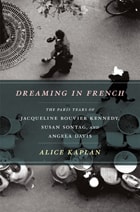
Dreaming in French
The Paris Years of Jacqueline Bouvier Kennedy, Susan Sontag, and Angela DavisAlice Kaplan
University of Chicago Press, 2012
All three women would go on to become icons, key figures in American cultural, intellectual, and political life, but when they embarked for France, they were young, little-known, uncertain about their future, and drawn to the culture, sophistication, and drama that only Paris could offer. Yet their backgrounds and their dreams couldn’t have been more different. Jacqueline Bouvier was a twenty-year-old debutante, a Catholic girl from a wealthy East Coast family. Susan Sontag was twenty-four, a precocious Jewish intellectual from a North Hollywood family of modest means, and Paris was a refuge from motherhood, a failing marriage, and graduate work in philosophy at Oxford. Angela Davis, a French major at Brandeis from a prominent African American family in Birmingham, Alabama, found herself the only black student in her year abroad program—in a summer when all the news from Birmingham was of unprecedented racial violence.
Kaplan takes readers into the lives, hopes, and ambitions of these young women, tracing their paths to Paris and tracking the discoveries, intellectual adventures, friendships, and loves that they found there. For all three women, France was far from a passing fancy; rather, Kaplan shows, the year abroad continued to influence them, a significant part of their intellectual and cultural makeup, for the rest of their lives. Jackie Kennedy carried her love of France to the White House and to her later career as a book editor, bringing her cultural and linguistic fluency to everything from art and diplomacy to fashion and historic restoration—to the extent that many, including Jackie herself, worried that she might seem “too French.” Sontag found in France a model for the life of the mind that she was determined to lead; the intellectual world she observed from afar during that first year in Paris inspired her most important work and remained a key influence—to be grappled with, explored, and transcended—the rest of her life. Davis, meanwhile, found that her Parisian vantage strengthened her sense of political exile from racism at home and brought a sense of solidarity with Algerian independence. For her, Paris was a city of political commitment, activism, and militancy, qualities that would deeply inform her own revolutionary agenda and soon make her a hero to the French writers she had once studied.
Kaplan, whose own junior year abroad played a prominent role in her classic memoir, French Lessons, spins these three quite different stories into one evocative biography, brimming with the ferment and yearnings of youth and shot through with the knowledge of how a single year—and a magical city—can change a whole life. No one who has ever dreamed of Paris should miss it.
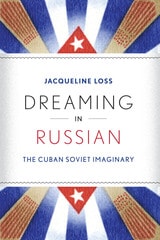
Dreaming in Russian
The Cuban Soviet ImaginaryBy Jacqueline Loss
University of Texas Press, 2013
The specter of the Soviet Union lingers in Cuba, yet until now there has been no book-length work on the ways Cubans process their country’s relationship with the Soviet bloc. Dreaming in Russian at last brings into the light the reality that for nearly three decades, the Soviet Union subsidized the island economically, intervened in military matters, and exported distinct pedagogical and cultural models to Cuba. Drawing on interviews with Cuban artists and intellectuals, as well as treasures from cinematographic and bibliographic archives, Jacqueline Loss delivers the first book to show that Cuba remembers and retains many aspects of the Soviet era, far from shedding those cultural facets as relics of the Cold War.
Weaving together intriguing, seldom-seen images, Dreaming in Russian showcases the ways in which Cuba’s relationship to its Soviet benefactors lingered after the disintegration of the U.S.S.R. in 1991. Analyzing numerous literary texts and works of visual art, Loss also incorporates aspects of architecture, popular culture, the space race, and other strands to create a captivating new perspective on Cuban society. Among the luminaries featured are poet Reina María Rodríguez, writer Antonio José Ponte, visual artist Tonel, and novelist Wendy Guerra. A departure from traditional cultural history, Loss’s approach instead presents a kaleidoscopic series of facets, reflecting the hybrid nature of the self-images that emerged in the aftermath of the Soviet aegis. As speculations about Cuba’s future under Fidel Castro’s heir apparent continue, the portrait that emerges in Dreaming in Russian is both timely and mesmerizing.
Dreaming of Justice, Waking to Wisdom
Rousseau's Philosophic LifeLaurence D. Cooper
University of Chicago Press, 2023
Dreaming of Justice, Waking to Wisdom reveals what could be thought of as the capstone of Rousseau’s thought, even if that capstone has been nearly invisible to readers. Despite criticizing philosophy for its corrosive effects on both natural goodness and civic virtue, Rousseau, argues Laurence D. Cooper, held the philosophic life as an ideal. Cooper expertly unpacks Rousseau’s vivid depiction of the philosophic life and the case for that life as the most natural, the freest, or, in short, the best or most choice-worthy of lives. Cooper focuses especially on a single feature, arguably the defining feature of the philosophic life: the overcoming of the ordinary moral consciousness in favor of the cognitivist view of morality. Cooper shows that Rousseau, with his particular understanding and embrace of the philosophic life, proves to be a kind of latter-day Socratic. Thorough and thought-provoking, Dreaming of Justice, Waking to Wisdom provides vital insight into Rousseau.

Dreaming of a Mail-Order Husband
Russian-American Internet RomanceEricka Johnson
Duke University Press, 2007
Each chapter presents one woman’s story and then links it to a discussion of gender roles, the mail-order bride industry, and the severe economic and social constraints of life in Russia. The transitional economy has often left people, after a month’s work, either unpaid or paid unexpectedly with a supply of sunflower oil or toilet paper. Women over twenty-three are considered virtually unmarriageable in Russian society. Russia has a large population of women who are single, divorced, or widowed, who would like to be married yet feel that they have no chance finding a Russian husband. Grim realities such as these motivate women to seek better lives abroad. For many of those seeking a mail-order husband, children or parents play significant roles in the search for better lives, and they play a role in Johnson’s account as well. In addition to her research in the former Soviet Union, Johnson conducted interviews in the United States, and she shares the insights—about dating, marriage, and cross-cultural communication—of a Russian-American married couple who met via the Internet.
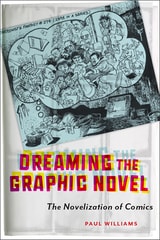
Dreaming the Graphic Novel
The Novelization of ComicsPaul Williams
Rutgers University Press, 2020
Honorable Mention, 2019-2020 Research Society for American Periodicals Book Prize
The term “graphic novel” was first coined in 1964, but it wouldn’t be broadly used until the 1980s, when graphic novels such as Watchmen and Maus achieved commercial success and critical acclaim. What happened in the intervening years, after the graphic novel was conceptualized yet before it was widely recognized?
Dreaming the Graphic Novel examines how notions of the graphic novel began to coalesce in the 1970s, a time of great change for American comics, with declining sales of mainstream periodicals, the arrival of specialty comics stores, and (at least initially) a thriving underground comix scene. Surveying the eclectic array of long comics narratives that emerged from this fertile period, Paul Williams investigates many texts that have fallen out of graphic novel history. As he demonstrates, the question of what makes a text a ‘graphic novel’ was the subject of fierce debate among fans, creators, and publishers, inspiring arguments about the literariness of comics that are still taking place among scholars today.
Unearthing a treasure trove of fanzines, adverts, and unpublished letters, Dreaming the Graphic Novel gives readers an exciting inside look at a pivotal moment in the art form’s development.
Dreaming the Mississippi
Katherine Fischer
University of Missouri Press, 2006
Mandela's Dark Years
A Political Theory of DreamingSharon Sliwinski
University of Minnesota Press, 2015
Inspired by one of Nelson Mandela’s recurring nightmares, Mandela’s Dark Years offers a political reading of dream-life. Sharon Sliwinski guides the reader through the psychology of apartheid, recasting dreaming as a vital form of resistance to political violence, away from a rational binary of thinking.
This short, provocative study blends political theory with clinical psychoanalysis, opening up a new space to consider the politics of reverie.
Forerunners is a thought-in-process series of breakthrough digital works. Written between fresh ideas and finished books, Forerunners draws on scholarly work initiated in notable blogs, social media, conference plenaries, journal articles, and the synergy of academic exchange. This is gray literature publishing: where intense thinking, change, and speculation take place in scholarship.
Unfurl
Survivals, Sorrows, and DreamingEli Clare
Duke University Press, 2025