Results by title
3 books match the query 'Dreyfus, Hubert L.'
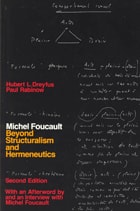
Michel Foucault
Beyond Structuralism and HermeneuticsHubert L. Dreyfus and Paul Rabinow
University of Chicago Press, 1983
This book, which Foucault himself has judged accurate, is the first to provide a sustained, coherent analysis of Foucault's work as a whole.
To demonstrate the sense in which Foucault's work is beyond structuralism and hermeneutics, the authors unfold a careful, analytical exposition of his oeuvre. They argue that during the of Foucault's work became a sustained and largely successful effort to develop a new method—"interpretative analytics"—capable fo explaining both the logic of structuralism's claim to be an objective science and the apparent validity of the hermeneutical counterclaim that the human sciences can proceed only by understanding the deepest meaning of the subject and his tradition.
"There are many new secondary sources [on Foucault]. None surpass the book by Hubert Dreyfus and Paul Rabinow. . . . The American paperback edition contains Foucault's 'On the Genealogy of Ethics,' a lucid interview that is now our best source for seeing how he construed the whole project of the history of sexuality."—David Hoy, London Review of Books
[more]
Philosophical Topics 27.2
The Intersection of Analytic and Continental PhilosophyHubert L. Dreyfus
University of Arkansas Press, 1999
[more]
Sense and Non-Sense
Maurice Merleau-Ponty
Northwestern University Press, 1992
Written between 1945 and 1947, the essays in Sense and Non-Sense provide an excellent introduction to Merleau-Ponty's thought. They summarize his previous insights and exhibit their widest range of application-in aesthetics, ethics, politics, and the sciences of man. Each essay opens new perspectives to man's search for reason.
The first part of Sense and Non-Sense, "Arts," is concerned with Merleau-Ponty's concepts of perception, which were advanced in his major philosophical treatise, Phenomenology of Perception. Here the analysis is focused and enriched in descriptions of the perceptual world of Cezanne, the encounter with the Other as expressed in the novels of Simone de Beauvoir and Sartre, and the gestalt quality of experience brought out in the film art form. In the second part, "Ideas," Merleau-Ponty shows how the categories of the phenomenology of perception can be understood as an outgrowth of the behavioral sciences and how a model of existence based on perception sensitizes us to the insights and limitations of previous philosophies and suggests constructive criticisms of contemporary philosophy. The third part, "Politics," clarifies the political dilemmas facing intellectuals in postwar France.
The first part of Sense and Non-Sense, "Arts," is concerned with Merleau-Ponty's concepts of perception, which were advanced in his major philosophical treatise, Phenomenology of Perception. Here the analysis is focused and enriched in descriptions of the perceptual world of Cezanne, the encounter with the Other as expressed in the novels of Simone de Beauvoir and Sartre, and the gestalt quality of experience brought out in the film art form. In the second part, "Ideas," Merleau-Ponty shows how the categories of the phenomenology of perception can be understood as an outgrowth of the behavioral sciences and how a model of existence based on perception sensitizes us to the insights and limitations of previous philosophies and suggests constructive criticisms of contemporary philosophy. The third part, "Politics," clarifies the political dilemmas facing intellectuals in postwar France.
[more]