Results by title
3 books match the query 'Du Bois'
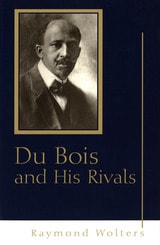
Du Bois and His Rivals
Raymond Wolters
University of Missouri Press, 2002
In Du Bois and His Rivals, Raymond Wolters provides a distinctive biography of this great pioneer of the American civil rights movement. Readers are able to follow the outline of Du Bois’s life, but the book’s main emphasis is on discrete scenes in his life, especially the controversies that pitted Du Bois against his principal black rivals. He challenged Booker T. Washington because he could not abide Washington’s conciliatory approach toward powerful whites. At the same time, Du Bois’s pluralism led him to oppose the leading separatists and integrationists of his day. He berated Marcus Garvey for giving up on America and urging blacks to pursue a separate destiny. He also rejected Walter White’s insistence that integration was the best way to promote the advancement of black people.
Du Bois felt that American blacks should be full-fledged Americans, with all the rights of other American citizens. However, he believed that they should also preserve and develop enough racial distinctiveness to enable them to maintain and foster a sense of racial identity, community, and pride. Du Bois and His Rivals shows that Du Bois stood for much more than protest against racial oppression. He was also committed to pluralism, and his pluralism emphasized the importance of traditional standards and of internal cooperation within the black community. Anyone interested in the civil rights movement, black history, or the history of the United States during the early twentieth century will find this book valuable.
From Du Bois to Obama
African American Intellectuals in the Public ForumCharles Pete Banner-Haley
Southern Illinois University Press, 2014
In his groundbreaking new book Charles Pete Banner-Haley explores the history of African American intellectualism and reveals the efforts of black intellectuals in the ongoing struggle against racism, showing how they have responded to Jim Crow segregation, violence against black Americans, and the more subtle racism of the postintegration age. Banner-Haley asserts that African American intellectuals—including academicians, social critics, activists, and writers—serve to generate debate, policy, and change, acting as a moral force to persuade Americans to acknowledge their history of slavery and racism, become more inclusive and accepting of humanity, and take responsibility for social justice.
Other topics addressed in this insightful study include the disconnection over time between black intellectuals and the masses for which they speak; the ways African American intellectuals identify themselves in relation to the larger black community, America as a whole, and the rest of the world; how black intellectuals have gained legitimacy in American society and have accrued moral capital, especially in the area of civil rights; and how that moral capital has been expended. Among the influential figures covered in the book are W. E. B. Du Bois, Ralph Ellison, Richard Wright, James Weldon Johnson, E. Franklin Frazier, Ralph Bunche, Oliver C. Cox, George S. Schuyler, Zora Neale Hurston, Martin Luther King, Jr., Jesse Jackson, Cornel West, Toni Morrison, bell hooks, Charles Johnson, and Barack Obama.
African American intellectuals, as Banner-Haley makes clear, run the political gamut from liberal to conservative. He discusses the emergence of black conservatism, with its accompanying questions about affirmative action, government intervention on behalf of African Americans, and the notion of a color-blind society. He also looks at how popular music—particularly rap and hip-hop—television, movies, cartoons, and other media have functioned as arenas for investigating questions of identity, exploring whether African American intellectuals can also be authentically black.
A concluding discussion of the so-called browning of America, and the subsequent rise in visibility and influence of black intellectuals culminates with the historic election of President Barack Obama, an African American intellectual who has made significant contributions to American society through his books, articles, and speeches. Banner-Haley ponders what Obama’s election will mean for the future of race relations and black intellectualism in America.

Rewriting Exodus
American Futures from Du Bois to ObamaAnna Hartnell
Pluto Press, 2011
Exodus, as a powerful narrative of liberation, has been a central imaginative touchstone in the black American struggle against US racism. This book traces the concept in a number of pivotal black thinkers, and explores its signficance for contemporary America.
The exodus story is a fitting allegory for the painful experience of exile that disproportionately afflicted African Americans in the aftermath of Hurricane Katrina, and it also provides compelling imagery for the triumphant election of Barack Obama in 2008. Building around these themes, Anna Hartnell traces the intellectual development of one of the defining narratives of black American thinking on social justice in the United States.
In placing black America at the centre of the study of US culture, Rewriting Exodus suggests new ways of thinking about America's relationship with the Middle East and the wider postcolonial world. Hartnell's groundbreaking contribution marks a vital new chapter in American cultural and political history.