Results by title
5 books match the query 'Dualism'
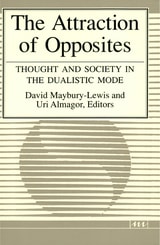
Attraction of Opposites
Thought and Society in the Dualistic ModeDavid Maybury-Lewis and Uri Almagor, Editors
University of Michigan Press, 1989
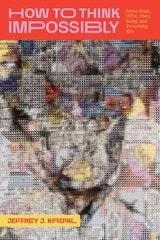
How to Think Impossibly
About Souls, UFOs, Time, Belief, and Everything ElseJeffrey J. Kripal
University of Chicago Press, 2024
Now in paperback, a mind-bending invitation to experience the impossible as fundamentally human.
From precognitive dreams and telepathic visions to near-death experiences, UFO encounters, and beyond, so-called impossible phenomena are not supposed to happen. But they do happen—all the time. Jeffrey J. Kripal asserts that the impossible is a function not of reality but of our everchanging assumptions about what is real. How to Think Impossibly invites us to think about these fantastic (yet commonplace) experiences as an essential part of being human, expressive of a deeply shared reality that is neither mental nor material but gives rise to both. Thinking with specific individuals and their extraordinary experiences in vulnerable, open, and often humorous ways, Kripal interweaves humanistic and scientific inquiry to foster an awareness that the fantastic is real, the supernatural is super natural, and the impossible is possible.

Kings of Disaster
Dualism, Centralism and the Scapegoat King in Southeastern SudanSimon Simonse
Michigan State University Press, 2018
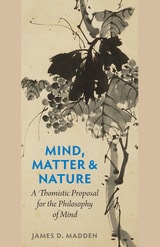
Mind, Matter, and Nature
James D. Madden
Catholic University of America Press, 2013
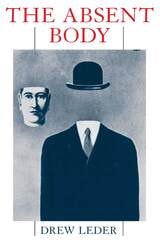
The Absent Body
Drew Leder
University of Chicago Press, 1990
In part 1, Leder explores a wide range of bodily functions with an eye to structures of concealment and alienation. He discusses not only perception and movement, skills and tools, but a variety of "bodies" that philosophers tend to overlook: the inner body with its anonymous rhythms; the sleeping body into which we nightly lapse; the prenatal body from which we first came to be. Leder thereby seeks to challenge "primacy of perception." In part 2, Leder shows how this phenomenology allows us to rethink traditional concepts of mind and body. Leder argues that Cartesian dualism exhibits an abiding power because it draws upon life-world experiences. Descartes' corpus is filled with disruptive bodies which can only be subdued by exercising "disembodied" reason. Leder explores the origins of this notion of reason as disembodied, focusing upon the hidden corporeality of language and thought. In a final chapter, Leder then proposes a new ethic of embodiment to carry us beyond Cartesianism.
This original, important, and accessible work uses examples from the author's medical training throughout. It will interest all those concerned with phenomenology, the philosophy of mind, or the Cartesian tradition; those working in the health care professions; and all those fascinated by the human body.