Results by title
6 books match the query 'Dublin'
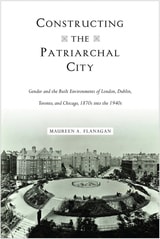
Constructing the Patriarchal City
Gender and the Built Environments of London, Dublin, Toronto, and Chicago, 1870s into the 1940sMaureen A. Flanagan
Temple University Press, 2018
In the Anglo-Atlantic world of the late nineteenth century, groups of urban residents struggled to reconstruct their cities in the wake of industrialization and to create the modern city. New professional men wanted an orderly city that functioned for economic development. Women’s vision challenged the men’s right to reconstruct the city and resisted the prevailing male idea that women in public caused the city’s disorder.
Constructing the Patriarchal City compares the ideas and activities of men and women in four English-speaking cities that shared similar ideological, professional, and political contexts. Historian Maureen Flanagan investigates how ideas about gender shaped the patriarchal city as men used their expertise in architecture, engineering, and planning to fashion a built environment for male economic enterprise and to confine women in the private home. Women consistently challenged men to produce a more equitable social infrastructure that included housing that would keep people inside the city, public toilets for women as well as men, housing for single, working women, and public spaces that were open and safe for all residents.
Joseph Holloway's Abbey Theatre
A Selection from His Unpublished Journal "Impressions of a Dublin Playgoer"Edited by Robert Hogan and Michael J. O'Neill. Preface by Harry T. Moore
Southern Illinois University Press, 1967
Until his death in 1944, Holloway attended almost every performance of the Abbey Theatre and daily recorded in his journal his reactions to plays and players and his comments about and conversations with literary and theatrical people. From the journal’s 221 bulky volumes, housed in the National Library of Ireland, Mr. Hogan and Mr. O’Neill have compiled this book of extracts from the approximately 25,000,000 words written by the Irishman. The years from 1899 to 1926 were chosen because they are generally considered to be the significant ones for the Abbey Theatre: the year of its founding to the production of Sean O’Casey’s The Plough and the Stars, which caused a riot in the theatre. Mr. Holloway attended every play during these years, as well as many rehearsals, and talked with nearly everybody who had anything to do with the theatre. This journal reflects the tensions, feuds, and anguish that produced one of the great theatres of modern times.
The meticulous display of minute detail makes Joseph Holloway’s Abbey Theatre imperative reading for the student of modern theatre, particularly since its character as a daily account permits ready checking of dates listed in previous works about the Irish National Theatre.
Love in the Lav
A Social Biography of Same-Sex Desire in Ireland, 1922-1972Averill Earls
Temple University Press, 2025
Earls uses courtroom testimonies, police records, and family history archives as well as “educated speculation” to show how structures governing male same-sex desire in Ireland played out on the bodies of the men who desired men, the teen boys who sold sex to men, and the way the Catholic-nationalist ethos shaped the Gardaí who policed them.
Love in the Lav examines the experiences of people such as cabbie James Hand, who was put on trial for gross indecency, to provide a window into the queer working-class subculture of 1930s Dublin. Earls also focuses on issues of consent, especially with teens, and the unregulated queer Irish world of public figures, including Micheál Mac Liammóir, Hilton Edwards, Ronald Brown, and John Broderick.
By examining twentieth-century Ireland through the lived experiences of ordinary same-sex-desiring Irish men who were relegated to obscurity by Irish society, Earls reveals the contradictions, possibilities, and magnitude of postcolonial Irish Catholic nationalism.
In the series Sexuality Studies
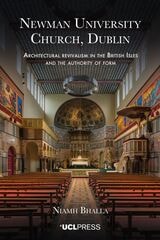
Newman University Church, Dublin
Architectural Revivalism in the British Isles and the Authority of FormNiamh Bhalla
University College London, 2024
Newman University Church, Dublin charts the first ever analysis of University Church’s significance within the history of Victorian revivalist architecture. Author Niamh Bhalla explores the relationship between the church’s context as the first Catholic university in Ireland and the ambiguity of its “early Christian” style, providing an effective lens to understand the architectural revivalism of the nineteenth century, particularly basilican and Byzantine revivalist architectures in the British Isles.
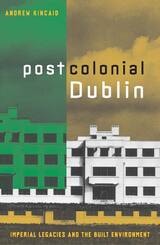
Postcolonial Dublin
Imperial Legacies And The Built EnvironmentAndrew Kincaid
University of Minnesota Press, 2006

World Film Locations
DublinEdited by Jez Conolly and Caroline Whelan
Intellect Books, 2011