Results by title
4 books match the query 'Dubois, Laurent'
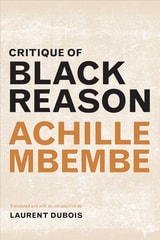
Critique of Black Reason
Achille Mbembe
Duke University Press, 2017
In Critique of Black Reason eminent critic Achille Mbembe offers a capacious genealogy of the category of Blackness—from the Atlantic slave trade to the present—to critically reevaluate history, racism, and the future of humanity. Mbembe teases out the intellectual consequences of the reality that Europe is no longer the world's center of gravity while mapping the relations among colonialism, slavery, and contemporary financial and extractive capital. Tracing the conjunction of Blackness with the biological fiction of race, he theorizes Black reason as the collection of discourses and practices that equated Blackness with the nonhuman in order to uphold forms of oppression. Mbembe powerfully argues that this equation of Blackness with the nonhuman will serve as the template for all new forms of exclusion. With Critique of Black Reason, Mbembe offers nothing less than a map of the world as it has been constituted through colonialism and racial thinking while providing the first glimpses of a more just future.
[more]
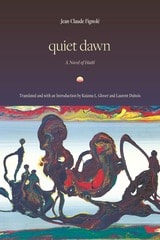
Quiet Dawn
Jean-Claude Fignolé. Translated and with an Introduction by Kaiama L. Glover and Laurent Dubois.
Duke University Press, 2025
Jean-Claude Fignolé’s Quiet Dawn tells an enthralling story of Haiti’s transition from French colony to independent Black republic. The swirling, multilayered novel provides intimate portraits of an eighteenth-century slaveholder, his wife, and their enslaved laborers set against the devastating backdrop of enslavement and revolution. Into this Gothic colonial tale Fignolé interweaves a series of tragic events involving a present-day French nun doing penance for the sins of her ancestors. One of the few contemporary Haitian novels to explicitly grapple with Haiti’s revolution, Quiet Dawn foregrounds issues of race, power, the continuing legacy of historical trauma, and the unresolved tensions between the past and present. Published in French in 1990 and appearing here in English for the first time, Quiet Dawn forcefully pushes against the silencing of Haiti’s past, belying its title to depict a clamorous Atlantic world that comprises Europe, Africa, and the vast expanse of the Americas.
[more]

The Fernando Coronil Reader
The Struggle for Life Is the MatterFernando Coronil
Duke University Press, 2019
In The Fernando Coronil Reader Venezuelan anthropologist Fernando Coronil challenges us to rethink our approaches to key contemporary epistemological, political, and ethical questions. Consisting of work written between 1991 and 2011, this posthumously published collection includes Coronil's landmark essays “Beyond Occidentalism” and “The Future in Question” as well as two chapters from his unfinished book manuscript, "Crude Matters." Taken together, the essays highlight his deep concern with the Global South, Latin American state formation, theories of nature, empire, and postcolonialism, and anthrohistory as an intellectual and ethical approach. Presenting a cross section of Coronil's oeuvre, this volume cements his legacy as one of the most innovative critical social thinkers of his generation.
[more]

The Haiti Reader
History, Culture, PoliticsLaurent Dubois, Kaiama L. Glover, Nadève Ménard, Millery Polyné, and Chantalle F. Verna, editors
Duke University Press, 2020
While Haiti established the second independent nation in the Western Hemisphere and was the first black country to gain independence from European colonizers, its history is not well known in the Anglophone world. The Haiti Reader introduces readers to Haiti's dynamic history and culture from the viewpoint of Haitians from all walks of life. Its dozens of selections—most of which appear here in English for the first time—are representative of Haiti's scholarly, literary, religious, visual, musical, and political cultures, and range from poems, novels, and political tracts to essays, legislation, songs, and folk tales. Spanning the centuries between precontact indigenous Haiti and the aftermath of the 2010 earthquake, the Reader covers widely known episodes in Haiti's history, such as the U.S. military occupation and the Duvalier dictatorship, as well as overlooked periods such as the decades immediately following Haiti's “second independence” in 1934. Whether examining issues of political upheaval, the environment, or modernization, The Haiti Reader provides an unparalleled look at Haiti's history, culture, and politics.
[more]