Results by title
4 books match the query 'Duckett, Victoria'
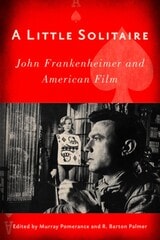
A Little Solitaire
John Frankenheimer and American FilmPomerance, Murray
Rutgers University Press, 2011
Think about some commercially successful film masterpieces--The Manchurian Candidate. Seven Days in May. Seconds. Then consider some lesser known, yet equally compelling cinematic achievements--The Fixer. The Gypsy Moths. Path to War. These triumphs are the work of the best known and most highly regarded Hollywood director to emerge from live TV drama in the 1950s--five-time Emmy-award-winner John Frankenheimer.
Although Frankenheimer was a pioneer in the genre of political thrillers who embraced the antimodernist critique of contemporary society, some of his later films did not receive the attention they deserved. Many claimed that at a midpoint in his career he had lost his touch. World-renowned film scholars put this myth to rest in A Little Solitaire, which offers the only multidisciplinary critical account of Frankenheimer's oeuvre. Especially emphasized is his deep and passionate engagement with national politics and the irrepressible need of human beings to assert their rights and individuality in the face of organizations that would reduce them to silence and anonymity.
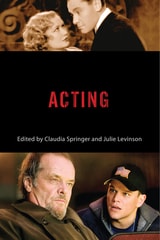
Acting
Springer, Claudia
Rutgers University Press, 2015
The chapters in Acting provide a fascinating, in-depth look at the history of film acting, from its inception in 1895 when spectators thrilled at the sight of vaudeville performers, Wild West stars, and athletes captured in motion, to the present when audiences marvel at the seamless blend of human actors with CGI. Experts in the field take readers behind the silver screen to learn about the craft of film acting in six eras: the silent screen (1895–1928), classical Hollywood (1928–1946), postwar Hollywood (1947–1967), the auteur renaissance (1968–1980), the New Hollywood (1981–1999), and the modern entertainment marketplace (2000–present). The contributors pay special attention to definitive performances by notable film stars, including Lillian Gish, Dick Powell, Ginger Rogers, Beulah Bondi, Marilyn Monroe, Marlon Brando, Jack Nicholson, Robert De Niro, Nicholas Cage, Denzel Washington, and Andy Serkis.
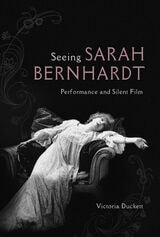
Seeing Sarah Bernhardt
Performance and Silent FilmVictoria Duckett
University of Illinois Press, 2015
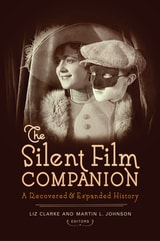
The Silent Film Companion
A Recovered and Expanded HistoryLiz Clarke
Rutgers University Press, 2027
Silent film is more than just a cinema of firsts, greats, or classics. It is a cinema of experimentation, ambition, and connection. To watch a silent film is to be transported into another world. The Silent Film Companion seeks to broaden the silent film canon by focusing on compelling non-canonical films from around the globe, providing a fresh perspective and new view of silent cinema. With over fifty films discussed, this volume captures just a sliver of the many delights silent cinema has to offer. It encourages discovery, and rediscovery, of the world of silent cinema: one where the movies were still young, full of possibility, and eager to entice others to take part in a wonderful adventure.
Films covered are from fourteen countries, including Brazil, Mexico, China, Cuba, India, Italy, and Russia, and represent a diversity of subjects. Each chapter provides historical and cultural context to the film, the filmmakers, and a concise analysis of each film. The Silent Film Companion is a must-read for students and fans of silent cinema interested in seeing a side of silent cinema that is rarely explored.