Results by title
9 books match the query 'Dust'
City of Dust
A Cement Company Town in the Land of Tom SawyerGregg Andrews
University of Missouri Press, 2002
Dust of the Zulu
Ngoma Aesthetics after ApartheidLouise Meintjes
Duke University Press, 2017
Dust
The Archive and Cultural HistoryCarolyn Steedman
Rutgers University Press, 2002
In this witty, engaging, and challenging book, Carolyn Steedman has produced an originaland sometimes irreverentinvestigation into how modern historiography has developed. Dust: The Archive and Cultural History considers our stubborn set of beliefs about an objective material worldinherited from the nineteenth centurywith which modern history writing and its lack of such a belief, attempts to grapple. Drawing on her own published and unpublished writing, Carolyn Steedman has produced a sustained argument about the way in which history writing belongs to the currents of thought shaping the modern world.
Steedman begins by asserting that in recent years much attention has been paid to the archive by those working in the humanities and social sciences; she calls this practice "archivization." By definition, the archive is the repository of "that which will not go away," and the book goes on to suggest that, just like dust, the "matter of history" can never go away or be erased.
This unique work will be welcomed by all historians who want to think about what it is they do.
For Those Who Sleep in the Dust
Essays on Archaeology and the BibleWilliam G. Dever
SBL Press, 2026
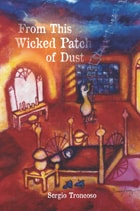
From This Wicked Patch of Dust
Sergio Troncoso
University of Arizona Press, 2011
Spanning four decades, this is a story of a family’s struggle to become American and yet not be pulled apart by a maelstrom of cultural forces. As a young adult, daughter Julieta is disenchanted with Catholicism and converts to Islam. Youngest son Ismael, always the bookworm, is accepted to Harvard but feels out of place in the Northeast where he meets and marries a Jewish woman. The other boys—Marcos and Francisco—toil in their father’s old apartment buildings, serving as the cheap labor to fuel the family’s rise to the middle class. Over time, Francisco isolates himself in El Paso while Marcos eventually leaves to become a teacher, but then returns, struggling with a deep bitterness about his work and marriage. Through it all, Pilar clings to the idea of her family and tries to hold it together as her husband’s health begins to fail.
This backdrop is then shaken to its core by the historic events of 2001 in New York City. The aftermath sends shockwaves through this newly American family. Bitter conflicts erupt between siblings and the physical and cultural spaces between them threaten to tear them apart. Will their shared history and once-common dreams be enough to hold together a family from Ysleta, this wicked patch of dust?
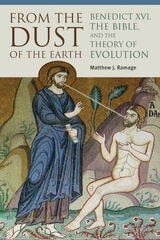
From the Dust of the Earth
Benedict XVI, the Bible , and the Theory of EvolutionMatthew J. Ramage
Catholic University of America Press, 2022
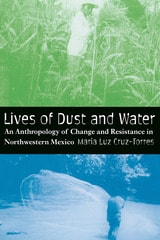
Lives of Dust and Water
An Anthropology of Change and Resistance in Northwestern MexicoMaría Luz Cruz-Torres
University of Arizona Press, 2004
A political ecology of human survival in one of the most important ecological regions of Mexico, it describes how these communities contest environmental degradation and economic impoverishment arising from political and economic forces beyond their control. María Luz Cruz-Torres evokes the rich and varied experiences of the people who live in the villages of Celaya and El Cerro, showing how they invent and utilize their own social capital to emerge as whole persons in the face of globalization. She traces the histories of the two villages to illustrate the complex variation involved in community formation and to show how people respond to and utilize Mexican law and reform. Surrounded by limited resources, poverty, illness, sudden death, and daily oppression, these men and women create innovative social and cultural forms that mitigate these impacts.
Cruz-Torres reveals not only how they manage to survive in the midst of horrendous circumstances but also how they transcend those impediments with dignity. She details the participation of household members in the subsistence, formal, and informal sectors of the economy, and how women use a variety of resources to guarantee their families’ survival. A sometimes tragic but ultimately vibrant story of human resistance, Lives of Dust and Water offers an important look at a little-studied but dynamically developing region of Mexico. It contributes to a more precise understanding of how rural coastal communities in Mexico emerged and continue to develop and adjust to the uncertainties of the globalizing world.

Raising the Dust
The Literary Housekeeping of Mary Ward, Sarah Grand, and Charlotte Perkins GilmanBeth Sutton-Ramspeck
Ohio University Press, 2004
To Mary Augusta Ward, Sarah Grand, and Charlotte Perkins Gilman, housekeeping represented public responsibilities: making the food supply safe, reforming politics, and improving the human race itself. Raising the Dust places their writing in the context of the late-Victorian era, in particular the eugenics movement, the proliferation of household conveniences, the home economics movement, and decreased reliance on servants. These changes affected relationships between the domestic sphere and the public sphere, and hence shaped the portrayal of domesticity in the era's fiction and nonfiction.
Moreover, Ward, Grand, and Gilman articulated a domestic aesthetic that swept away boundaries. Sutton-Ramspeck uncovers a new paradigm here: literature as engaging the public realm through the devices and perspectives of the domestic. Her innovative and ambitious book also connects fixations on cleaning with the discovery of germs (the first bacterium discovered was anthrax, and knowledge of its properties increased fears of dust); analyzes advertising cards for soap; and links the mental illness in Gilman's “The Yellow Wall-Paper” to fears during the period of arsenic poisoning from wallpaper.
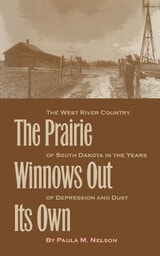
The Prairie Winnows Out Its Own
The West River Country of South Dakota in the Years of Depression and DustNelson, Paula M.
University of Iowa Press, 1996
Between 1900 and 1915, in the last great land rush, over one hundred thousand homesteaders flooded into the west river country of South Dakota, a land noted for its aridity and unpredictable weather, its treelessness, and its endless sky. The settlers of “the last, best west” weathered their first crisis in the severe drought of 1910-1911, which winnowed out many of the speculators and faint of heart; they abandoned their founding hopes of quick success and substituted a new ethos of “next year country”—while this year was hard, next year would be better, an ironic phrase at once optimistic and fatalistic.
“Next year,” however, was in many of those years not better. The collapse of the agricultural economy in the immediate aftermath of the boom years of World War I set in motion a pattern of regional decline amid national prosperity and cultural change: the rise of radio and mass culture increased rural folks' awareness of national trends and tastes, a development which paradoxically increased their own sense of remoteness and isolation. The failure of the farm economy to recover to any substantial degree in the twenties caused a less dramatic but cumulatively greater impact on the west river country's population and prospects—a second great crisis.
The Great Depression and the dustbowl years of the thirties were the greatest test of the west river people. The drought of 1910-1911, heretofore seen as the benchmark of bad times, faded even in the remembrances of the original pioneers in the face of the thirties' relentless drought, grasshoppers, blowing dust, and the accompanying starvation, struggle, and despair. The Depression in the west river country was a blast furnace from which a hardened yet still hopeful people emerged, scathed but undefeated. The Prairie Winnows Out Its Own is the voice of this experience.