Results by title
4 books match the query 'Dutch Golden Age'
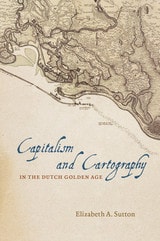
Capitalism and Cartography in the Dutch Golden Age
Elizabeth A. Sutton
University of Chicago Press, 2015
In Capitalism and Cartography in the Dutch Golden Age, Elizabeth A. Sutton explores the fascinating but previously neglected history of corporate cartography during the Dutch Golden Age, from ca. 1600 to 1650. She examines how maps were used as propaganda tools for the Dutch West India Company in order to encourage the commodification of land and an overall capitalist agenda.
Building her exploration around the central figure of Claes Jansz Vischer, an Amsterdam-based publisher closely tied to the Dutch West India Company, Sutton shows how printed maps of Dutch Atlantic territories helped rationalize the Dutch Republic’s global expansion. Maps of land reclamation projects in the Netherlands, as well as the Dutch territories of New Netherland (now New York) and New Holland (Dutch Brazil), reveal how print media were used both to increase investment and to project a common narrative of national unity. Maps of this era showed those boundaries, commodities, and topographical details that publishers and the Dutch West India Company merchants and governing Dutch elite deemed significant to their agenda. In the process, Sutton argues, they perpetuated and promoted modern state capitalism.
Building her exploration around the central figure of Claes Jansz Vischer, an Amsterdam-based publisher closely tied to the Dutch West India Company, Sutton shows how printed maps of Dutch Atlantic territories helped rationalize the Dutch Republic’s global expansion. Maps of land reclamation projects in the Netherlands, as well as the Dutch territories of New Netherland (now New York) and New Holland (Dutch Brazil), reveal how print media were used both to increase investment and to project a common narrative of national unity. Maps of this era showed those boundaries, commodities, and topographical details that publishers and the Dutch West India Company merchants and governing Dutch elite deemed significant to their agenda. In the process, Sutton argues, they perpetuated and promoted modern state capitalism.
[more]
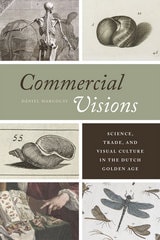
Commercial Visions
Science, Trade, and Visual Culture in the Dutch Golden AgeDániel Margócsy
University of Chicago Press, 2014
Entrepreneurial science is not new; business interests have strongly influenced science since the Scientific Revolution. In Commercial Visions, Dániel Margócsy illustrates that product marketing, patent litigation, and even ghostwriting pervaded natural history and medicine—the “big sciences” of the early modern era—and argues that the growth of global trade during the Dutch Golden Age gave rise to an entrepreneurial network of transnational science.
Margócsy introduces a number of natural historians, physicians, and curiosi in Amsterdam, London, St. Petersburg, and Paris who, in their efforts to boost their trade, developed modern taxonomy, invented color printing and anatomical preparation techniques, and contributed to philosophical debates on topics ranging from human anatomy to Newtonian optics. These scientific practitioners, including Frederik Ruysch and Albertus Seba, were out to do business: they produced and sold exotic curiosities, anatomical prints, preserved specimens, and atlases of natural history to customers all around the world. Margócsy reveals how their entrepreneurial rivalries transformed the scholarly world of the Republic of Letters into a competitive marketplace.
Margócsy’s highly readable and engaging book will be warmly welcomed by anyone interested in early modern science, global trade, art, and culture.
[more]
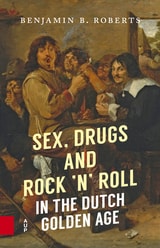
Sex, Drugs and Rock 'n' Roll in the Dutch Golden Age
Benjamin B. Roberts
Amsterdam University Press, 2018
Binge drinking and illicit sex were just as common in the Dutch Golden Age as they are today, if not more so. Sex, Drugs and Rock 'n' Roll in the Dutch Golden Age is a compelling narrative about the generation of young men that came of age in the Dutch Republic during the economic boom of the early seventeenth century. Contrary to their parents' wishes, the younger generation grew up in luxury and wore extravagant clothing, grew their hair long, and squandered their time drinking and smoking. They created a new youth culture with many excesses; one that we today associate with the counterculture generation of the 1960s.
With his engaging storytelling style and humorous anecdotes, Roberts convincingly reveals that deviant male youth behavior is common to all times, especially periods when youngsters have too much money and too much free time on their hands.
With his engaging storytelling style and humorous anecdotes, Roberts convincingly reveals that deviant male youth behavior is common to all times, especially periods when youngsters have too much money and too much free time on their hands.
[more]
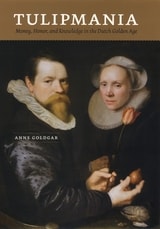
Tulipmania
Money, Honor, and Knowledge in the Dutch Golden AgeAnne Goldgar
University of Chicago Press, 2007
In the 1630s the Netherlands was gripped by tulipmania: a speculative fever unprecedented in scale and, as popular history would have it, folly. We all know the outline of the story—how otherwise sensible merchants, nobles, and artisans spent all they had (and much that they didn’t) on tulip bulbs. We have heard how these bulbs changed hands hundreds of times in a single day, and how some bulbs, sold and resold for thousands of guilders, never even existed. Tulipmania is seen as an example of the gullibility of crowds and the dangers of financial speculation.
But it wasn’t like that. As Anne Goldgar reveals in Tulipmania, not one of these stories is true. Making use of extensive archival research, she lays waste to the legends, revealing that while the 1630s did see a speculative bubble in tulip prices, neither the height of the bubble nor its bursting were anywhere near as dramatic as we tend to think. By clearing away the accumulated myths, Goldgar is able to show us instead the far more interesting reality: the ways in which tulipmania reflected deep anxieties about the transformation of Dutch society in the Golden Age.
“Goldgar tells us at the start of her excellent debunking book: ‘Most of what we have heard of [tulipmania] is not true.’. . . She tells a new story.”—Simon Kuper, Financial Times
“Goldgar tells us at the start of her excellent debunking book: ‘Most of what we have heard of [tulipmania] is not true.’. . . She tells a new story.”—Simon Kuper, Financial Times
[more]