Results by title
5 books match the query 'Duty'

Duty To Warn
A NovelSara Kersting
Acre Books, 2018
To aid him in the chase, Malden calls on his colleague, the awkward, remote, intimidatingly tall Sonja Nielsen. She reluctantly agrees to help, either because of or despite her previous entanglements with Malden.
Told from the perspectives of these three characters, the story swerves and jolts and switches back, much like Percy’s recollections of his upbringing. Kersting presents the interior struggles of her characters in a searingly spare style, all the while drawing the reader through an escalating series of events as Percy hitches rides and takes buses, searching the small towns of central Michigan, alternately helped and hindered by both old and new acquaintances.
While following disparate leads toward Percy’s final, surprising destination, all three conflicted souls are compelled to examine their loyalties, test their convictions, admit their frailties, and confront the ghosts lurking in their pasts, resulting in a revelatory climax.
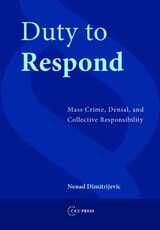
Duty to Respond
Mass Crime, Denial, and Collective ResponsibilityNenad Dimitrijevic
Central European University Press, 2011

Duty to Serve, Duty to Conscience
The Story of Two Conscientious Objector Combat Medics during the Vietnam WarJames C. Kearney
University of North Texas Press, 2023
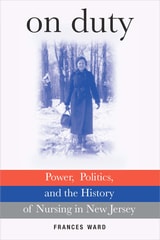
On Duty
Power, Politics, and the History of Nursing in New JerseyWard, Frances
Rutgers University Press, 2009
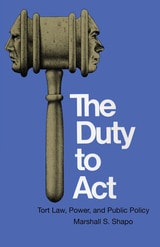
The Duty to Act
Tort Law, Power, and Public PolicyBy Marshall S. Shapo
University of Texas Press, 1977
A woman terrified by the threats of a jilted suitor is denied police protection. A workman collapses on the job and the employer is slow to help him. A bully in a bar begins to carry out threats of serious injury to a customer, after the bartender’s lackadaisical response. Springing from varied areas of human activity, such cases occupy an important area of the legal battleground called modern tort law. They also provide the basis for a fascinating legal analysis by Marshall S. Shapo.
Tort law is an important social mediator of events surrounding personal injuries. It impinges on many other areas of the law—those dealing with crime, constitutional protections against government officials and agencies, and property rights. Since litigated tort cases often involve brutal treatment or accidents inflicting severe physical harm, this area of the law generates much emotion and complex legal doctrine.
Shapo cuts through the emotion and the complexity to present a view of these problems that is both legally sound and intuitively appealing. His emphasis is on power relationships between private citizens and other individuals, as well as between private persons and governments and officials. He undertakes to define power in a meaningful way as it relates to many tort issues faced by ordinary citizens, and to make this definition precise by constant reference to concrete cases. His particular focus is on an age-old problem in tort law: the question of when a person has a duty to aid another in peril.
In analyzing a large number of cases in this category, Shapo develops an analysis that blends considerations of economic efficiency and humanitarian concern. Recognizing that economic considerations are significant in judicial analysis of these cases, he emphasizes elements that go beyond a simple concern with efficiency, especially the ability of one person to control another’s actions or exposure to risk.
These considerations of power and corresponding dependence provide the basis for Shapo’s study of the duties of both private citizens and governments to prevent injury to others. Calling on a broad range of legal precedents, he also refers to social science research dealing with the behavior of bystanders when fellow citizens are under attack.
Beyond his application of a power-based analysis to litigation traditionally based in tort doctrine, Shapo offers some speculative suggestions on the possible applicability of his views to several controversial areas of welfare law: medical care, municipal services, and educational standards.
This book was written with a view to readership by interested citizens as well as legal scholars, judges, and practicing attorneys.