Results by title
3 books match the query 'Dym, Jordana'
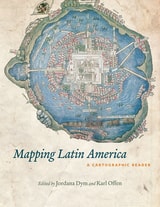
Mapping Latin America
A Cartographic ReaderEdited by Jordana Dym and Karl Offen
University of Chicago Press, 2011
For many, a map is nothing more than a tool used to determine the location or distribution of something—a country, a city, or a natural resource. But maps reveal much more: to really read a map means to examine what it shows and what it doesn’t, and to ask who made it, why, and for whom. The contributors to this new volume ask these sorts of questions about maps of Latin America, and in doing so illuminate the ways cartography has helped to shape this region from the Rio Grande to Patagonia.
In Mapping Latin America,Jordana Dym and Karl Offen bring together scholars from a wide range of disciplines to examine and interpret more than five centuries of Latin American maps.Individual chapters take on maps of every size and scale and from a wide variety of mapmakers—from the hand-drawn maps of Native Americans, to those by famed explorers such as Alexander von Humboldt, to those produced in today’s newspapers and magazines for the general public. The maps collected here, and the interpretations that accompany them, provide an excellent source to help readers better understand how Latin American countries, regions, provinces, and municipalities came to be defined, measured, organized, occupied, settled, disputed, and understood—that is, how they came to have specific meanings to specific people at specific moments in time.
The first book to deal with the broad sweep of mapping activities across Latin America, this lavishly illustrated volume will be required reading for students and scholars of geography and Latin American history, and anyone interested in understanding the significance of maps in human cultures and societies.
Politics, Economy, and Society in Bourbon Central America, 1759-1821
Jordana Dym
University Press of Colorado, 2007
These reforms profoundly changed aspects of Central America's politics and society; however, these essays reveal that changes in the region were shaped both internally and externally and that they weakened the region's ties to metropolitan Spain as often as they reinforced them. Contributors focus on specific policy changes and their consequences as well as transformations throughout the region for which no direct Bourbon inspiration appears to be responsible. Together they demonstrate that whether or not the Crown achieved its primary goals of centralization and control, its policies nevertheless provided opportunities for evident, often subtle, and occasionally unintentional shifts in the colonial government's relationship to its constituent populations. Contributors include Christophe Belaubre, Michel Bertrand, Jordana Dym, Jorge H. González, Timothy Hawkins, Sajid Alfredo Herrera, Gustavo Palma, Eugenia Rodriguez, Doug Tompson, and Stephen Webre.
The Rise of Constitutional Government in the Iberian Atlantic World
The Impact of the Cádiz Constitution of 1812Scott Eastman
University of Alabama Press, 2015
Exploring the constitution that transformed governance, citizenship, and political culture across the Hispanic Atlantic world.
In March 1812, while Napoleon’s brother Joseph sat on the throne of Spain and the armies of France occupied much of the country, legislators elected from Spain and its overseas territories met in the Andalusian city of Cádiz. There, as the cornerstone of a government in exile, they drafted and adopted the first liberal constitution in the Hispanic world, a document that became known as the Cádiz Constitution of 1812.
The 1812 Constitution was extremely influential in and beyond Europe, and this collection of essays explores how its enduring legacy not only shaped the history of state-building, elections, and municipal governance in Iberian America, but also affected national identities and citizenship as well as the development of race and gender in the region.
A bold blueprint for governing a global, heterogeneous monarchy, the Constitution represented a rupture with Spain’s Antiguo Régimen (Old Regime) in numerous ways—in the limits it placed on the previously autocratic Bourbon monarchs, in the admission to its governing bodies of deputies from Spain’s American viceroyalties as equals, and in its framers’ vociferous debate over the status of castas (those of mixed ancestry) and slaves. The Rise of Constitutional Government in the Iberian Atlantic World covers these issues and adopts a transatlantic perspective that recovers the voices of those who created a vibrant political culture accessible to commoners and elite alike.
The bicentenary of the Constitution of 1812 offered scholars an excellent moment to reexamine the form and role of constitutions across the Spanish-speaking world. Constitutionalism remains a topic of intense debate in Latin America, while contemporary Spain itself continues to seek ways to balance a strong central government with centripetal forces in its regions, notably the Basque and Catalan provinces. The multifaceted essays compiled here by Scott Eastman and Natalia Sobrevilla Perea both shed new light on the early, liberal Hispanic societies and show how the legacies of those societies shape modern Spain and Latin America.