Results by title
7 books match the query 'Dystopias in literature'

Dystopias in Nineteenth-Century Latin American Literature
Elías J. Palti
Bucknell University Press, 2027
How did nineteenth-century Latin American novelists respond to moments when history itself seemed to come undone? Rather than treating dystopia as a futuristic genre, Palti traces its emergence from concrete political crises in Mexico, Argentina, and Brazil, as writers confronted national defeat, dictatorship, and revolutionary uncertainty. Reading Mexican fiction written after the U.S. occupation; Argentine texts produced under Juan Manuel de Rosas, including works by Esteban Echeverría, Domingo F. Sarmiento, and José Mármol; and Brazilian novels from the transition from Empire to Republic, with particular attention to Machado de Assis, the book shows how narrative form begins to falter. Plots stall, identities fragment, and stories resist closure. These breakdowns constitute early dystopian modes—atopia-atropia, heterotopia, and transtopia—through which literature registers the collapse of historical intelligibility. By locating dystopia in narrative form rather than theme, Palti offers a rich new account of literature under political catastrophe.
Published by Bucknell University Press. Distributed worldwide by Rutgers University Press.

Human Nature in Utopia
Zamyatin's WeBrett Cooke
Northwestern University Press, 2002
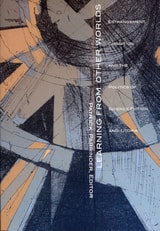
Learning from Other Worlds
Estrangement, Cognition, and the Politics of Science Fiction and UtopiaPatrick Parrinder, ed.
Duke University Press, 2001
In exploring the relationship between imaginative invention and that of allegory or fable, the essays in Learning from Other Worlds comment on the field’s most abiding concerns and employ a variety of critical approaches—from intellectual history and genre studies to biographical criticism, feminist cultural studies, and political textual analysis. Among the topics discussed are the works of John Wyndham, Kim Stanley Robinson, Stanislau Lem, H.G. Wells, and Ursula Le Guin, as well as the media’s reactions to the 1997 cloning of Dolly the Sheep. Darko Suvin’s characteristically outspoken and penetrating afterword responds to the essays in the volume and offers intimations of a further stage in his long and distinguished career.
This useful compendium and companion offers a coherent view of science fiction studies as it has evolved while paying tribute to the debt it owes Suvin, one of its first champions. As such, it will appeal to critics and students of science fiction, utopia, and fantasy writing.
Contributors. Marc Angenot, Marleen S. Barr, Peter Fitting, Carl Freedman, Edward James, Fredric Jameson, David Ketterer, Gerard Klein, Tom Moylan, Rafail Nudelman, Darko Suvin

Modern Utopian Fictions from H. G. Wells to Iris Murdoch
Peter Edgerly Firchow
Catholic University of America Press, 2007

No Place Else
Explorations in Utopian and Dystopian FictionEric S Rabkin
Southern Illinois University Press, 1983
Writers have created fictions of social perfection at least since Plato’s Republic. Sir Thomas More gave this thread of intellectual history a name when he called his contribution to it Utopia, Greek for noplace.
With each subsequent author cognizant of his predecessors and subject to altered real-world conditions which suggest ever-new causes for hope and alarm, “no place” changed. The fourteen essays presented in this book critically assess man’s fascination with and seeking for “no place.”
“In discussing these central fictions, the contributors see ‘no place’ from diverse perspectives: the sociological, the psychological, the political, the aesthetic. In revealing the roots of these works, the contributors cast back along the whole length of utopian thought. Each essay stands alone; together, the essays make clear what ‘no place’ means today. While it may be true that ‘no place’ has always seemed elsewhere or elsewhen, in fact all utopian fiction whirls contemporary actors through a costume dance no place else but here.”—from the Preface
The contributors are Eric S. Rabkin, B. G. Knepper, Thomas J.Remington, Gorman Beauchamp, William Matter, Ken Davis, Kenneth M. Roemer, William Steinhoff, Howard Segal, Jack Zipes, Kathleen Woodward, Merritt Abrash, and James W. Bittner.
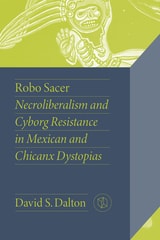
Robo Sacer
Necroliberalism and Cyborg Resistance in Mexican and Chicanx DystopiasDavid S. Dalton
Vanderbilt University Press, 2023
Harvey L. Johnson Publication Award, Southwest Council of Latin American Studies, 2026
Premio Alambique, Alambique: Revista Académica de Ciencia Ficción y Fantasía, 2025
Robo Sacer engages the digital humanities, critical race theory, border studies, biopolitical theory, and necropolitical theory to interrogate how technology has been used to oppress people of Mexican descent—both within Mexico and in the United States—since the advent of the North American Free Trade Agreement (NAFTA) in 1994. As the book argues, robo-sacer identity emerges as transnational flows of bodies, capital, and technology become an institutionalized state of exception that relegates people from marginalized communities to the periphery.
And yet the same technology can be utilized by the oppressed in the service of resistance. The texts studied here represent speculative stories about this technological empowerment. These texts theorize different means of techno-resistance to key realities that have emerged within Mexican and Chicano/a/x communities under the rise and reign of neoliberalism. The first three chapters deal with dehumanization, the trafficking of death, and unbalanced access to technology. The final two chapters deal with the major forms of violence—feminicide and drug-related violence—that have grown exponentially in Mexico with the rise of neoliberalism. These stories theorize the role of technology both in oppressing and in providing the subaltern with necessary tools for resistance.
Robo Sacer builds on the previous studies of Sayak Valencia, Irmgard Emmelhainz, Guy Emerson, Achille Mbembe, and of course Giorgio Agamben, but it differentiates itself from them through its theorization on how technology—and particularly cyborg subjectivity—can amend the reigning biopolitical and necropolitical structures of power in potentially liberatory ways. Robo Sacer shows how the cyborg can denaturalize constructs of zoē by providing an outlet through which the oppressed can tell their stories, thus imbuing the oppressed with the power to combat imperialist forces.
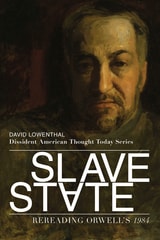
Slave State
Rereading Orwell's 1984David Lowenthal
St. Augustine's Press, 2021
There is no positive political message in 1984, argues Lowenthal, but there is positive moral message that is nearly always overlooked by commentators. “Through the movement of the novel, Orwell tries to impress on the passions, hearts and minds of his readers the most valuable lessons concerning the right and wrong way to live. With the decline of Christianity’s influence in forming the moral sense of the West and the concomitant increase in power hunger, wielding instruments born of modern enlightenment, what mankind most needed was moral guidance, conveyed not abstractly, through philosophy, but in such a way as to grip the whole soul.”
But can Orwell be trusted as a guide to the goodness in human nature? Lowenthal says he can be, and more. He gives us a sketch of the intellectual process that compels Orwell to ultimately outgrow Marxism, his detection and rejection of totalitarian regimes (above all in Communism), and in what way the principles of liberalism of his day were given warning labels by a writer who was not a formally educated political philosopher. Laced with relativism, any current of thought that does not acknowledge the proper ends of man will be effaced by the next master of the masses. Lowenthal echoes Orwell when he says, “we have abandoned inculcating good citizenship, higher ideals and a sense of personal worth in the schools, encouraging instead an aimless low-level conformist ‘individuality’ just waiting to be harnessed together and directed. Given these conditions, can we be sure we have left the conditions to the horrors of 1984 far behind as mere fiction?”
Orwell and Lowenthal are unlikely co-collaborators, unless one perceives how much alike in their exhortations to fellow man they are. The steady tenor of their hard warning is made possible by a hope-soaked confidence that, in utter sobriety, is repulsed by anything that threatens human freedom and dignity. This book is required reading for anyone who believes in the return of socialism. Indeed, any recent university graduate should be debriefed by Lowenthal before entering the real world.