Results by title
5 books match the query 'Early American Literature'
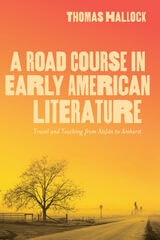
A Road Course in Early American Literature
Travel and Teaching from Atzlán to AmherstThomas Hallock
University of Alabama Press, 2021
Essays that fuse literary scholarship and personal travelogue to explore American identity
A Road Course in Early American Literature: Travel and Teaching from Atzlán to Amherst explores a two-part question: what does travel teach us about literature, and how can reading guide us to a deeper understanding of place and identity? Thomas Hallock charts a teacher’s journey to answering these questions, framing personal experiences around the continued need for a survey course covering early American literature up to the mid-nineteenth century.
Hallock approaches literary study from the overlapping perspectives of pedagogue, scholar, unrepentant tourist, husband, father, friend, and son. Building on Ralph Waldo Emerson’s premise that there is “creative reading as well as creative writing,” Hallock turns to the vibrant and accessible tradition of American travel writing, employing the form of biblio-memoir to bridge the impasse between public and academic discourse and reintroduce the dynamic field of early American literature to wider audiences.
Hallock’s own road course begins and ends at the Low country of Georgia and South Carolina, following a circular structure of reflection. He weaves his journey through a wide swath of American literatures and authors: from Native American and African American oral traditions, to Wheatley and Equiano, through Emerson, Poe, and Dickinson, among others. A series of longer, place-oriented narratives explore familiar and lesser-known literary works from the sixteenth-century invasion of Florida through the Mexican War of 1846–1848 and the American Civil War. Shorter chapters bridge the book’s central themes—the mapping of cognitive and physical space, our personal stake in reading, the tensions that follow earlier acts of erasure, and the impossibility of ever fully shutting out the past.
Exploring complex cultural histories and contemporary landscapes filled with ghosts and new voices, this volume draws inspiration from a tradition of travel, place-oriented, and literature-based works ranging from William Carlos Williams’s In the American Grain and Jack Kerouac’s On the Road to Alice Walker’s In Search of Our Mother’s Gardens, Wendy Lesser’s Why I Read: The Serious Pleasure of Books, and Rebecca Mead’s My Life in Middlemarch.
An accompanying bibliographic essay is periodically updated and available at Hallock’s website: www.roadcourse.us.
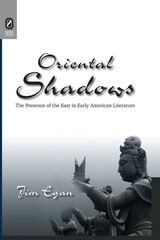
Oriental Shadows
The Presence of the East in Early American LiteratureJim Egan
The Ohio State University Press, 2011
Through the use of several iconic early American authors (Anne Bradstreet, James Kirkpatrick, Benjamin Franklin, and Edgar Allan Poe), Jim Egan’s Oriental Shadows: The Presence of the East in Early American Literature explores the presence of “the East” in American writing.
In bringing to light this largely overlooked archive of images within the American literary canon, Oriental Shadows suggests that the East played a key role in the emergence of a distinctively American literary tradition and, further, that early American identity was born as much from figures of the East as it was from the colonists’ encounters with the frontier.
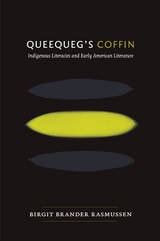
Queequeg's Coffin
Indigenous Literacies and Early American LiteratureBirgit Brander Rasmussen
Duke University Press, 2012
By recovering the literatures and textual practices that were indigenous to the Americas, Birgit Brander Rasmussen reimagines the colonial conflict as one organized by alternative but equally rich forms of literacy. From central Mexico to the northeastern shores of North America, in the Andes and across the American continents, indigenous peoples and European newcomers engaged each other in dialogues about ways of writing and recording knowledge. In Queequeg's Coffin, such exchanges become the foundation for a new kind of early American literary studies.
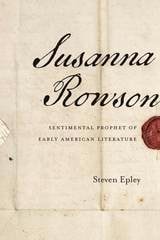
Susanna Rowson
Sentimental Prophet of Early American LiteratureSteven Epley
Northwestern University Press, 2016
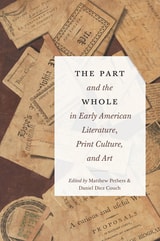
The Part and the Whole in Early American Literature, Print Culture, and Art
Matthew Pethers
Bucknell University Press, 2024
The essays in this pathbreaking collection consider the significance of varied early American fragmentary genres and practices—from diaries and poetry, to almanacs and commonplace books, to sermons and lists, to Indigenous ruins and other material shards and fragments—often overlooked by critics in a scholarly privileging of the “whole.” Contributors from literary studies, book history, and visual culture discuss a host of canonical and non-canonical figures, from Edward Taylor and Washington Irving to Mary Rowlandson and Sarah Kemble Knight, offering insight into the many intellectual, ideological, and material variations of “form” that populated the early American cultural landscape. As these essays reveal, the casting of the fragmentary as aesthetically eccentric or incomplete was a way of reckoning with concerns about the related fragmentation of nation, society, and self. For a contemporary audience, they offer new ways to think about the inevitable gaps and absences in our cultural and historical archive.