Results by title
11 books match the query 'Early Christianity'
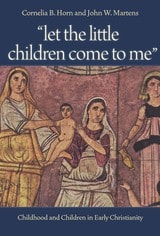
"Let the Little Children Come to Me"
Childhood and Children in Early Christianity"Cornelia B. Horn
Catholic University of America Press, 2009
Ancient Christian Apocrypha
Marginalized Texts in Early ChristianityOuti Lehtipuu
SBL Press, 2022
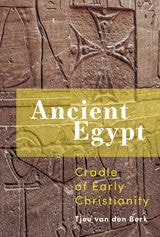
Ancient Egypt
Cradle of Early ChristianityTjeu van den Berk
Eburon Academic Publishers, 2021
The earliest Christian myths emerged in the melting pot of gnostic Alexandria—not in orthodox Jerusalem, classical Athens, or legalistic Rome. In this book, Tjeu van den Berk traces the sources of the Christian faith to the banks of the river Nile. Focusing on ancient archetypes, van den Berk underscores the striking similarities between the Egyptian and Christian religions. In this fascinating study, he explores the symbolism of the Trinity, the cross, and the myths of a god born of a virgin. He also traces the origins of the stories of Lazarus and Saint George, and he finds stunning parallels between Egyptian mythology and the Book of Revelation.
History of Political Ideas, Volume 1 (CW19)
Hellenism, Rome, and Early ChristianityEric Voegelin, Edited & Intro by Athanasios Moulakis
University of Missouri Press, 1997
Reaching from the decline of the Greek Polis to Saint Augustine, this first volume of Eric Voegelin's eagerly anticipated History of Political Ideas fills the gap left between volumes 3 and 4 of Order and History. The heart of the book is the powerful account of Apostolic Christianity's political implications and the work of the early church fathers. Voegelin's consideration of the political philosophy of Rome and his unique analysis of Greek and early Roman law are of particular interest.
Although History of Political Ideas was begun as a textbook for Macmillan, Voegelin never intended it to be a conventional "synthesis." He sought instead an original comprehensive interpretation, founded on primary materials and taking into account the most advanced specialist scholarship—or science as he called it—available to him. Because of this, the book grew well beyond the confines of an easily marketable college survey and until now remained unpublished.
In the process of writing it, Voegelin himself outgrew the conceptual frame of a "History of Political Ideas," turning to compose Order and History and the other works of his maturity. History of Political Ideas became the ordered collection of materials from which much of Voegelin's later theoretical elaboration grew, structured in a manner that reveals the conceptual intimations of his later thought. As such, it provides an unparalleled opportunity to observe the working methods and the intellectual evolution of one of our century's leading political thinkers. In its embracing scope, History of Political Ideas contains both analyses of themes Voegelin developed in his later works and discussions of authors and ideas to which he did not return or which he later approached from a different angle and with a different emphasis.
In Hellenism, Rome, and Early Christianity, Voegelin demonstrates that the "spiritual disintegration" of the Hellenic world inaugurated a long process of transition in the self- understanding of Mediterranean and European man. The reflections that emerge remain universal concerns regarding the order of human existence in society and history. Although one may come to different conclusions, Voegelin's responses to the problems of the period suggest avenues of investigation that are still little traveled.
One God, One People
Oneness and Unity in Early ChristianityStephen C. Barton
SBL Press, 2023
Pedagogy in Ancient Judaism and Early Christianity
Karina Martin Hogan
SBL Press, 2017
Engage fourteen essays from an international group of experts
There is little direct evidence for formal education in the Bible and in the texts of Second Temple Judaism and early Christianity. At the same time, pedagogy and character formation are important themes in many of these texts. This book explores the pedagogical purpose of wisdom literature, in which the concept of discipline (Hebrew musar) is closely tied to the acquisition of wisdom. It examines how and why the concept of musar came to be translated as paideia (education, enculturation) in the Greek translation of the Hebrew Bible (Septuagint), and how the concept of paideia was deployed by ancient Jewish authors writing in Greek. The different understandings of paideia in wisdom and apocalyptic writings of Second Temple Judaism are this book's primary focus. It also examines how early Christians adapted the concept of paideia, influenced by both the Septuagint and Greco-Roman understandings of this concept.
Features
Textual History and the Reception of Scripture in Early Christianity
Johannes de Vries
SBL Press, 2013
The Didache
A Missing Piece of the Puzzle in Early ChristianityJonathan A. Draper
SBL Press, 2015
An intriguing dilemma for those who study ancient Christian contexts and literature
This edited volume includes essays and responses from specialists in the Didache and in early church history in general.
Features:
- Strategies for understanding liturgical constructions and ritual worship found in the text
- Studies that apply generally to the overall content and background of the Didache
- Essays on the relationship between the Didache and scripture—particularly with respect to the Gospel of Matthew

The Lion and the Cross
Early Christianity in Victorian NovelsRoyal W. Rhodes
The Ohio State University Press, 1900
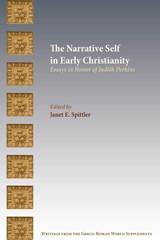
The Narrative Self in Early Christianity
Essays in Honor of Judith PerkinsJanet E. Spittler
SBL Press, 2019
Essays that explore early Christian texts and the broader world in which they were written
This volume of twelve essays celebrates the contributions of classicist Judith Perkins to the study of early Christianity. Drawing on Perkins's insights related to apocryphal texts, representations of pain and suffering, and the creation of meaning, contributors explore the function of Christian narratives that depict pain and suffering, the motivations of the early Christians who composed these stories, and their continuing value to contemporary people. Contributors also examine how narratives work to create meaning in a religious context. These contributions address these issues from a variety of angles through a wide range of texts.
Features:
- Introductions to and treatments of several largely unknown early Christian texts
- Essays by ten women and two men influenced or mentored by Judith Perkins
- Essays on the Deuterocanon, the New Testament, and early Christian relics
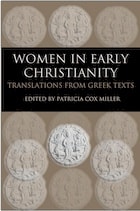
Women in Early Christianity
Translations from Greek TextsPatricia Cox Miller
Catholic University of America Press, 2005