Results by title
5 books match the query 'Early Cinema'
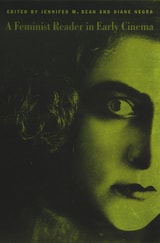
A Feminist Reader in Early Cinema
Jennifer M. Bean and Diane Negra, eds.
Duke University Press, 2002
While fostering new ways of thinking about film history, A Feminist Reader in Early Cinema illuminates the many questions that the concept of "early cinema" itself raises about the relation of gender to modernism, representation, and technologies of the body. The contributors bring a number of disciplinary frameworks to bear, including not only film studies but also postcolonial studies, dance scholarship, literary analysis, philosophies of the body, and theories regarding modernism and postmodernism.
Reflecting the stimulating diversity of early cinematic styles, technologies, and narrative forms, essays address a range of topics—from the dangerous sexuality of the urban flâneuse to the childlike femininity exemplified by Mary Pickford, from the Shanghai film industry to Italian diva films—looking along the way at birth-control sensation films, French crime serials, "war actualities," and the stylistic influence of art deco. Recurring throughout the volume is the protean figure of the New Woman, alternately garbed as childish tomboy, athletic star, enigmatic vamp, languid diva, working girl, kinetic flapper, and primitive exotic.
Contributors. Constance Balides, Jennifer M. Bean, Kristine Butler, Mary Ann Doane, Lucy Fischer, Jane Gaines, Amelie Hastie, Sumiko Higashi, Lori Landay, Anne Morey, Diane Negra, Catherine Russell, Siobhan B. Somerville, Shelley Stamp, Gaylyn Studlar, Angela Dalle Vacche, Radha Vatsal, Kristen Whissel, Patricia White, Zhang Zhen
Copy/Rights and Early Cinema
Proceedings of the 17th International Domitor ConferenceEdited by Clara Auclair, Ian Christie, Martin L. Johnson, Tami Williams, and Colin Williamson
Lever Press, 2026
Histories of early cinema often focus on technological, social, and aesthetic developments in the medium. But cinema also posed legal challenges throughout the world and continues to do so in the era of digital media and AI. The methods used to establish and defend copyright varied across national contexts and changed over time, shaping how films were circulated and preserved. This edited volume includes essays based on conference papers given at the 17th Domitor conference and includes case studies from a range of national, historical, and cultural contexts.
The essays in this volume address an array of themes, including copyright and early intermediality, piracy and censorship, international distribution, infamy and defamation, and publicity, privacy, and rights to the image. Although these essays center the first decades of cinema, the rights they address continue to resonate today. Since intellectual property law is constantly struggling to stay abreast of technological innovation, this collection has special relevance in a new era of global production and digital technologies that is as momentous as the invention of cinema. Claiming, defining, and defending rights are returned to the spotlight as AI draws upon the past of cinema to shape its future.
Crafts, Trades, and Techniques of Early Cinema
Ian Christie, Priska Morrissey, Louis Pelletier, Valentine Robert, Jean-Pierre Sirois-Trahan, and Tami Williams
Michigan Publishing Services, 2024
The intermedial approaches deployed in this collection bring into focus the influence of multiple professional worlds and cultural practices on the nascent film medium, as well as the necessary adaptations and transformations required by the latter. This circulatory dynamic concerns people and practices, studied in a non-diffusionist approach taking into account transcultural interactions. Chapters examine the mechanisms of professionalization and identity-building as they relate to professions such as filmmaker or colorist, as well as to more unexpected occupations such as accountant, censor, or chemical engineer.
The notion of technique is broadly defined. Several of the volume’s chapters deal with cameras or special effects, as well as with new historical investigation into mysterious technical devices such as shutters, cue systems or working samples. Going beyond this preoccupation with materiality, the collected studies also approach technique as a human and cultural activity, and thus as a set of gestures, crafts, and expertise. The book more specifically opens up a reflection on the skills of screen performers and on the training that brought the institutionalization of body techniques and film acting. The book further illustrates to an unprecedented extent that the first film workers were frequently women.
Several chapters are dedicated to the unconventional careers of specific film workers, with particular attention being given to the diversity and complexity of professional trajectories. Indeed, this book demonstrates that the invention of cinema was deeply enmeshed with the rise of international networks, which resulted in the standardization of technical practices within corporate and national contexts being ultimately shaped by globalization.
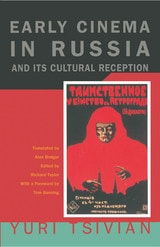
Early Cinema in Russia and Its Cultural Reception
Yuri Tsivian
University of Chicago Press, 1998
"Tsivian casts a probing beam of illumination into some of the most obscure areas of film history. And the terrain he lights up with his careful assembly and insightful reading of the records of early film viewing in Russia not only changes our sense of the history of this period but also . . . causes us to re-evaluate some of our most basic theoretical and historical assumptions about what a film is and how it affects its audiences."—Tom Gunning, from the Foreword
"Early Cinema in Russia . . . reveals Tsivian's strengths very well and demonstrates why he is . . . the finest film historian of his generation in the former Soviet Union."—Denise Y. Youngblood, Historical Journal of Film, Radio, and Television
"A work of fundamental importance."—Julian Graffy, Recent Studies of Russian and Soviet Cinema
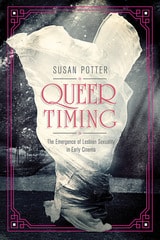
Queer Timing
The Emergence of Lesbian Sexuality in Early CinemaSusan Potter
University of Illinois Press, 2019
John Leo and Dana Heller Award for Best Single Work, Anthology, Multi-Authored or Edited Book in LGBTQ Studies, Popular Culture Association (PCA), 2020
In Queer Timing, Susan Potter offers a counter-history that reorients accepted views of lesbian representation and spectatorship in early cinema. Potter sees the emergence of lesbian figures as only the most visible but belated outcome of multiple sexuality effects. Early cinema reconfigured older erotic modalities, articulated new--though incoherent--sexual categories, and generated novel forms of queer feeling and affiliation.
Potter draws on queer theory, silent film historiography, feminist film analysis, and archival research to provide an original and innovative analysis. Taking a conceptually oriented approach, she articulates the processes of filmic representation and spectatorship that reshaped, marginalized, or suppressed women's same-sex desires and identities. As she pursues a sense of "timing," Potter stages scenes of the erotic and intellectual encounters shared by historical spectators, on-screen figures, and present-day scholars. The result is a daring revision of feminist and queer perspectives that foregrounds the centrality of women's same-sex desire to cinematic discourses of both homo- and heterosexuality.