Results by title
3 books match the query 'Early Modern Britain'
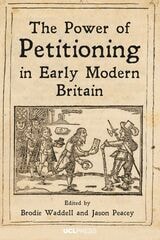
Power of Petitioning in Early Modern Britain
Edited by Brodie Waddell and Jason Peacey
University College London, 2024
The humble petition was ubiquitous in early modern society and featured prominently in crucial moments such as the outbreak of civil wars and in everyday local negotiations about taxation, welfare, and litigation. People at all levels of society, from noblemen to paupers, used petitions to make their voices heard, and these are valuable sources for mapping the structures of authority and agency that framed early modern society.
The Power of Petitioning in Early Modern Britain offers a holistic study of this crucial topic in early modern British history. The contributors to this volume survey a vast range of sources, showing the myriad ways people petitioned the authorities from the sixteenth to the eighteenth centuries. They cross the jurisdictional, sub-disciplinary, and chronological boundaries that have otherwise constrained the current scholarly literature on petitioning and popular political engagement. Teasing out broad conclusions from innumerable smaller interventions in public life, they not only address the aims, attitudes, and strategies of those involved but also assess the significance of the processes they used. This volume makes it possible to rethink the power of petitioning and to re-evaluate broad trends regarding political culture, institutional change, and state formation.
The Specter of the Archive
Political Practice and the Information State in Early Modern BritainNicholas Popper
University of Chicago Press, 2024
We are used to thinking of ourselves as living in a time when more information is more available than ever before. In The Specter of the Archive, Nicholas Popper shows that earlier eras had to grapple with the same problem—how to deal with too much information at their fingertips.
He reveals that early modern Britain was a society newly drowning in paper, a light and durable technology whose spread allowed statesmen to record drafts, memoranda, and other ephemera that might otherwise have been lost, and also made it possible for ordinary people to collect political texts. As original paperwork and copies alike flooded the government, information management became the core of politics. Focusing on two of the primary political archives of early modern England, the Tower of London Record Office and the State Paper Office, Popper traces the circulation of their materials through the government and the broader public sphere. In this early media-saturated society, we find the origins of many issues we face today: Who shapes the archive? Can we trust the pictures of the past and the present that it shows us? And, in a more politically urgent vein: Does a huge volume of widely available information (not all of it accurate) risk contributing to polarization and extremism?
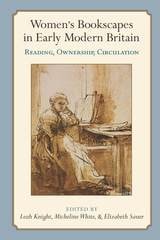
Women’s Bookscapes in Early Modern Britain
Reading, Ownership, CirculationLeah Knight, Micheline White, and Elizabeth Sauer, Editors
University of Michigan Press, 2018
Women in 16th- and 17th-century Britain read, annotated, circulated, inventoried, cherished, criticized, prescribed, and proscribed books in various historically distinctive ways. Yet, unlike that of their male counterparts, the study of women’s reading practices and book ownership has been an elusive and largely overlooked field.
In thirteen probing essays, Women’s Bookscapesin Early Modern Britain brings together the work of internationally renowned scholars investigating key questions about early modern British women’s figurative, material, and cultural relationships with books. What constitutes evidence of women’s readerly engagement? How did women use books to achieve personal, political, religious, literary, economic, social, familial, or communal goals? How does new evidence of women’s libraries and book usage challenge received ideas about gender in relation to knowledge, education, confessional affiliations, family ties, and sociability? How do digital tools offer new possibilities for the recovery of information on early modern women readers?
The volume’s three-part structure highlights case studies of individual readers and their libraries; analyses of readers and readership in the context of their interpretive communities; and new types of scholarly evidence—lists of confiscated books and convent rules, for example—as well as new methodologies and technologies for ongoing research. These essays dismantle binaries of private and public; reading and writing; female and male literary engagement and production; and ownership and authorship.
Interdisciplinary, timely, cohesive, and concise, this collection’s fresh, revisionary approaches represent substantial contributions to scholarship in early modern material culture; book history and print culture; women’s literary and cultural history; library studies; and reading and collecting practices more generally.