Results by title
2 books match the query 'Early Modernity'
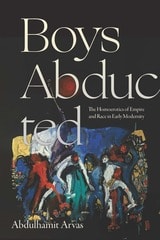
Boys Abducted
The Homoerotics of Empire and Race in Early ModernityAbdulhamit Arvas
Duke University Press, 2025
In Boys Abducted, Abdulhamit Arvas explores the history of abducted boys in English and Ottoman literary and visual culture to examine the relationships between homoeroticism, race, and empire in the early modern period. The popular literary trope of the abducted beautiful boy—often eroticized as an exotic object of desire—intersects with the historical phenomenon of vulnerable youths who were captured and exchanged within the global traffic in bodies. Arvas offers a queer-historicist analysis of a wide array of Ottoman and English texts and genres ranging from poetry, drama, and travelogue to chronicles, maps, and visual arts. He shows how the boy in these representations crosses boundaries between nations and empires, embodying the tensions and dissonances between the aestheticized eroticism of literary and cultural representations and the violent history of abductions, conversions, and enslavements. In so doing, Arvas presents complex parallels and connections between the two societies, highlighting the circulation of sexual and racial discourses in imperial imaginings to uncover discursive formations and formulations of sexuality, race, and empire.
[more]
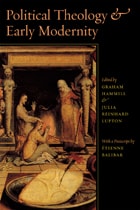
Political Theology and Early Modernity
Edited by Graham Hammill and Julia Reinhard Lupton
University of Chicago Press, 2012
Political theology is a distinctly modern problem, one that takes shape in some of the most important theoretical writings of the twentieth and twenty-first centuries. But its origins stem from the early modern period, in medieval iconographies of sacred kinship and the critique of traditional sovereignty mounted by Hobbes and Spinoza. In this book, Graham Hammill and Julia Reinhard Lupton assemble established and emerging scholars in early modern studies to examine the role played by sixteenth- and seventeenth-century literature and thought in modern conceptions of political theology.
Political Theology and Early Modernity explores texts by Shakespeare, Machiavelli, Milton, and others that have served as points of departure for such thinkers as Schmitt, Strauss, Benjamin, and Arendt. Written from a spectrum of positions ranging from renewed defenses of secularism to attempts to reconceive the religious character of collective life and literary experience, these essays probe moments of productive conflict, disavowal, and entanglement in politics and religion as they pass between early modern and modern scenes of thought. This stimulating collection is the first to answer not only how Renaissance and baroque literature help explain the persistence of political theology in modernity and postmodernity, but also how the reemergence of political theology as an intellectual and political problem deepens our understanding of the early modern period.
[more]