Results by title
3 books match the query 'Early State Formation'

Early State Formation in Central Madagascar
An Archaeological Survey of Western AvaradranoEdited by Henry T. Wright
University of Michigan Press, 2007
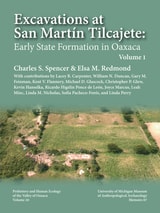
Excavations at San Martín Tilcajete
Early State Formation in Oaxaca, Volume ICharles S. Spencer and Elsa M. Redmond
University of Michigan Press, 2026
In this two-volume site report, authors Charles Spencer and Elsa Redmond report the final, comprehensive results of two decades of archaeological fieldwork (1993–2014) on the lands of San Martín Tilcajete, in the Ocotlán-Zimatlán subvalley of the Oaxaca Valley of Mexico. Their work focused on El Mogote and El Palenque, two archaeological sites with successive occupations spanning 500–100 BC, a time of transformational cultural change in Oaxaca. El Mogote and El Palenque were the largest sites in the Ocotlán-Zimatlán subvalley during their phases of greatest occupation: the Early Monte Albán I phase (500–300 BC) at El Mogote, and the Late Monte Albán I phase (300–100 BC) at El Palenque.
Through intensive survey and large-scale excavation of public buildings and residences, Spencer, Redmond, and their crew documented major political and religious changes between the Early Monte Albán I phase and the Late Monte Albán I phase, notably the appearance around 300 BC at El Palenque of key state institutions such as the palace and multiroom temple. The evidence also revealed that the Tilcajete locality maintained its political independence from the city of Monte Albán until the 1st century BC, even though Monte Albán had conquered far more distant regions by 300 BC. State formation at Tilcajete played a substantial role in this independent polity’s ability to resist Monte Albán’s aggressions for two centuries.
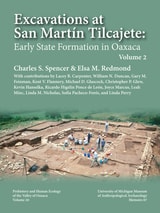
Excavations at San Martín Tilcajete
Early State Formation in Oaxaca, Volume IICharles S. Spencer and Elsa M. Redmond
University of Michigan Press, 2026
In this two-volume site report, authors Charles Spencer and Elsa Redmond report the final, comprehensive results of two decades of archaeological fieldwork (1993–2014) on the lands of San Martín Tilcajete, in the Ocotlán-Zimatlán subvalley of the Oaxaca Valley of Mexico. Their work focused on El Mogote and El Palenque, two archaeological sites with successive occupations spanning 500–100 BC, a time of transformational cultural change in Oaxaca. El Mogote and El Palenque were the largest sites in the Ocotlán-Zimatlán subvalley during their phases of greatest occupation: the Early Monte Albán I phase (500–300 BC) at El Mogote, and the Late Monte Albán I phase (300–100 BC) at El Palenque.
Through intensive survey and large-scale excavation of public buildings and residences, Spencer, Redmond, and their crew documented major political and religious changes between the Early Monte Albán I phase and the Late Monte Albán I phase, notably the appearance around 300 BC at El Palenque of key state institutions such as the palace and multiroom temple. The evidence also revealed that the Tilcajete locality maintained its political independence from the city of Monte Albán until the 1st century BC, even though Monte Albán had conquered far more distant regions by 300 BC. State formation at Tilcajete played a substantial role in this independent polity’s ability to resist Monte Albán’s aggressions for two centuries.