Results by title
6 books match the query 'Early United States'
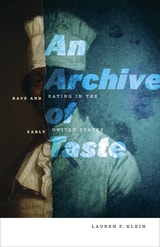
An Archive of Taste
Race and Eating in the Early United StatesLauren F. Klein
University of Minnesota Press, 2020
A groundbreaking synthesis of food studies, archival theory, and early American literature
There is no eating in the archive. This is not only a practical admonition to any would-be researcher but also a methodological challenge, in that there is no eating—or, at least, no food—preserved among the printed records of the early United States. Synthesizing a range of textual artifacts with accounts (both real and imagined) of foods harvested, dishes prepared, and meals consumed, An Archive of Taste reveals how a focus on eating allows us to rethink the nature and significance of aesthetics in early America, as well as of its archive.
Lauren F. Klein considers eating and early American aesthetics together, reframing the philosophical work of food and its meaning for the people who prepare, serve, and consume it. She tells the story of how eating emerged as an aesthetic activity over the course of the eighteenth century and how it subsequently transformed into a means of expressing both allegiance and resistance to the dominant Enlightenment worldview. Klein offers richly layered accounts of the enslaved men and women who cooked the meals of the nation’s founders and, in doing so, directly affected the development of our national culture—from Thomas Jefferson’s emancipation agreement with his enslaved chef to Malinda Russell’s Domestic Cookbook, the first African American–authored culinary text.
The first book to examine the gustatory origins of aesthetic taste in early American literature, An Archive of Taste shows how thinking about eating can help to tell new stories about the range of people who worked to establish a cultural foundation for the United States.
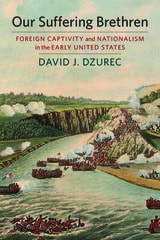
Our Suffering Brethren
Foreign Captivity and Nationalism in the Early United StatesDavid J. Dzurec III
University of Massachusetts Press, 2019
In October 1785, American statesman John Jay acknowledged that the more his countrymen “are treated ill abroad, the more we shall unite and consolidate at home.” Behind this simple statement lies a complicated history. From the British impressment of patriots during the Revolution to the capture of American sailors by Algerian corsairs and Barbary pirates at the dawn of the nineteenth century, stories of Americans imprisoned abroad helped jumpstart democratic debate as citizens acted on their newly unified identity to demand that their government strengthen efforts to free their fellow Americans. Deliberations about the country's vulnerabilities in the Atlantic world reveal America's commitment to protecting the legacy of the Revolution as well as growing political divisions.
Drawing on newspaper accounts, prisoner narratives, and government records, David J. Dzurec III explores how stories of American captivity in North America, Europe, and Africa played a critical role in the development of American political culture, adding a new layer to our understanding of foreign relations and domestic politics in the early American republic.
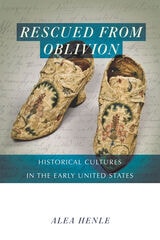
Rescued from Oblivion
Historical Cultures in the Early United StatesAlea Henle
University of Massachusetts Press, 2020
With in-depth research and an expansive scope, Rescued from Oblivion offers a vital account of the formation of historical culture and consciousness in the early United States, re-centering in the record groups long marginalized from the national memory. As Alea Henle demonstrates, these societies laid the groundwork for professional practices that are still embraced today: collection policies, distinctions between preservation of textual and nontextual artifacts, publication programs, historical rituals and commemorations, reconciliation of scholarly and popular approaches, and more. At the same time, officers of these early societies faced challenges to their historical authority from communities interested in preserving a broader range of materials and documenting more inclusive histories, including fellow members, popular historians, white women, and peoples of color.
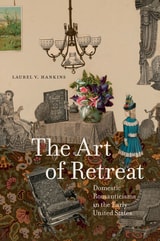
The Art of Retreat
Domestic Romanticisms in the Early United StatesLaurel V. Hankins
Bucknell University Press, 2025
The political and cultural fantasy of home as a retreat from the pressures of the world first emerged in the U.S. alongside two major nineteenth-century literary movements: Romanticism and domestic fiction. Upending accepted gendered narratives from this period, The Art of Retreat posits that these movements originated from a domestic culture already in transition, in which home was frequently a more complicated site of self-interested pleasure, coerced labor, creole social reproduction, homosocial intimacy, bachelor whimsy, petty tyranny, racial abuse, and transgender capacity. The early national periodicals, sketches, and novels examined here lend themselves to this interpretation. Hankins argues that the literary tradition emerging from these decades—one that aligned creative genius with domestic retreat—reminds us that a politics that appeals to private feeling must reckon with new interpretations of labor, kinship, and reform in exchange for the promise of consensual citizenship.
Published by Bucknell University Press. Distributed worldwide by Rutgers University Press.
The Making of Tocqueville's America
Law and Association in the Early United StatesKevin Butterfield
University of Chicago Press, 2015
Butterfield explains that the first generations of American citizens found in the concept of membership—in churches, fraternities, reform societies, labor unions, and private business corporations—a mechanism to balance the tension between collective action and personal autonomy, something they accomplished by emphasizing law and procedural fairness. As this post-Revolutionary procedural culture developed, so too did the legal substructure of American civil society. Tocqueville, then, was wrong to see associations as the training ground for democracy, where people learned to honor one another’s voices and perspectives. Rather, they were the training ground for something no less valuable to the success of the American democratic experiment: increasingly formal and legalistic relations among people.
The Technology of Drawing
Image and Industry in the Early United StatesElizabeth Bacon Eager
University of Chicago Press, 2026
A richly illustrated study of how technical drawing shaped culture in the early United States.
With The Technology of Drawing, Elizabeth Bacon Eager explores the importance of manual skill and graphic literacy in the emergence of American industry, offering readers a new lens through which to view the visual culture of the early United States. Focused on questions of materiality and process, the book traces the development of drawing as a technology and argues for it as an embodied way of thinking and knowing, revealing the significance of such knowledge in the construction of both scientific and social authority. Through close analysis of materials, including construction drawings, mechanical treatises, cartographic surveys, and patent drawings, many of which have never been published before, Eager presents a history of American art focused on materiality and process through the view of the mechanic rather than the fine artist.
Reaching beyond the traditional boundaries of art historical study to engage objects rarely considered as art, The Technology of Drawing treats the technical image as a site of extraordinary creativity, in which eighteenth- and nineteenth-century Americans across the social spectrum negotiated critical concepts of identity, invention, and authorship with a remarkable degree of material intelligence and visual sophistication.