Results by title
11 books match the query 'Earthquakes & Volcanoes'
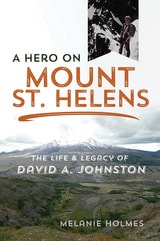
A Hero on Mount St. Helens
The Life and Legacy of David A. JohnstonMelanie Holmes. Foreword by Jeff Renner
University of Illinois Press, 2019
Melanie Holmes tells the story of Johnston's journey from a nature-loving Boy Scout to a committed geologist. Blending science with personal detail, Holmes follows Johnston through his encounters with Aleutian volcanoes, his work helping the Portuguese government assess the geothermal power of the Azores, and his dream job as a volcanologist with the U.S. Geological Survey. Interviews and personal writings reveal what a friend called “the most unjaded person I ever met,” an imperfect but kind and intelligent young scientist passionately in love with his life and work and determined to make a difference.
A Hero on Mount St. Helens
The Life and Legacy of David A. JohnstonMelanie Holmes. Narrated by Jeff Renner. Foreword by Jeff Renner
University of Illinois Press, 2024
Melanie Holmes tells the story of Johnston's journey from a nature-loving Boy Scout to a committed geologist. Blending science with personal detail, Holmes follows Johnston through his encounters with Aleutian volcanoes, his work helping the Portuguese government assess the geothermal power of the Azores, and his dream job as a volcanologist with the U.S. Geological Survey. Interviews and personal writings reveal what a friend called “the most unjaded person I ever met,” an imperfect but kind and intelligent young scientist passionately in love with his life and work and determined to make a difference.

Apocalypse 1692
Empire, Slavery, and the Great Port Royal EarthquakeBen Hughes
Westholme Publishing, 2017
A haven for pirates and the center of the New World’s frenzied trade in slaves and sugar, Port Royal, Jamaica, was a notorious cutthroat settlement where enormous fortunes were gained for the fledgling English empire. But on June 7, 1692, it all came to a catastrophic end. Drawing on research carried out in Europe, the Caribbean, and the United States, Apocalypse 1692: Empire, Slavery, and the Great Port Royal Earthquake by Ben Hughes opens in a post–Glorious Revolution London where two Jamaica-bound voyages are due to depart. A seventy-strong fleet will escort the Earl of Inchiquin, the newly appointed governor, to his residence at Port Royal, while the Hannah, a slaver belonging to the Royal African Company, will sail south to pick up human cargo in West Africa before setting out across the Atlantic on the infamous Middle Passage. Utilizing little-known first-hand accounts and other primary sources, Apocalypse 1692 intertwines several related themes: the slave rebellion that led to the establishment of the first permanent free black communities in the New World; the raids launched between English Jamaica and Spanish Santo Domingo; and the bloody repulse of a full-blown French invasion of the island in an attempt to drive the English from the Caribbean. The book also features the most comprehensive account yet written of the massive earthquake and tsunami which struck Jamaica in 1692, resulting in the deaths of thousands, and sank a third of the city beneath the sea. From the misery of everyday life in the sugar plantations, to the ostentation and double-dealings of the plantocracy; from the adventures of former-pirates-turned-treasure-hunters to the debauchery of Port Royal, Apocalypse 1692 exposes the lives of the individuals who made late seventeenth-century Jamaica the most financially successful, brutal, and scandalously corrupt of all of England’s nascent American colonies.
Earthquake Fears, Predictions, and Preparations in Mid-America
John E. Farley
Southern Illinois University Press, 1998
The New Madrid Seismic Zone (NMSZ) generated the strongest earthquakes ever observed in the lower forty-eight states in 1811 and 1812. And the region is overdue for another damaging quake. When self-proclaimed climatologist lben Browning predicted that a major earthquake would shatter the Heartland on 2 or 3 December 1990, many living within reach of the New Madrid fault zone reacted with varying combinations of preparation and panic.
John Farley’s study reports the results of four surveys conducted in the NMSZ both before and after the quake prediction. Thus, Farley notes the level of awareness and preparation at the height of the Browning-induced scare and shows to what extent earthquake awareness and preparedness were sustained in this region after the most widely publicized prediction in recent history proved baseless. All four surveys offer important insights into what people believe about earthquake risk in the NMSZ, what they know about earthquakes, what specific actions they have—and have not—taken in preparation for earthquakes, and what they think a severe quake would do to their neighborhoods.
Farley is the first researcher to study the response to an earthquake prediction while the prediction remained in effect and to continue the inquiry after the date covered by the prediction had passed. He is also the first researcher to look at earthquake awareness and preparedness in the NMSZ over an extended period of time.
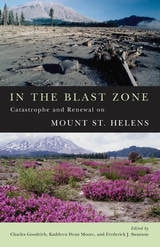
In the Blast Zone
Catastrophe and Renewal on Mt. St. HelensCharles Goodrich
Oregon State University Press, 2008
In the Blast Zone is the first book to present a cross-pollination of literary and scientific perspectives on the mountain's history of cataclysm and renewal. Most of the contributors to this volume camped together on Mount St. Helens for four days, hiking, observing, and sharing ideas. They asked the question: What can this radically altered landscape tell us about nature and how to live our lives? In the Blast Zone collects some of their answers. While introducing ecological and geological insights, it also tells compelling stories about how science and literature inform our lives and our relationship to nature.
These writings will startle readers with new recognition of the matchless gifts of Mount St. Helens: the gifts of beauty, of illumination, of hope. The Contributors Gary Braasch, John Calderazzo, Christine Colasurdo, Charlie Crisafulli, John Daniel, Jerry Franklin, Charles Goodrich, Robin Kimmerer, Ursula K. LeGuin, Tim McNulty, Kathleen Dean Moore, Nalini Nadkarni, Robert Michael Pyle, Scott Russell Sanders, James Sedell, Gary Snyder, Kim Stafford, Frederick J. Swanson, Tony Vogt, Ann Zwinger, Susan Zwinger

Living with Earthquakes in the Pacific Northwest
Robert S. Yeats
Oregon State University Press, 1998
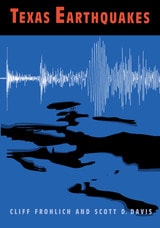
Texas Earthquakes
By Cliff Frohlich and Scott D. Davis
University of Texas Press, 2003
When nature goes haywire in Texas, it isn't usually an earthshaking event. Though droughts, floods, tornadoes, and hail all keep Texans talking about the unpredictable weather, when it comes to earthquakes, most of us think we're on terra firma in this state. But we're wrong! Nearly every year, earthquakes large enough to be felt by the public occur somewhere in Texas.
This entertaining, yet authoritative book covers "all you really need to know" about earthquakes in general and in Texas specifically. The authors explain how earthquakes are caused by natural forces or human activities, how they're measured, how they can be predicted, and how citizens and governments should prepare for them. They also thoroughly discuss earthquakes in Texas, looking at the occurrences and assessing the risks region by region and comparing the amount of seismic activity in Texas to other parts of the country and the world. The book concludes with a compendium of over one hundred recorded earthquakes in Texas from 1811 to 2000 that briefly describes the location, timing, and effects of each event.
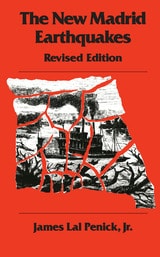
The New Madrid Earthquakes, Revised Edition
James Lal Penick, Jr.
University of Missouri Press, 1981
Since its publication in a cloth edition in 1976, Penick’s book has met with enormous regional appeal as well as critical acclaim. For the new paper edition, the author has written a new introduction. New material in the final chapter reports on the scientific inquiries into the New Madrid quakes since 1976.
Critical comments on the cloth edition: “James Penick has put together a well-written account of the quakes and their effects upon people, animals, waterways, and land. Based on the scattered accounts of the times it offers a good insight into the reactions of persons suddenly confronted with the perils of the unknown. The vivid description of the devastation wrought upon the face of the land gives a picture of dramatic change brought about by the upheaval of natural forces. In short, reading Penick’s work one is readily caught up in the total violence of the event.”—American Historical Review
“Penick provides information relevant to present studies of earthquakes in this area.”—Earthquake Information Bulletin
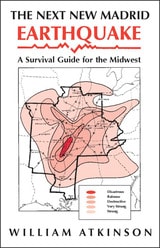
The Next New Madrid Earthquake
A Survival Guide for the MidwestWilliam Atkinson
Southern Illinois University Press, 1989
Scientists who specialize in the study of Mississippi Valley earthquakes say that the region is overdue for a powerful tremor that will cause major damage and undoubtedly some casualties.
The inevitability of a future quake and the lack of preparation by both individuals and communities provided the impetus for this book. Atkinson brings together applicable information from many disciplines: history, geology and seismology, engineering, zoology, politics and community planning, economics, environmental science, sociology, and psychology and mental health to provide the most comprehensive perspective to date of the myriad impacts of a major earthquake on the Mississippi Valley.
Atkinson addresses such basic questions as "What, actually, are earthquakes? How do they occur? Where are they likely to occur? Can they be predicted, perhaps even prevented?" He also addresses those steps that individuals can take to improve their chances for survival both during and after an earthquake.
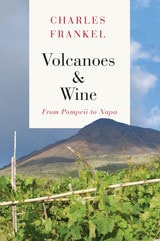
Volcanoes and Wine
From Pompeii to NapaCharles Frankel
University of Chicago Press, 2019
Traveling across regions wellknown to wine lovers like Sicily, Oregon, and California, as well as the less familiar places, such as the Canary Islands, Frankel gives an in-depth account of famous volcanoes and the wines that spring from their idiosyncratic soils. From Santorini’s vineyards of rocky pumice dating back to a four-thousand-year-old eruption to grapes growing in craters dug in the earth of the Canary Islands, from Vesuvius’s famous Lacryma Christi to the ambitious new generation of wine growers reviving the traditional grapes of Mount Etna, Frankel takes us across the stunning and dangerous world of volcanic wines. He details each volcano’s most famous eruptions, the grapes that grow in its soils, and the people who make their homes on its slopes, adapting to an ever-menacing landscape. In addition to introducing the history and geology of these volcanoes, Frankel's book serves as a travel guide, offering a host of tips ranging from prominent vineyards to visit to scenic hikes in each location.
This illuminating guide will be indispensable for wine lovers looking to learn more about volcanic terroirs, as well as anyone curious about how cultural heritage can survive and thrive in the shadow of geological danger.
Volcanoes
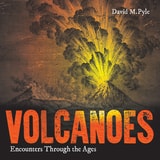
Encounters through the AgesDavid M. Pyle
Bodleian Library Publishing, 2017
That’s Pliny the Younger, writing to Tacitus about the eruption of Vesuvius in 79 CE, one of many volcanic eruptions that have become part of the story of human history. We have always, it seems, been simultaneously fascinated and terrified by volcanoes, and this book brings together an unforgettable selection of firsthand accounts from around the world and through the centuries.
In these pages, anonymous seventeenth-century seafarers tell of exploding islands, Alexander Von Humboldt and Charles Darwin show us volcanoes through the eyes of developing science, and artists sketch the spectacular London sunsets created by the eruption of Krakatoa, half the world away. As the years pass, words and paintings give way to the first photograph of an eruption, and eventually to detailed satellite imagery, but the awesome force of volcanoes still comes through, sublime and spectacular.
As we were reminded in 2010 when the eruption of Iceland’s Eyjafjallajökull snarled travel throughout Europe, volcanoes remain powerful and unpredictable even today. In the pages of this book, we can appreciate their majesty from a safe distance.