Results by title
9 books match the query 'East Germany'

African Students in East Germany, 1949-1975
Sara Pugach
University of Michigan Press, 2022
This book explores the largely unexamined history of Africans who lived, studied, and worked in the German Democratic Republic. African students started coming to the East in 1951 as invited guests who were offered scholarships by the East German government to prepare them for primarily technical and scientific careers once they returned home to their own countries. Drawn from previously unexplored archives in Germany, Ghana, Kenya, Zambia, and the United Kingdom, African Students in East Germany, 1949–1975 uncovers individual stories and reconstructs the pathways that African students took in their journeys to the GDR and what happened once they got there. The book places these experiences within the larger context of German history, questioning how ideas of African racial difference that developed from the eighteenth through the early twentieth centuries impacted East German attitudes toward the students.
The book additionally situates African experiences in the overlapping contexts of the Cold War and decolonization. During this time, nations across the Western and Soviet blocs were inviting Africans to attend universities and vocational schools as part of a drive to offer development aid to newly independent countries and encourage them to side with either the United States or Soviet Union in the Cold War. African leaders recognized their significance to both Soviet and American blocs, and played on the desire of each to bring newly independent nations into their folds. Students also recognized their importance to Cold War competition, and used it to make demands of the East German state. The book is thus located at the juncture of many different histories, including those of modern Germany, modern Africa, the Global Cold War, and decolonization.
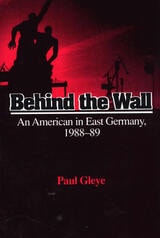
Behind the Wall
An American in East Germany, 1988-89Paul Gleye
Southern Illinois University Press, 1991
Standing in long lines in the shops, coaxing clean laundry from an outdated washing machine, traveling despite unpredictable train schedules, and being without hot water, fruit, and vegetables through the gray winter months failed to dull Paul Gleye’s perceptions during the year he lived in Weimar, East Germany. Day by day Gleye documented his varied observations and experiences, unaware that they would prove a unique record of what would soon be an extinct society.
Gleye was in East Germany as a Fulbright lecturer. Living beyond the capital city of East Berlin and traveling and conversing freely, Gleye gained access to people and places that had been almost completely closed to Americans and other Westerners for decades.
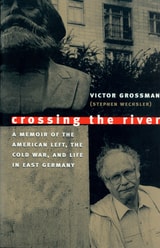
Crossing the River
A Memoir of the American Left, the Cold War, and Life in East GermanyVictor Grossman
University of Massachusetts Press, 2003
What could possibly impel a relatively privileged twenty-four-year-old American-serving in the U.S. Army in Germany in 1952 to swim across the Danube River to what was then referred to as the Soviet Zone? How are we to understand his decision to forsake the land of his birth and build a new life in the still young German Democratic Republic? These are the questions at the core of this memoir by Victor Grossman, who was born Stephen Wechsler but changed his name after defecting to the GDR.
A child of the Depression, Grossman witnessed firsthand the dislocations wrought by the collapse of the U.S. economy during the 1930s. Widespread unemployment and poverty, CIO sit-down strikes, and the fight to save Republican Spain from fascism-all made an indelible impression as he grew up in an environment that nurtured a commitment to left-wing causes. He continued his involvement with communist activities as a student at Harvard in the late 1940s and after graduation, when he took jobs in two factories in Buffalo, New York, and tried to organize their workers.
Fleeing McCarthyite America and potential prosecution, Grossman worked in the GDR with other Western defectors and eventually became, as he notes, the “only person in the world to attend Harvard and Karl Marx universities.” Later, he was able to establish himself as a freelance journalist, lecturer, and author. Traveling throughout East Germany, he evaluated the failures as well as the successes of the GDR's “socialist experiment.” He also recorded his experiences, observations, and judgments of life in East Berlin after reunification, which failed to bring about the post-Communist paradise so many had expected.
Written with humor as well as candor, Crossing the River provides a rare look at the Cold War from the other side of the ideological divide.
Mark Solomon, a distinguished historian of the American left, provides a historical afterword that places Grossman's experiences in a larger Cold War context.
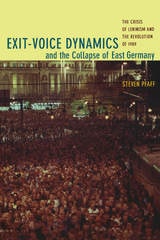
Exit-Voice Dynamics and the Collapse of East Germany
The Crisis of Leninism and the Revolution of 1989Steven Pfaff
Duke University Press, 2006
East Germany was the first domino to fall when the Soviet bloc began to collapse in 1989. Its topple was so swift and unusual that it caught many area specialists and social scientists off guard; they failed to recognize the instability of the Communist regime, much less its fatal vulnerability to popular revolt. In this volume, Steven Pfaff identifies the central mechanisms that propelled the extraordinary and surprisingly bloodless revolution within the German Democratic Republic (GDR). By developing a theory of how exit-voice dynamics affect collective action, Pfaff illuminates the processes that spurred mass demonstrations in the GDR, led to a peaceful surrender of power by the hard-line Leninist elite, and hastened German reunification. While most social scientific explanations of collective action posit that the option for citizens to emigrate—or exit—suppresses the organized voice of collective public protest by providing a lower-cost alternative to resistance, Pfaff argues that a different dynamic unfolded in East Germany. The mass exit of many citizens provided a focal point for protesters, igniting the insurgent voice of the revolution.
Pfaff mines state and party records, police reports, samizdat, Church documents, and dissident manifestoes for his in-depth analysis not only of the genesis of local protest but also of the broader patterns of exit and voice across the entire GDR. Throughout his inquiry, Pfaff compares the East German rebellion with events occurring during the same period in other communist states, particularly Czechoslovakia, China, Poland, and Hungary. He suggests that a trigger from outside the political system—such as exit—is necessary to initiate popular mobilization against regimes with tightly centralized power and coercive surveillance.
Origins of a Spontaneous Revolution
East Germany, 1989Karl-Dieter Opp, Peter Voss, and Christiane Gern
University of Michigan Press, 1995
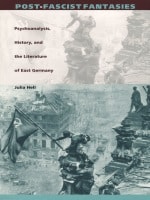
Post-Fascist Fantasies
Psychoanalysis, History, and the Literature of East GermanyJulia Hell
Duke University Press, 1997
By focusing on the unconscious fantasies about post-fascist body and post-fascist voice that suffuse the texts of Wolf and others, Hell radically reconceptualizes the notion of the author’s subjective authenticity. Since this notion occupies a key position in previous literary-historical accounts of East German culture, Hell’s psychoanalytic approach problematizes the established literary model of an "authentic feminine voice" that gradually liberates itself from the GDR’s dominant ideological narrative. Far from operating solely on a narrowly political level, the novels of Wolf and others were intricate family sagas portraying psychic structures linked in complex ways to the GDR’s social dynamics. Hell traces this link through East German literatrure’s dominant narrative, a paternal narrative organized around the figure of the Communist father as antifascist hero.
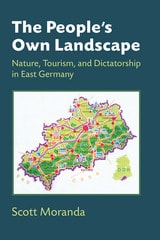
The People's Own Landscape
Nature, Tourism, and Dictatorship in East GermanyScott Moranda
University of Michigan Press, 2014
East Germany’s Socialist Unity Party aimed to placate a public well aware of the higher standards of living enjoyed elsewhere by encouraging them to participate in outdoor activities and take vacations in the countryside. Scott Moranda considers East Germany’s rural landscapes from the perspective of both technical experts (landscape architects, biologists, and physicians) who hoped to dictate how vacationers interacted with nature, and the vacationers themselves, whose outdoor experience shaped their understanding of environmental change. As authorities eliminated traditional tourist and nature conservation organizations, dissident conservationists demanded better protection of natural spaces. At the same time, many East Germans shared their government’s expectations for economic development that had real consequences for the land. By the 1980s, environmentalists saw themselves as outsiders struggling against the state and a public that had embraced mainstream ideas about limitless economic growth and material pleasures.

Twelve Years
An American Boyhood in East GermanyJoel Agee
University of Chicago Press, 2000
"A wonderfully evocative memoir. . . . Agee evoked for me the atmosphere of postwar Berlin more vividly than the actual experience of it—and I was there." —Christopher Lehmann-Haupt, New York Times
"One of those rare personal memoirs that brings to life a whole country and an epoch." —Christopher Isherwood
"Twelve Years consists of a series of finely honed anecdotes written in a precise, supple prose rich with sensual detail." —David Ghitelman, Newsday
"By turns poetic and picturesque, Agee energetically catalogues his expatriate passage to manhood with a pinpoint eye and a healthy American distaste for pretension. . . . Huckleberry Finn would have . . . welcomed [him] as a soulmate on the raft." —J. D. Reed, Time
"A triumph. . . . Unfettered by petty analysis or quick explanations, a story that is timeless and ageless and vital." —Robert Michael Green, Baltimore Sun
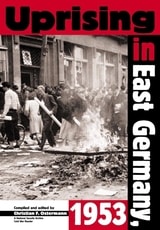
Uprising in East Germany, 1953
The Cold War, the German Question, and the First Major Upheaval behind the Iron CurtainThe National Security Archive Ostermann
Central European University Press, 2001
This volume is the second in the series Cold War Documentary Readers, a project of the US National Security Archive and the Cold War International History Project.
The volume is the first documented account of this early Cold War crisis from both sides of the Iron Curtain. Based on the recent unprecedented access to the once-closed archives of several member states of the Warsaw Pact, this collection of primary-source documents presents one of the most notorious events of post-war European history in a highly readable format.
Previously unreleased Kremlin records, once highly classified American documents, materials from the Soviet Foreign Ministry, and transcripts of internal East German Communist Party Politburo meetings in the days leading to the uprising in the German Democratic Republic (GDR) are among the highlights of this sensational documentary.
In this volume, as in the previous one in the series, each part is preceded by a detailed introductory essay to provide the necessary historical and political context. The individual documents are introduced by short headnotes summarizing the contents and orienting the reader. A chronology, glossary and bibliography offer further background information.