Results by title
3 books match the query 'Easter Rising, 1916'
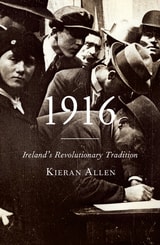
1916
Ireland's Revolutionary TraditionKieran Allen
Pluto Press, 2016
The Easter Rising of 1916, in which just over a thousand Irish rebels seized key locations in Dublin and proclaimed the independence of the Irish Republic before being brutally suppressed by the vastly larger and better-equipped British Army, is an event whose meaning remains contested to this day. For some it represents a blood sacrifice without the hope—or even the intention—of success. For others, it was the first act in a tumultuous political drama played out in Dublin streets and London cabinet rooms that led to the eventual formation of an independent Irish state.
In 1916, Kieran Allen argues that this pivotal moment in Irish history has been obscured by those who see it only as a prelude for a war of independence. Emphasizing an often ignored social and political radicalism at the heart of the rebellion, he shows that it gave birth to a revolutionary tradition that continues to haunt the Irish elite. Socialist aspirations mixed, and sometimes clashed, with the republican current, but both were crushed in a counterrevolution that accompanied the Anglo-Irish treaty of 1921. The result today is a partitioned Ireland that acts as a neoliberal tax haven for multinational corporations—a state of affairs quite alien to both Connolly’s and Pearse’s vision.
Published to coincide with the Rising’s centennial, 1916: Ireland’s Revolutionary Tradition re-establishes the political role of socialist republican figures, offers a highly accessible history of the Easter Rising, and explores the militancy and radicalism that continues to haunt the Irish elite one hundred years later.
[more]
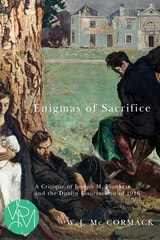
Enigmas of Sacrifice
A Critique of Joseph M. Plunkett and the Dublin Insurrection of 1916W. J. Mc Cormack
Michigan State University Press, 2016
Enigmas of Sacrifice: A Critique of Joseph M. Plunkett and the Dublin Insurrection of 1916 is the first critical study of the religious poet and militarist Joseph M. Plunkett, who was executed with the other leaders of the Dublin insurrection of 1916. Through Plunkett the author gains access to areas of nationalist thought that were more often assumed or repressed than publicly formulated. In this eye-opening book, W. J. Mc Cormack explores and analyzes Plunkett’s brief life, work, and influence, beginning with his wealthy but dysfunctional family, irregular Jesuit education, and self-canceling sexuality. Mc Cormack continues through Plunkett’s active phase when amateur theatricals and a magazine editorship brought him into the emergent neonationalist discourse of early twentieth-century Ireland. Finally, the author arrives at Holy Week 1916, when Plunkett masterminded the forgery of official documentation in order to provoke and justify the insurrection he planned. Mc Cormack analyzes Plunkett’s significant texts and provides context through critical perspectives on his milieu. Enigmas of Sacrifice is unique in its effort to understand a major figure of Irish nationalism in terms that reach beyond political identity.
[more]
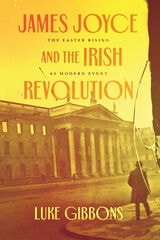
James Joyce and the Irish Revolution
The Easter Rising as Modern EventLuke Gibbons
University of Chicago Press, 2023
A provocative history of Ulysses and the Easter Rising as harbingers of decolonization.
When revolutionaries seized Dublin during the 1916 Easter Rising, they looked back to unrequited pasts to point the way toward radical futures—transforming the Celtic Twilight into the electric light of modern Dublin in James Joyce’s Ulysses. For Luke Gibbons, the short-lived rebellion converted the Irish renaissance into the beginning of a global decolonial movement. James Joyce and the Irish Revolution maps connections between modernists and radicals, tracing not only Joyce’s projection of Ireland onto the world stage, but also how revolutionary leaders like Ernie O’Malley turned to Ulysses to make sense of their shattered worlds. Coinciding with the centenary of both Ulysses and Irish independence, this book challenges received narratives about the rebellion and the novel that left Ireland changed, changed utterly.
When revolutionaries seized Dublin during the 1916 Easter Rising, they looked back to unrequited pasts to point the way toward radical futures—transforming the Celtic Twilight into the electric light of modern Dublin in James Joyce’s Ulysses. For Luke Gibbons, the short-lived rebellion converted the Irish renaissance into the beginning of a global decolonial movement. James Joyce and the Irish Revolution maps connections between modernists and radicals, tracing not only Joyce’s projection of Ireland onto the world stage, but also how revolutionary leaders like Ernie O’Malley turned to Ulysses to make sense of their shattered worlds. Coinciding with the centenary of both Ulysses and Irish independence, this book challenges received narratives about the rebellion and the novel that left Ireland changed, changed utterly.
[more]