Results by title
5 books match the query 'Eastern Front'
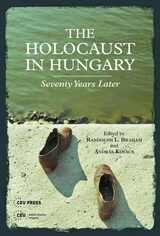
The Holocaust in Hungary
Seventy Years LaterRandolph L. Braham
Central European University Press, 2016
According to most historians, the Holocaust in Hungary represented a unique chapter in the singular history of what the Nazis termed as the “Final Solution” of the “Jewish question” in Europe. More than seventy years after the Shoah, the origins and prehistory as well as the implementation and aftermath of the genocide still provide ample ground for scholarship. In fact, Hungarian historians began to seriously deal with these questions only after the 1980s. Since then, however, a consistently active and productive debate has been waged about the history and interpretation of the Holocaust in Hungary and with the passage of time, more and more questions have been raised in connection with its memorialization. This volume includes twelve selected scholarly papers thematically organized under four headings: 1. The newest trends in the study of the Holocaust in Hungary. 2. The anti-Jewish policies of Hungary during the interwar period 3. The Holocaust era in Hungary 4. National and international aspects of Holocaust remembrance. The studies reflect on the anti-Jewish atmosphere in Hungary during the interwar period; analyze the decision-making process that led to the deportations, and the options left open to the Hungarian government. They also provide a detailed presentation of the Holocaust in Transylvania and describe the experience of Hungarian Jewish refugees in Austria after the end of the war.
[more]
The Secret Protocol
The Molotov-Ribbentrop Pact and the Falsification of HistoryAntonella Salomoni, Translated by Antony Shugaar
University of Wisconsin Press, 2025
In 1939, the Soviet Union and Germany agreed to a nonaggression treaty named for its signatories, foreign ministers Vyacheslav Molotov and Joachim von Ribbentrop. Kept hidden from the public was an addendum to the Molotov-Ribbentrop Pact, a “secret protocol” whose existence was denied by the Soviet Union until 1992. It defined new borders for German and Soviet spheres of influence, effectively preparing for the partition of Poland, the Baltic states, and Bessarabia. Shortly after signing on August 23, 1939, both the USSR and Nazi Germany invaded Poland. In this volume, Antonella Salomoni scrutinizes this consequential document and its afterlives, focusing predominantly on the discourse that surrounded it.
From the moment of the secret protocol’s inception—and the near-instantaneous rumors of its existence—it generated friction and competing narratives. The document became public during the Nuremberg trials, but the USSR declared it a fabrication evidencing the West’s willingness to falsify history. It continues to be relevant to the reconfiguration of history currently advanced by Vladimir Putin. By centering the rumors, accusations, and propaganda the pact precipitated, Salomoni illuminates how political actors can use and abuse history, how they create and disseminate truths and falsehoods, and how they can blur the boundary between facts and fictions even in the glaring face of black-and-white documentation.
From the moment of the secret protocol’s inception—and the near-instantaneous rumors of its existence—it generated friction and competing narratives. The document became public during the Nuremberg trials, but the USSR declared it a fabrication evidencing the West’s willingness to falsify history. It continues to be relevant to the reconfiguration of history currently advanced by Vladimir Putin. By centering the rumors, accusations, and propaganda the pact precipitated, Salomoni illuminates how political actors can use and abuse history, how they create and disseminate truths and falsehoods, and how they can blur the boundary between facts and fictions even in the glaring face of black-and-white documentation.
[more]
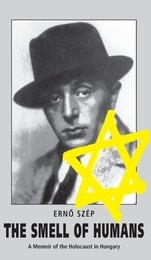
The Smell of Humans
A Memoir of the Holocaust in HungaryErno Szép
Central European University Press, 1994
Primarily a piece of creative writing and autobiographical literature of a very distinctive Central European kind, this detailed and imaginative short memoir is also an important document of the Holocaust in Hungary in 1944. Written by a master of twentieth-century Hungarian literature, it describes life for the Jewish population of German-occupied Budapest—the constant fear of deportation overshadowing the daily trials of living in the ghetto—before concentrating on the writer's own internment in a labor camp during the first weeks of rule by the extremist Arrow Cross regime. The experiences of those nineteen days spent in the camp are both harsh and disturbing, yet throughout his memoir Szep manages to maintain an extraordinary degree of compassion and detachment, even humor. Published to coincide with the fiftieth anniversary of the events described, this is the last of Szep's many literary works to appear in English."
[more]
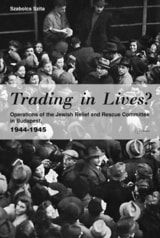
Trading in Lives?
Operations of the Jewish Relief and Rescue Committee in Budapest, 1944-1945Szabolcs Szita
Central European University Press, 2005
Set in the tumultuous moments of 1944–45 Budapest, this work discusses the operations of the Budapest Relief and Rescue Committee. Drawing out the contradictions and complexities of the mass deportations of Hungarian Jews during the final phase of World War II, Szita suggests that in the Hungarian context, a commerce in lives ensued, where prominent Zionists like Dr. Rezso Kasztner negotiated with the higher echelons of the SS, trying to garner the freedom of Hungarian Jews. Szita's portrait of the controversial Kasztner is a more sympathetic rendition of a powerful Zionist leader who was later assassinated in Israel for his dealings with Nazi leaders. Szita reveals a story of interweaving personalities and conflicts during arguably the most tragic moment in European history. The author's extensive research is a tremendous contribution to a field of study that has been much ignored by scholarship-the Hungarian holocaust and the trade in human lives.
[more]
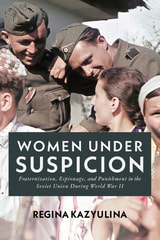
Women Under Suspicion
Fraternization, Espionage, and Punishment in the Soviet Union During World War IIRegina Kazyulina
University of Wisconsin Press, 2025
Officially, women in the Soviet Union enjoyed a degree of equality unknown elsewhere in Allied countries at the time. However, long-standing norms of gendered behavior and stereotypes that cast women as morally weak, politically fallible, and sexually tempting meant that women in the army or living behind enemy lines were viewed with skepticism, seen as weak points easily exploited by the enemy. Concerned about sabotage, espionage, and ideological corruption, authorities categorized women who fraternized with the enemy—or who were suspected of doing so—as “socially dangerous,” a uniquely Soviet legal designation that exposed the accused to prosecution, imprisonment, and exile. Even without official sanction, women rumored to be involved with German occupiers were reviled, and treated accordingly, by their neighbors. By reading official reports against the grain and incorporating rare personal documents, Kazyulina provides a multifaceted study of the realities for non-Jewish Soviet women—in the army or resistance, or at home in occupied territories—during and after Nazi occupation.
[more]