Results by title
3 books match the query 'Ecclesiastical law'
Law and Religion in a Secular Age
Rafael Domingo
Catholic University of America Press, 2023
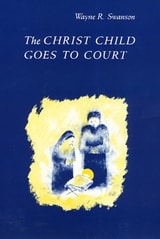
The Christ Child Goes to Court
Wayne R. Swanson
Temple University Press, 1992
In December 1981, when the American Civil Liberties Union challenged the Nativity scene in the Christmas display put on by the city of Pawtucket, Rhode Island, an emotional controversy erupted. Two federal courts disallowed the crèche because its religious impact in the taxpayer-supported display overstepped the constitutional boundary between church and state. In March 1984, the United States Supreme Court by a 5-4 vote in Lynch V. Donnelly overruled the lower courts, deciding that in the predominantly secular context of Pawtucket’s display, the purpose and effect of the Nativity scene was not to promote religion, but only to acknowledge the spirit of the holiday season. The Christ Child Goes to Court traces the judicial history of a case that lasted more than two years and explores its implications for future issues concerning the relationship between religion and government.
Wayne R. Swanson describes how this compelling constitutional issue polarized public opinion in Rhode Island and generated "unimaginable vilification" of the Roman Catholic judge who first ordered the crèche removed. He reports the reactions of local citizens, which echoed the national debate on this issue. By carefully documenting the case’s trek through the judiciary, Swanson illustrates the workings of the judicial process in the United States, the political nature of the courts, and how their interpretation of the Constitution helps to shape the development of public policy.
An important conclusion of this critical examination of the courts’ approach to a controversial church-state question is that judicial decisions are usually interim in nature and often lead to imperfect solutions. Lynch V. Donnelly did not solve the problems posed by government-supported Nativity scenes or other religious symbols. The controversy lives on and the courts continue to struggle with one of the most difficult First Amendment problems.

What Brings a Marriage into Existence?
An Historical Re-examination of the Canon Law of the Latin ChurchBrendan Killeen
University of Scranton Press, 2010
Of the seven sacraments of the Roman Catholic Church, matrimony is the most discussed, debated, disputed, and adjudicated in all of canon law. In this book, Brendan Killeen employs the fundamental question “What brings a marriage into existence?” as the legal and scholarly means to explore the very nature of marriage within the framework of the canon law of the Catholic Church.
Killeen conducts his exploration in two phases. First he scrutinizes the canon law’s primary sources—texts dating as far back as the Roman Empire—and gives readers a fresh perspective of the law’s historical progression. He then examines the papers from the Second Vatican Council and offers both an objective evaluation of the law at present and some possible amendments for its future.
Noteworthy for its diligent research and in-depth analysis, What Brings a Marriage into Existence? will be useful to both newcomers to the canon law of marriage as well as seasoned scholars.