Results by title
8 books match the query 'Eclipse'
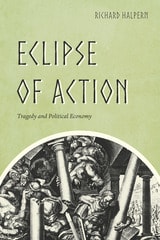
Eclipse of Action
Tragedy and Political EconomyRichard Halpern
University of Chicago Press, 2017
Since Aristotle, tragedy has been seen as uniquely exhibiting the importance of action for human happiness. Beginning with Adam Smith, however, political economy has claimed that the source of happiness is primarily production. Eclipse of Action examines the tense relations between action and production, doing and making, in playwrights from Aeschylus, Marlowe, Shakespeare, and Milton to Beckett, Arthur Miller, and Sarah Kane. Richard Halpern places these figures in conversation with works by Aristotle, Smith, Hegel, Marx, Hannah Arendt, Georges Bataille, and others in order to trace the long history of the ways in which economic thought and tragic drama interact.
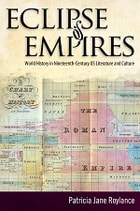
Eclipse of Empires
World History in Nineteenth-Century U.S. Literature and CulturePatricia Jane Roylance
University of Alabama Press, 2013
Patricia Jane Roylance’s central claim in Eclipse of Empires is that historical episodes of imperial eclipse, for example Incan Peru yielding to Spain or the Ojibway to the French, heightened the concerns of many American writers about specific intranational social problems plaguing the nation at the time—race, class, gender, religion, economics. Given the eventual dissolution of great civilizations previously plagued by these very same problems, many writers, unlike those who confidently emphasized U.S. exceptionalism, exhibited both an anxiety about the stability of American society and a consistent practice of self-scrutiny in identifying the national defects that they felt could precipitate America’s decline.
Roylance studies, among other texts, James Fenimore Cooper’s The Water-Witch (1830) and The Bravo (1831), which address the eclipse of Venice by New York City as a maritime power in the eighteenth century; William Hickling Prescott’s Conquest of Peru (1847), which responds to widespread anxiety about communist and abolitionist threats to the U.S. system of personal property by depicting Incan culture as a protocommunist society doomed to failure; and Henry Wadsworth Longfellow’s The Song of Hiawatha (1855), which resists the total eclipse of Ojibwa culture by incorporating Ojibway terms and stories into his poem and by depicting the land as permanently marked by their occupation.

Eclipse of the Assassins
The CIA, Imperial Politics, and the Slaying of Mexican Journalist Manuel BuendíaRussell H. Bartley and Sylvia Erickson Bartley
University of Wisconsin Press, 2015
Authors Russell and Sylvia Bartley shed new light on the U.S.-instigated “dirty wars” that ravaged all of Latin America in the 1960s, ’70s, and ’80s and reveal—for the first time—how Mexican officials colluded with Washington in its proxy contra war against the Sandinista government of Nicaragua. They draw together the strands of a clandestine web linking:
- the assassination of prominent Mexican journalist Manuel Buendía
- the torture and murder of U.S. Drug Enforcement Administration agent Enrique Camarena
- the Iran-Contra scandal
- a major DEA sting against key CIA-linked Bolivian, Panamanian, and Mexican drug traffickers
- CIA-orchestrated suppression of investigative journalists
- criminal collusion of successive U.S. and Mexican administrations that has resulted in the unprecedented power of drug kingpins like “El Chapo” Guzmán.
Best books for public & secondary school libraries from university presses, American Library Association
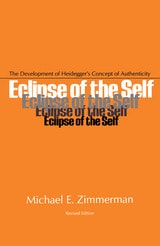
Eclipse of the Self
The Development of Heidegger’s Concept of AuthenticityMichael E. Zimmerman
Ohio University Press, 1986
Although it is sometimes said that Martin Heidegger’s later philosophy no longer concerned itself with the theme of authenticity so crucial to Being and Time (1927), this book argues that his interest in authenticity was always strong.
After leaving the seminary to become a philosophy student, Heidegger began to “de–mythologize” religious themes for his own philosophical purposes. Like the Christian notion of faith, Heidegger’s notion of authenticity involves relinquishing the egotistical self–understanding which blocks our openness for possibilities. Yet authenticity as “resoluteness” includes an element of voluntarism foreign to the idea of faith. Heidegger’s brief engagement with National Socialism (1933–1934) helped him to re–think the Nietzschean concept of will which had influenced his early views on authenticity. Although part of the meaning of resoluteness is to allow things to be revealed, it also suggests that an individual can somehow will to be authentic. After about 1936, Heidegger emphasized that an individual can only be released from egoism (inauthenticity) by a power which transcends him. The abiding theological issue concerning the efficacy of works as against the saving power of grace finds expression in the distinction between resoluteness and releasement.

Eclipse of the Sun
Boxing PoemsRed Shuttleworth
University of Nevada Press, 2023
In this striking poetry collection, Red Shuttleworth, who holds the record as the oldest active boxer (professional or amateur), offers evocative imagery that unapologetically reveals the life of a boxer. From the inspiring hopes of an early career to agonizing defeats, the poems in Eclipse of the Sun take readers on a journey from moderate successes to the realization that a dream of a promising future has become the reality of the long haul of a journeyman. Along the way, Shuttleworth rubs elbows with greats like Muhammad Ali, Chickie Ferrara, and Ron Lyle, exposing the resolute path and difficult end of a hard-lived life.
This collection is an homage to boxing at its grittiest levels, and to fighters who persevere—with hope, blood, and bone—against sense and loss. Few professional boxers earn a living in the ring, and even fewer arrive in their forties with any money left from their sport. In this collection, boxers attain poverty rather than riches, end up in post-career menial jobs, and have no pension plan to fall back on. Shuttleworth’s poetry is a visceral inside look at the brutality and humanity at the heart of boxing.
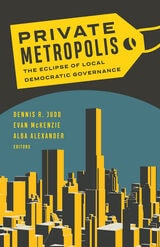
Private Metropolis
The Eclipse of Local Democratic GovernanceDennis R. Judd
University of Minnesota Press, 2021
Examines the complex ecology of quasi-public and privatized institutions that mobilize and administer many of the political, administrative, and fiscal resources of today’s metropolitan regions
In recent decades metropolitan regions in the United States have witnessed the rise of multitudes of “shadow governments” that often supersede or replace functions traditionally associated with municipalities and other local governments inherited from the urban past. Shadow governments take many forms, ranging from billion-dollar special authorities that span entire urban regions, to public–private partnerships and special districts created to accomplish particular tasks, to privatized gated communities, to neighborhood organizations empowered to receive private and public funds. They finance and administer public services ranging from the prosaic (garbage collection and water utilities) to the transformative (economic development and infrastructure). Private Metropolis demonstrates that this complex ecosystem of local governance has compromised and even eclipsed democratic processes by moving important policy decisions out of public sight.
The quasi-public institutions of urban governance generally escape the budgetary and statutory restraints imposed on traditional local governments and protect policy decisions from the limitations and vagaries of electoral politics. Moving major policy decisions into a privatized and corporatized realm facilitates efficiency and speed, but at the cost of democratic oversight. Increasingly, the urban electorate is left debating symbolic issues only tangentially connected to the actual distribution of the resources that affect people’s lives.
The essays in Private Metropolis grapple with the difficult and timely questions that arise from this new ecology of governance: What are the consequences of the proliferation of special authorities, privatized governments, and public–private arrangements? Is the trade-off between democratic accountability and efficiency worth it? Has the public sector, with its messiness and inefficiencies—but also its checks and balances—ceded too much power to these new institutions? By examining such questions, this book provokes a long-overdue debate about the future of urban governance.
Contributors: Douglas Cantor, California State U, Long Beach; Ellen Dannin, Pennsylvania State U; Jameson W. Doig, Princeton U; Mary Donoghue; Peter Eisinger, New School; Steven P. Erie, U of California, San Diego; Rebecca Hendrick, U of Illinois at Chicago; Sara Hinkley, U of California, Berkeley; Amanda Kass, U of Illinois at Chicago; Scott A. MacKenzie, U of California, Davis; David C. Perry, U of Illinois at Chicago; James M. Smith, U of Indiana South Bend; Shu Wang, Michigan State U; Rachel Weber, U of Illinois at Chicago.
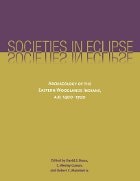
Societies in Eclipse
Archaeology of the Eastern Woodlands Indians, A.D. 1400-1700Edited by David S. Brose, C. Wesley Cowan, and Robert C. Mainfort
University of Alabama Press, 2001
After establishing the distribution of prehistoric and historic populations from the northeastern Appalachian forests to the southern trans-Mississippian prairies, the contributors consider the archaeological and cultural record of several specific groups, including Mohawk and Onondaga, Monacan, Coosa, and Calusa. For each, they present new evidence of cultural changes prior to European contact, including populations movements triggered by the Little Ice Age (AD 1550–1770), shifting exchange and warfare networks, geological restriction of effective maize subsistence, and use of empty hunting territories as buffers between politically unstable neighbors. The contributors also trace European influences, including the devastation caused by European-introduced epidemics and the paths of European trade goods that transformed existing Native American-exchange networks.
While the profound effects of European explorers, missionaries, and traders on Eastern Woodlands tribes cannot be denied, the archaeological evidence suggests that several indigenous societies were already in the process of redefinition prior to European contact. The essays gathered here show that, whether formed in response to natural or human forces, cultural change may be traced through archaeological artifacts, which play a critical role in answering current questions regarding cultural persistence.

The Eclipse I Call Father
Essays on AbsenceDavid Axelrod
Oregon State University Press, 2019
The essays in this collection grew from a ten-year period when the author found himself periodically living and working abroad, wondering why foreign landscapes haunted him more than the familiar landscapes of the inland Pacific Northwest he called home. Each place had a long history of habitation, but at home he was blind, unable to see past the surfaces of things. Axelrod examines many aspects of that phenomenon in these pages, framing surface realities and imagining the scale and scope of that surface, but also trying to sense what is absent or changed, and how, despite its absence, the unseen accretes to ever-greater densities and persists as something uncanny.
Curious, alert, and keenly observant, these essays probe the boundaries between what is here and what is gone, what is present and what is past, in elegant prose. Readers familiar with Axelrod’s poetry will find a new facet of his lyrical gifts, while those encountering his work for the first time will be richly rewarded by the discovery of this Northwest literary talent.