Results by title
3 books match the query 'Ecological Change'
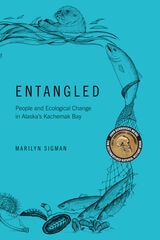
Entangled
People and Ecological Change in Alaska's Kachemak BayMarilyn Sigman
University of Alaska Press, 2018
Kachemak Bay is a place where people and the living resources they depend on have ebbed and flowed for thousands of years. The forces of the earth are dynamic here: they can change in an instant, shaking the ground beneath your feet or overturning kayaks in a rushing wave. Glaciers have advanced and receded over centuries. The climate, like the ocean, has shifted from warmer to colder and back again in a matter of decades. The ocean food web has been shuffled from bottom to top again and again.
In Entangled, Sigman contemplates the patterns of people staying and leaving, of settlement and displacement, nesting her own journey to Kachemak Bay within diasporas of her Jewish ancestors and of ancient peoples from Asia to the southern coast of Alaska. Along the way she weaves in scientific facts about the region as well as the stories told by Alaska’s indigenous peoples. It is a rhapsodic introduction to this stunning region and a siren call to protect the land’s natural resources in the face of a warming, changing world.
Performing Environmentalisms
Expressive Culture and Ecological ChangeEdited by John Holmes McDowell, Katherine Borland, Rebecca Dirksen, and Sue Tuohy
University of Illinois Press, 2021
Interdisciplinary in approach and wide-ranging in scope, Performing Environmentalisms is an engaging look at the merger of cultural expression and environmental action on the front lines of today's global emergency.
Contributors: Aaron S. Allen, Eduardo S. Brondizio, Assefa Tefera Dibaba, Rebecca Dirksen, Mary Hufford, John Holmes McDowell, Mark Pedelty, Jennifer C. Post, Chie Sakakibara, Jeff Todd Titon, Rory Turner, Lois Wilcken
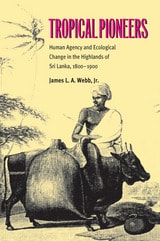
Tropical Pioneers
Human Agency and Ecological Change in the Highlands of Sri Lanka, 1800–1900James L. A. Webb Jr.
Ohio University Press, 2002
In 1800, the highlands of Sri Lanka had some of the most biologically diverse primary tropical rainforest ecosystems in the world. By 1900, only a few craggy corners and mountain caps had been spared the fire stick. Highland villagers, through the extension of slash-and-burn agriculture, and British managers, through the creation of plantations—first of coffee, then cinchona, and finally tea—had removed virtually the entire primary forest cover.
Tropical Pioneers documents the conversion of a tropical rainforest biome and the collision between what previously had been more discrete ecological zones within South Asia. The ecological impacts were transformational. Author James L. A. Webb, Jr., demonstrates that profound ecological disruption occurred in the central highlands of Sri Lanka during the nineteenth century and suggests that the theme of ecological crisis brought about by the integration of tropical ecological zones during precolonial and colonial periods alike is an important one for historians to investigate elsewhere.
Tropical Pioneers is based on extensive research in the National Archives of Sri Lanka, the National Agricultural Library at Gannaruwa, the Library of the Royal Asiatic Society-Ceylon Branch, the Royal Botanic Gardens at Kew, the Public Record Office of the United Kingdom, and the British Library.