Results by title

17 books match the query 'Ecological and Evolutionary Physiology'
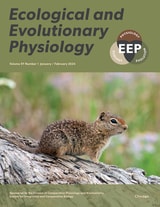
cover of Ecological and Evolutionary Physiology, volume 97 number 1 (January/February 2024)

Ecological and Evolutionary Physiology, volume 97 number 1 (January/February 2024)

The University of Chicago Press

University of Chicago Press Journals, 2024
This is volume 97 issue 1 of Ecological and Evolutionary Physiology. Ecological and Evolutionary Physiology primarily publishes original research in physiological ecology, ecophysiology, comparative physiology, and evolutionary physiology. Studies at all levels of biological organization from the molecular to the whole organism are welcome, and work that integrates across levels of organization is particularly encouraged. Studies that focus on behavior or morphology are welcome, so long as they include ties to physiology or biochemistry, in addition to having an ecological or evolutionary context. Subdisciplines of interest include nutrition and digestion, salt and water balance, epithelial and membrane transport, gas exchange and transport, acid-base balance, temperature adaptation, energetics, structure and function of macromolecules, chemical coordination and signal transduction, nitrogen metabolism and excretion, locomotion and muscle function, biomechanics, circulation, behavioral, comparative and mechanistic endocrinology, sensory physiology, neural coordination, and ecotoxicology ecoimmunology.
[more]
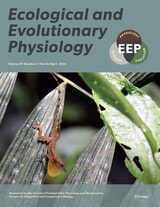
cover of Ecological and Evolutionary Physiology, volume 97 number 2 (March/April 2024)

Ecological and Evolutionary Physiology, volume 97 number 2 (March/April 2024)

The University of Chicago Press

University of Chicago Press Journals, 2024
This is volume 97 issue 2 of Ecological and Evolutionary Physiology. Ecological and Evolutionary Physiology primarily publishes original research in physiological ecology, ecophysiology, comparative physiology, and evolutionary physiology. Studies at all levels of biological organization from the molecular to the whole organism are welcome, and work that integrates across levels of organization is particularly encouraged. Studies that focus on behavior or morphology are welcome, so long as they include ties to physiology or biochemistry, in addition to having an ecological or evolutionary context. Subdisciplines of interest include nutrition and digestion, salt and water balance, epithelial and membrane transport, gas exchange and transport, acid-base balance, temperature adaptation, energetics, structure and function of macromolecules, chemical coordination and signal transduction, nitrogen metabolism and excretion, locomotion and muscle function, biomechanics, circulation, behavioral, comparative and mechanistic endocrinology, sensory physiology, neural coordination, and ecotoxicology ecoimmunology.
[more]
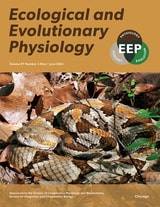
cover of Ecological and Evolutionary Physiology, volume 97 number 3 (May/June 2024)

Ecological and Evolutionary Physiology, volume 97 number 3 (May/June 2024)

The University of Chicago Press

University of Chicago Press Journals, 2024
This is volume 97 issue 3 of Ecological and Evolutionary Physiology. Ecological and Evolutionary Physiology primarily publishes original research in physiological ecology, ecophysiology, comparative physiology, and evolutionary physiology. Studies at all levels of biological organization from the molecular to the whole organism are welcome, and work that integrates across levels of organization is particularly encouraged. Studies that focus on behavior or morphology are welcome, so long as they include ties to physiology or biochemistry, in addition to having an ecological or evolutionary context. Subdisciplines of interest include nutrition and digestion, salt and water balance, epithelial and membrane transport, gas exchange and transport, acid-base balance, temperature adaptation, energetics, structure and function of macromolecules, chemical coordination and signal transduction, nitrogen metabolism and excretion, locomotion and muscle function, biomechanics, circulation, behavioral, comparative and mechanistic endocrinology, sensory physiology, neural coordination, and ecotoxicology ecoimmunology.
[more]
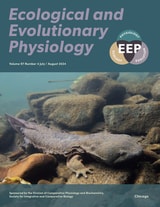
cover of Ecological and Evolutionary Physiology, volume 97 number 4 (July/August 2024)

Ecological and Evolutionary Physiology, volume 97 number 4 (July/August 2024)

The University of Chicago Press

University of Chicago Press Journals, 2024
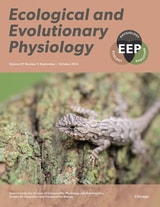
This is volume 97 issue 4 of Ecological and Evolutionary Physiology. Ecological and Evolutionary Physiology primarily publishes original research in physiological ecology, ecophysiology, comparative physiology, and evolutionary physiology. Studies at all levels of biological organization from the molecular to the whole organism are welcome, and work that integrates across levels of organization is particularly encouraged. Studies that focus on behavior or morphology are welcome, so long as they include ties to physiology or biochemistry, in addition to having an ecological or evolutionary context. Subdisciplines of interest include nutrition and digestion, salt and water balance, epithelial and membrane transport, gas exchange and transport, acid-base balance, temperature adaptation, energetics, structure and function of macromolecules, chemical coordination and signal transduction, nitrogen metabolism and excretion, locomotion and muscle function, biomechanics, circulation, behavioral, comparative and mechanistic endocrinology, sensory physiology, neural coordination, and ecotoxicology ecoimmunology.
[more]
cover of Ecological and Evolutionary Physiology, volume 97 number 5 (September/October 2024)

Ecological and Evolutionary Physiology, volume 97 number 5 (September/October 2024)

The University of Chicago Press

University of Chicago Press Journals, 2024
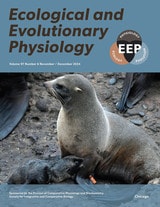
This is volume 97 issue 5 of Ecological and Evolutionary Physiology. Ecological and Evolutionary Physiology primarily publishes original research in physiological ecology, ecophysiology, comparative physiology, and evolutionary physiology. Studies at all levels of biological organization from the molecular to the whole organism are welcome, and work that integrates across levels of organization is particularly encouraged. Studies that focus on behavior or morphology are welcome, so long as they include ties to physiology or biochemistry, in addition to having an ecological or evolutionary context. Subdisciplines of interest include nutrition and digestion, salt and water balance, epithelial and membrane transport, gas exchange and transport, acid-base balance, temperature adaptation, energetics, structure and function of macromolecules, chemical coordination and signal transduction, nitrogen metabolism and excretion, locomotion and muscle function, biomechanics, circulation, behavioral, comparative and mechanistic endocrinology, sensory physiology, neural coordination, and ecotoxicology ecoimmunology.
[more]
cover of Ecological and Evolutionary Physiology, volume 97 number 6 (November/December 2024)

Ecological and Evolutionary Physiology, volume 97 number 6 (November/December 2024)

The University of Chicago Press

University of Chicago Press Journals, 2024
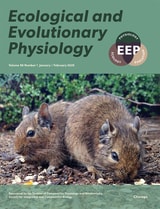
This is volume 97 issue 6 of Ecological and Evolutionary Physiology. Ecological and Evolutionary Physiology primarily publishes original research in physiological ecology, ecophysiology, comparative physiology, and evolutionary physiology. Studies at all levels of biological organization from the molecular to the whole organism are welcome, and work that integrates across levels of organization is particularly encouraged. Studies that focus on behavior or morphology are welcome, so long as they include ties to physiology or biochemistry, in addition to having an ecological or evolutionary context. Subdisciplines of interest include nutrition and digestion, salt and water balance, epithelial and membrane transport, gas exchange and transport, acid-base balance, temperature adaptation, energetics, structure and function of macromolecules, chemical coordination and signal transduction, nitrogen metabolism and excretion, locomotion and muscle function, biomechanics, circulation, behavioral, comparative and mechanistic endocrinology, sensory physiology, neural coordination, and ecotoxicology ecoimmunology.
[more]
cover of Ecological and Evolutionary Physiology, volume 98 number 1 (January/February 2025)

Ecological and Evolutionary Physiology, volume 98 number 1 (January/February 2025)

The University of Chicago Press

University of Chicago Press Journals, 2025
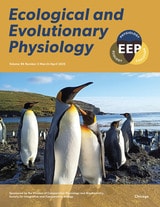
This is volume 98 issue 1 of Ecological and Evolutionary Physiology. Ecological and Evolutionary Physiology primarily publishes original research in physiological ecology, ecophysiology, comparative physiology, and evolutionary physiology. Studies at all levels of biological organization from the molecular to the whole organism are welcome, and work that integrates across levels of organization is particularly encouraged. Studies that focus on behavior or morphology are welcome, so long as they include ties to physiology or biochemistry, in addition to having an ecological or evolutionary context. Subdisciplines of interest include nutrition and digestion, salt and water balance, epithelial and membrane transport, gas exchange and transport, acid-base balance, temperature adaptation, energetics, structure and function of macromolecules, chemical coordination and signal transduction, nitrogen metabolism and excretion, locomotion and muscle function, biomechanics, circulation, behavioral, comparative and mechanistic endocrinology, sensory physiology, neural coordination, and ecotoxicology ecoimmunology.
[more]
cover of Ecological and Evolutionary Physiology, volume 98 number 2 (March/April 2025)

Ecological and Evolutionary Physiology, volume 98 number 2 (March/April 2025)

The University of Chicago Press

University of Chicago Press Journals, 2025

This is volume 98 issue 2 of Ecological and Evolutionary Physiology. Ecological and Evolutionary Physiology primarily publishes original research in physiological ecology, ecophysiology, comparative physiology, and evolutionary physiology. Studies at all levels of biological organization from the molecular to the whole organism are welcome, and work that integrates across levels of organization is particularly encouraged. Studies that focus on behavior or morphology are welcome, so long as they include ties to physiology or biochemistry, in addition to having an ecological or evolutionary context. Subdisciplines of interest include nutrition and digestion, salt and water balance, epithelial and membrane transport, gas exchange and transport, acid-base balance, temperature adaptation, energetics, structure and function of macromolecules, chemical coordination and signal transduction, nitrogen metabolism and excretion, locomotion and muscle function, biomechanics, circulation, behavioral, comparative and mechanistic endocrinology, sensory physiology, neural coordination, and ecotoxicology ecoimmunology.
[more]
cover of Ecological and Evolutionary Physiology, volume 98 number 3 (May/June 2025)

Ecological and Evolutionary Physiology, volume 98 number 3 (May/June 2025)

The University of Chicago Press

University of Chicago Press Journals, 2025
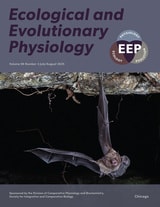
This is volume 98 issue 3 of Ecological and Evolutionary Physiology. Ecological and Evolutionary Physiology primarily publishes original research in physiological ecology, ecophysiology, comparative physiology, and evolutionary physiology. Studies at all levels of biological organization from the molecular to the whole organism are welcome, and work that integrates across levels of organization is particularly encouraged. Studies that focus on behavior or morphology are welcome, so long as they include ties to physiology or biochemistry, in addition to having an ecological or evolutionary context. Subdisciplines of interest include nutrition and digestion, salt and water balance, epithelial and membrane transport, gas exchange and transport, acid-base balance, temperature adaptation, energetics, structure and function of macromolecules, chemical coordination and signal transduction, nitrogen metabolism and excretion, locomotion and muscle function, biomechanics, circulation, behavioral, comparative and mechanistic endocrinology, sensory physiology, neural coordination, and ecotoxicology ecoimmunology.
[more]
cover of Ecological and Evolutionary Physiology, volume 98 number 4 (July/August 2025)

Ecological and Evolutionary Physiology, volume 98 number 4 (July/August 2025)

The University of Chicago Press

University of Chicago Press Journals, 2025
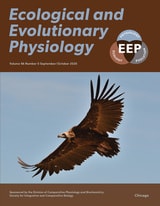
This is volume 98 issue 4 of Ecological and Evolutionary Physiology. Ecological and Evolutionary Physiology primarily publishes original research in physiological ecology, ecophysiology, comparative physiology, and evolutionary physiology. Studies at all levels of biological organization from the molecular to the whole organism are welcome, and work that integrates across levels of organization is particularly encouraged. Studies that focus on behavior or morphology are welcome, so long as they include ties to physiology or biochemistry, in addition to having an ecological or evolutionary context. Subdisciplines of interest include nutrition and digestion, salt and water balance, epithelial and membrane transport, gas exchange and transport, acid-base balance, temperature adaptation, energetics, structure and function of macromolecules, chemical coordination and signal transduction, nitrogen metabolism and excretion, locomotion and muscle function, biomechanics, circulation, behavioral, comparative and mechanistic endocrinology, sensory physiology, neural coordination, and ecotoxicology ecoimmunology.
[more]
cover of Ecological and Evolutionary Physiology, volume 98 number 5 (September/October 2025)

Ecological and Evolutionary Physiology, volume 98 number 5 (September/October 2025)

The University of Chicago Press

University of Chicago Press Journals, 2025
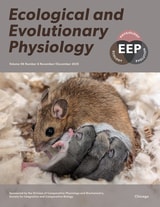
This is volume 98 issue 5 of Ecological and Evolutionary Physiology. Ecological and Evolutionary Physiology primarily publishes original research in physiological ecology, ecophysiology, comparative physiology, and evolutionary physiology. Studies at all levels of biological organization from the molecular to the whole organism are welcome, and work that integrates across levels of organization is particularly encouraged. Studies that focus on behavior or morphology are welcome, so long as they include ties to physiology or biochemistry, in addition to having an ecological or evolutionary context. Subdisciplines of interest include nutrition and digestion, salt and water balance, epithelial and membrane transport, gas exchange and transport, acid-base balance, temperature adaptation, energetics, structure and function of macromolecules, chemical coordination and signal transduction, nitrogen metabolism and excretion, locomotion and muscle function, biomechanics, circulation, behavioral, comparative and mechanistic endocrinology, sensory physiology, neural coordination, and ecotoxicology ecoimmunology.
[more]
cover of Ecological and Evolutionary Physiology, volume 98 number 6 (November/December 2025)

Ecological and Evolutionary Physiology, volume 98 number 6 (November/December 2025)

The University of Chicago Press

University of Chicago Press Journals, 2025
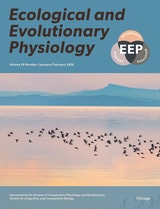
This is volume 98 issue 6 of Ecological and Evolutionary Physiology. Ecological and Evolutionary Physiology primarily publishes original research in physiological ecology, ecophysiology, comparative physiology, and evolutionary physiology. Studies at all levels of biological organization from the molecular to the whole organism are welcome, and work that integrates across levels of organization is particularly encouraged. Studies that focus on behavior or morphology are welcome, so long as they include ties to physiology or biochemistry, in addition to having an ecological or evolutionary context. Subdisciplines of interest include nutrition and digestion, salt and water balance, epithelial and membrane transport, gas exchange and transport, acid-base balance, temperature adaptation, energetics, structure and function of macromolecules, chemical coordination and signal transduction, nitrogen metabolism and excretion, locomotion and muscle function, biomechanics, circulation, behavioral, comparative and mechanistic endocrinology, sensory physiology, neural coordination, and ecotoxicology ecoimmunology.
[more]
cover of Ecological and Evolutionary Physiology, volume 99 number 1 (January/February 2026)

Ecological and Evolutionary Physiology, volume 99 number 1 (January/February 2026)

The University of Chicago Press

University of Chicago Press Journals, 2026
This is volume 99 issue 1 of Ecological and Evolutionary Physiology. Ecological and Evolutionary Physiology primarily publishes original research in physiological ecology, ecophysiology, comparative physiology, and evolutionary physiology. Studies at all levels of biological organization from the molecular to the whole organism are welcome, and work that integrates across levels of organization is particularly encouraged. Studies that focus on behavior or morphology are welcome, so long as they include ties to physiology or biochemistry, in addition to having an ecological or evolutionary context. Subdisciplines of interest include nutrition and digestion, salt and water balance, epithelial and membrane transport, gas exchange and transport, acid-base balance, temperature adaptation, energetics, structure and function of macromolecules, chemical coordination and signal transduction, nitrogen metabolism and excretion, locomotion and muscle function, biomechanics, circulation, behavioral, comparative and mechanistic endocrinology, sensory physiology, neural coordination, and ecotoxicology ecoimmunology.
[more]
cover of Ecological and Evolutionary Physiology, volume 99 number 2 (March/April 2026)

Ecological and Evolutionary Physiology, volume 99 number 2 (March/April 2026)

The University of Chicago Press

University of Chicago Press Journals, 2026
This is volume 99 issue 2 of Ecological and Evolutionary Physiology. Ecological and Evolutionary Physiology primarily publishes original research in physiological ecology, ecophysiology, comparative physiology, and evolutionary physiology. Studies at all levels of biological organization from the molecular to the whole organism are welcome, and work that integrates across levels of organization is particularly encouraged. Studies that focus on behavior or morphology are welcome, so long as they include ties to physiology or biochemistry, in addition to having an ecological or evolutionary context. Subdisciplines of interest include nutrition and digestion, salt and water balance, epithelial and membrane transport, gas exchange and transport, acid-base balance, temperature adaptation, energetics, structure and function of macromolecules, chemical coordination and signal transduction, nitrogen metabolism and excretion, locomotion and muscle function, biomechanics, circulation, behavioral, comparative and mechanistic endocrinology, sensory physiology, neural coordination, and ecotoxicology ecoimmunology.
[more]
cover of Ecological and Evolutionary Physiology, volume 99 number 3 (May/June 2026)

Ecological and Evolutionary Physiology, volume 99 number 3 (May/June 2026)

The University of Chicago Press

University of Chicago Press Journals, 2026
This is volume 99 issue 3 of Ecological and Evolutionary Physiology. Ecological and Evolutionary Physiology primarily publishes original research in physiological ecology, ecophysiology, comparative physiology, and evolutionary physiology. Studies at all levels of biological organization from the molecular to the whole organism are welcome, and work that integrates across levels of organization is particularly encouraged. Studies that focus on behavior or morphology are welcome, so long as they include ties to physiology or biochemistry, in addition to having an ecological or evolutionary context. Subdisciplines of interest include nutrition and digestion, salt and water balance, epithelial and membrane transport, gas exchange and transport, acid-base balance, temperature adaptation, energetics, structure and function of macromolecules, chemical coordination and signal transduction, nitrogen metabolism and excretion, locomotion and muscle function, biomechanics, circulation, behavioral, comparative and mechanistic endocrinology, sensory physiology, neural coordination, and ecotoxicology ecoimmunology.
[more]
cover of Ecological and Evolutionary Physiology, volume 99 number 4 (July/August 2026)

Ecological and Evolutionary Physiology, volume 99 number 4 (July/August 2026)

The University of Chicago Press

University of Chicago Press Journals, 2026
This is volume 99 issue 4 of Ecological and Evolutionary Physiology. Ecological and Evolutionary Physiology primarily publishes original research in physiological ecology, ecophysiology, comparative physiology, and evolutionary physiology. Studies at all levels of biological organization from the molecular to the whole organism are welcome, and work that integrates across levels of organization is particularly encouraged. Studies that focus on behavior or morphology are welcome, so long as they include ties to physiology or biochemistry, in addition to having an ecological or evolutionary context. Subdisciplines of interest include nutrition and digestion, salt and water balance, epithelial and membrane transport, gas exchange and transport, acid-base balance, temperature adaptation, energetics, structure and function of macromolecules, chemical coordination and signal transduction, nitrogen metabolism and excretion, locomotion and muscle function, biomechanics, circulation, behavioral, comparative and mechanistic endocrinology, sensory physiology, neural coordination, and ecotoxicology ecoimmunology.
[more]
cover of Ecological and Evolutionary Physiology, volume 99 number 5 (September/October 2026)

Ecological and Evolutionary Physiology, volume 99 number 5 (September/October 2026)

The University of Chicago Press

University of Chicago Press Journals, 2026

This is volume 99 issue 5 of Ecological and Evolutionary Physiology. Ecological and Evolutionary Physiology primarily publishes original research in physiological ecology, ecophysiology, comparative physiology, and evolutionary physiology. Studies at all levels of biological organization from the molecular to the whole organism are welcome, and work that integrates across levels of organization is particularly encouraged. Studies that focus on behavior or morphology are welcome, so long as they include ties to physiology or biochemistry, in addition to having an ecological or evolutionary context. Subdisciplines of interest include nutrition and digestion, salt and water balance, epithelial and membrane transport, gas exchange and transport, acid-base balance, temperature adaptation, energetics, structure and function of macromolecules, chemical coordination and signal transduction, nitrogen metabolism and excretion, locomotion and muscle function, biomechanics, circulation, behavioral, comparative and mechanistic endocrinology, sensory physiology, neural coordination, and ecotoxicology ecoimmunology.
[more]