Results by title
2 books match the query 'Economic Democracy'
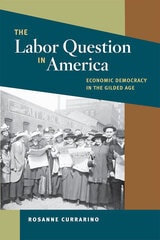
The Labor Question in America
Economic Democracy in the Gilded AgeRoseanne Currarino
University of Illinois Press, 2011
In The Labor Question in America: Economic Democracy in the Gilded Age, Rosanne Currarino traces the struggle to define the nature of democratic life in an era of industrial strife. As Americans confronted the glaring disparity between democracy's promises of independence and prosperity and the grim realities of economic want and wage labor, they asked, "What should constitute full participation in American society? What standard of living should citizens expect and demand?" Currarino traces the diverse efforts to answer to these questions, from the fledgling trade union movement to contests over immigration, from economic theory to popular literature, from legal debates to social reform. The contradictory answers that emerged--one stressing economic participation in a consumer society, the other emphasizing property ownership and self-reliance--remain pressing today as contemporary scholars, journalists, and social critics grapple with the meaning of democracy in post-industrial America.
[more]

The Politics of Money
Towards Sustainability and Economic DemocracyFrances Hutchinson, Mary Mellor, and Wendy Olsen
Pluto Press, 2002
On the whole, classical and radical economists have marginalised the role of money, most particularly the role of credit, in driving the machinery of accumulation and exclusion. Although critiques of capitalism from Marxist, feminist, ecological and many other perspectives abound, The Politics of Money is unique in gathering the strengths of these differing critiques into a coherent whole. The authors have drawn upon their varied expertise in economics and the social sciences to produce the foundations of a new political economy that will enable communities to reconstruct their socio-economic fabric through social and political control of money systems.
The book opens with a review of the role of money in current society, an overview of the history of money creation and a critique of the main theoretical developments in economic thought. Alternative perspectives on money are then presented through a review of a number of radical perspectives but focusing mainly on the work of Marx, Veblen and the social credit perspective of Douglas and the guild socialists. In the final part of the book contemporary monetary theories and experiments are analysed within the theoretical and historical perspectives provided in the earlier chapters. The main argument of the book is that it is necessary to understand the crucial role of finance in driving the 'free market' economy if a democratic and sustainable economy is to be achieved.
The book opens with a review of the role of money in current society, an overview of the history of money creation and a critique of the main theoretical developments in economic thought. Alternative perspectives on money are then presented through a review of a number of radical perspectives but focusing mainly on the work of Marx, Veblen and the social credit perspective of Douglas and the guild socialists. In the final part of the book contemporary monetary theories and experiments are analysed within the theoretical and historical perspectives provided in the earlier chapters. The main argument of the book is that it is necessary to understand the crucial role of finance in driving the 'free market' economy if a democratic and sustainable economy is to be achieved.
[more]