Results by title

7 books match the query 'Economic Theory'
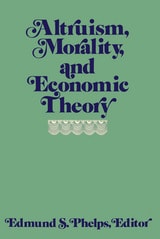
cover of Altruism, Morality, and Economic Theory

Altruism, Morality, and Economic Theory

Edmund S. Phelps

Russell Sage Foundation, 1975
Presents a collection of papers by economists theorizing on the roles of altruism and morality versus self-interest in the shaping of human behavior and institutions. Specifically, the authors examine why some persons behave in an altruistic way without any apparent reward, thus defying the economist's model of utility maximization. The chapters are accompanied by commentaries from representatives of other disciplines, including law and philosophy.
[more]
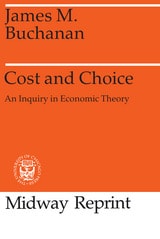
cover of Cost and Choice: An Inquiry in Economic Theory

Cost and Choice

An Inquiry in Economic Theory

James M. Buchanan

University of Chicago Press, 1979
"As he usually does, Professor Buchanan has produced an interesting and provocative piece of work. [Cost and Choice] starts off as an essay in the history of cost theory; the central ideas of the book are traced to Davenport and Knight in the United States, and to a series of distinguished writers associated at various times with the London School of Economics. The author emerges from this discussion with what can be described as the ultimate in subjectivist cost doctrines. . . . Economists should learn the lessons offered to us in this little book—and learn them well. It can save them from serious errors."—William J. Baumol, Journal of Economic Literature
[more]
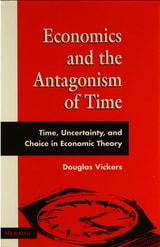
cover of Economics and the Antagonism of Time: Time, Uncertainty, and Choice in Economic Theory

Economics and the Antagonism of Time

Time, Uncertainty, and Choice in Economic Theory

Douglas Vickers

University of Michigan Press, 1994

Presenting a rigorous examination of the place and significance of time in economic theory, Douglas Vickers takes up the interrelated issues of uncertainty, ignorance, and criteria of choice. In the discussion of these questions he explains that the conventional thought-forms of probability are not generally applicable to theory-building in economics. To remedy this he provides a completely new paradigm of choice.The extent to which time has influenced, or been excluded from, economic theory is discussed on four levels: the banishment of time in general equilibrium theory; the incorporation of logical time, in pseudotemporal dynamic analysis in some widely adopted mathematically structured systems; the construction of ceteris paribus dynamics based on conventionally determined behavior; and the analysis of in-time economics, or the results of incorporating into economic theorizing historic time, ignorance, and uncertainty in a nonprobabilistic sense. A scheme of choice and decision making is presented that incorporates the concept of “potential surprise” in place of probability.Economic theorists and scholars in related disciplines will appreciate the originality of the book’s critique of the neoclassical system; its tracing of some of the most relevant intellectual history that sets off the traditions of Keynes and the post-Keynesians from the neoclassical system; the clarification of the meaning of—and the dissent from—probability theorizing in economics; and the treatment of the relevant epistemological foundations of the subject.
[more]
cover of Game and Economic Theory: Selected Contributions in Honor of Robert J. Aumann

Game and Economic Theory

Selected Contributions in Honor of Robert J. Aumann

Sergiu Hart and Abraham Neyman, Editors

University of Michigan Press, 1995

Game and Economic Theory studies the interactions of decision makers whose decisions affect each other. The analysis is from a rational viewpoint: every participant would like to obtain the outcome that he prefers most. However, each one has to take into account that the others are doing the same--trying to get what they prefer most. At times this leads to fierce competition; at other times, to mutually beneficial cooperation; and in general, to an appropriate combination of these two extreme behaviors. Game theory, which may be viewed as a sort of "unified field" theory for the rational side of social science, develops the theoretical foundations for the analysis of such multi-person interactive situations, and then applies these to many disciplines: economics, political science, biology, psychology. computer science, statistics and law. Foremost among these is economic theory, where game theory is playing a central role.
This volume consists of twenty-two selected contributions to various areas of game and economic theory. These important and pathbreaking contributions are all by former students of Robert J. Aumann, to whom this volume is dedicated. The volume will no doubt shed light on the far-reaching pertinence of game theory and its application to economics, and also on the monumental impact of Aumann on this discipline.
Sergiu Hart is Alice Kusiel de Vorreuter Professor of Mathematical Economics and Director of the Center for Rationality and Interactive Decision Theory, The Hebrew University of Jerusalem. Abraham Neyman is Professor of Mathematics, The Hebrew University of Jerusalem, and Leading Professor of Economics and Mathematics, State University of New York at Stony Brook.
[more]
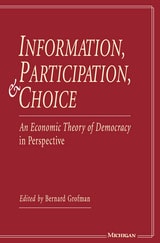
cover of Information, Participation, and Choice: An Economic Theory of Democracy in Perspective

Information, Participation, and Choice

An Economic Theory of Democracy in Perspective

Bernard Grofman, Editor

University of Michigan Press, 1993

Anthony Downs's An Economic Theory of Democracy is one of the handful of books that reshaped political science in the post-World War II period. Information, Participation, and Choice traces the influence of Downs's ideas on subsequent research on voters, candidates, and parties in the United States and elsewhere. Since their publication in 1957, Downs's seminal ideas -- tweedledum and tweedledee politics and the "rationality" of political ignorance and nonparticipation on the part of voters--have shaped an ongoing debate about how politics actually work. The debate pits a public-choice model inspired by microeconomic precepts against a traditional textbook model that presumes a responsible, informed, and civic-minded citizenry and a set of elected officials motivated by concern for the public interest and policy convictions. The essays comprising Information, Participation, and Choice, by leading political scientists and economists, provide both a summary of Downs's key theoretical insights and an empirical examination of how well models inspired by Downs accurately describe U.S. political competition for Congress and the presidency.
[more]
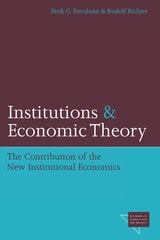
cover of Institutions and Economic Theory: The Contribution of the New Institutional Economics

Institutions and Economic Theory

The Contribution of the New Institutional Economics

Eirik Furubotn and Rudolf Richter

University of Michigan Press, 2005

This second edition assesses some of the major refinements, extensions, and useful applications that have developed in neoinstitutionalist thought in recent years. More attention is given to the overlap between the New Institutional Economics and developments in economic history and political science. In addition to updated references, new material includes analysis of parallel developments in the field of economic sociology and its attacks on representatives of the NIE as well as an explanation of the institution-as-an-equilibrium-of-game approach.

Already an international best seller, Institutions and Economic Theory is essential reading for economists and students attracted to the NIE approach. Scholars from such disciplines as political science, sociology, and law will find the work useful as the NIE continues to gain wide academic acceptance. A useful glossary for students is included.

Eirik Furubotn is Honorary Professor of Economics, Co-Director of the Center for New Institutional Economics, University of Saarland, Germany and Research Fellow, Private Enterprise Research Center, Texas A&M University.

Rudolph Richter is Professor Emeritus of Economics and Director of the Center for New Institutional Economics, University of Saarland, Germany.

[more]
cover of On the Economic Theory of Socialism

On the Economic Theory of Socialism

Oskar Lange

University of Minnesota Press, 1938

On the Economic Theory of Socialism was first published in 1938. Minnesota Archive Editions uses digital technology to make long-unavailable books once again accessible, and are published unaltered from the original University of Minnesota Press editions.Is socialism workable on economic grounds? “No,” say the chief European critics of socialism – von Mises, Robbins, and von Hayek. “Yes,” say Lange and Taylor in these two papers – the first refutation in English of the objections of these economists.There has been consistent demand for this book since it went out of print in 1944. This reprint is in response to that demand.
[more]