Results by title
6 books match the query 'Economic man'
Beyond Economic Man
Feminist Theory and EconomicsEdited by Marianne A. Ferber and Julie A. Nelson
University of Chicago Press, 1993
Beyond Economic Man raises questions about the discipline not because economics is too objective but because it is not objective enough. The contributors—nine economists, a sociologist, and a philosopher—discuss the extent to which gender has influenced both the range of subjects economists have studied and the way in which scholars have conducted their studies. They investigate, for example, how masculine concerns underlie economists' concentration on market as opposed to household activities and their emphasis on individual choice to the exclusion of social constraints on choice. This focus on masculine interests, the contributors contend, has biased the definition and boundaries of the discipline, its central assumptions, and its preferred rhetoric and methods. However, the aim of this book is not to reject current economic practices, but to broaden them, permitting a fuller understanding of economic phenomena.
These essays examine current economic practices in the light of a feminist understanding of gender differences as socially constructed rather than based on essential male and female characteristics. The authors use this concept of gender, along with feminist readings of rhetoric and the history of science, as well as postmodernist theory and personal experience as economists, to analyze the boundaries, assumptions, and methods of neoclassical, socialist, and institutionalist economics.
The contributors are Rebecca M. Blank, Paula England, Marianne A. Ferber, Nancy Folbre, Ann L. Jennings, Helen E. Longino, Donald N. McCloskey, Julie A. Nelson, Robert M. Solow, Diana Strassmann, and Rhonda M. Williams.
Economics as a Social Science
An Approach to Nonautistic TheoryAndrew M. Kamarck
University of Michigan Press, 2002
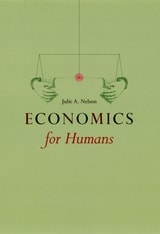
Economics for Humans
Julie A. Nelson
University of Chicago Press, 2006
At its core, an economy is about providing goods and services for human well-being. But many economists and critics preach that an economy is something far different: a cold and heartless system that operates outside of human control. In this impassioned and perceptive work, Julie A. Nelson asks a compelling question: If our economic world is something that we as humans create, aren’t ethics and human relationships—dimensions of a full and rich life—intrinsically part of the picture? Is it possible to take this thing we call economics and give it a body and a soul?
Economics for Humans argues against the well-ingrained notion that economics is immune to moral values and distant from human relationships. Here, Nelson locates the impediment to envisioning a more considerate economic world in an assumption that is shared by both neoliberals and the political left. Despite their seemingly insurmountable differences, Nelson notes that they both make use of the metaphor, first proposed by Adam Smith, that the economy is a machine. This pervasive idea, Nelson argues, has blinded us to the qualities that make us work and care for one another—qualities that also make businesses thrive and markets grow. We can wed our interest in money with our justifiable concerns about ethics and social well-being. And we can do so if we recognize that an economy is not a machine, but a living, beating heart that circulates blood to all parts of the body while also serving as an emblem of compassion and care.
Nothing less than a manifesto, Economics for Humans will both invigorate and inspire readers to reshape the way they view the economy, its possibilities, and their place within it.
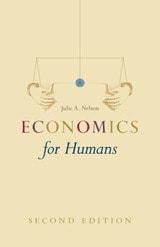
Economics for Humans, Second Edition
Julie A. Nelson
University of Chicago Press, 2018
Economics for Humans argues against the well-ingrained notion that economics is immune to moral values and distant from human relationships. Here, Nelson locates the impediment to a more considerate economic world in an assumption that is shared by both neoliberals and the political left. Despite their seemingly insurmountable differences, both make use of the metaphor, first proposed by Adam Smith, that the economy is a machine. This pervasive idea, Nelson argues, has blinded us to the qualities that make us work and care for one another—qualities that also make businesses thrive and markets grow. We can wed our interest in money with our justifiable concerns about ethics and social well-being. And we can do so if we recognize that an economy is not a machine, but a living thing in need of attention and careful tending.
This second edition has been updated and refined throughout, with expanded discussions of many topics and a new chapter that investigates the apparent conflict between economic well-being and ecological sustainability. Further developing the main points of the first edition, Economics for Humans will continue to both invigorate and inspire readers to reshape the way they view the economy, its possibilities, and their place within it.
Feminist Economics Today
Beyond Economic ManEdited by Marianne A. Ferber and Julie A. Nelson
University of Chicago Press, 2003
From Pleasure Machines to Moral Communities
An Evolutionary Economics without Homo economicusGeoffrey M. Hodgson
University of Chicago Press, 2012
Are humans at their core seekers of their own pleasure or cooperative members of society? Paradoxically, they are both. Pleasure-seeking can take place only within the context of what works within a defined community, and central to any community are the evolved codes and principles guiding appropriate behavior, or morality. The complex interaction of morality and self-interest is at the heart of Geoffrey M. Hodgson’s approach to evolutionary economics, which is designed to bring about a better understanding of human behavior.