Results by title
3 books match the query 'Economist'
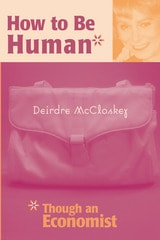
How to be Human*
*Though an EconomistDeirdre N. McCloskey
University of Michigan Press, 2000
In this thoroughly engaging book Deirdre McCloskey puts the "dismal science" under the microscope. She offers advice to young economists, offering models from the old; and she lambastes the middle-aged who have allowed economics to become, as she puts it with characteristic verve, "a boys' game in a sandbox." McCloskey deploys her wit and style to serious purpose: to bring economics back to science.
Anyone can learn about the field of economics from How to Be Human. She can learn how economics works as a discipline and as a piece of sociology, who the heroes are and the villains, how a career in economics relates to matters of ethics and epistemology. She can learn what it is like to be a new woman in a boys' subject, a subject that avoids at all costs the word "love."
During the 1990s Deirdre McCloskey established herself as the main internal critic of the economic mainstream. Her quarterly columns in the Eastern Economic Journal, many of which are collected here, have become a handbook for reform. Trained in economics herself, she knows the normal science of the field from the inside: she has done it as a distinguished economic historian; and has watched it work from the faculties of Chicago (for twelve years) and Iowa (for nineteen), and now at the University of Illinois at Chicago.
Her criticism from the inside is that the two methods on which economics has depended since the 1940s--existence-theorem mathematics and significance-testing statistics--are nonsense. They have, she claims, nothing to do with economic science, and have massively diverted economists from finding out how the economy works.
McCloskey's book is written for anyone interested in economics, whether trained in it or not--anyone who cares about the economy but is not taken in by the boys' game.
Deirdre McCloskey is University Professor of the Human Sciences, University of Illinois at Chicago.
[more]
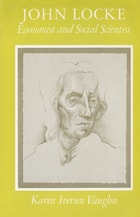
John Locke
Economist and Social ScientistKaren Iversen Vaughn
University of Chicago Press, 1980
In John Locke: Economist and Social Scientist Karen Iversen Vaughn presents a comprehensive treatment of Locke's important position in the development of eighteenth century economic thought.
[more]
The Economist as Public Intellectual, Volume 45
Steven G. Medema and Tiago Mata, special issue editors
Duke University Press, 0
The Economist as Public Intellectual examines the power of individual economists to intervene in public affairs and argues that economists’ public interventions have had profound consequences for both the structure and the content of the public sphere. Focusing on the encounters between economists and their publics in the United Kingdom and the United States, the essays in this volume demonstrate how publicity served different purposes in the evolving configurations of academe, business, government, and media during the twentieth century. The economists discussed include Gary Becker, Milton Friedman, John Kenneth Galbraith, and John Maynard Keynes. This volume concludes with a timely examination of economists’ reaction to the current financial downturn.
Subscribers to History of Political Economy will receive a copy of The Economist as Public Intellectual.
Tiago Mata is Senior Research Associate in the Department of History and Philosophy of Science at the University of Cambridge. Steven G. Medema is Professor of Economics at the University of Colorado at Denver.
[more]