Results by title
64 books match the query 'Ecuador' and 3 start with a
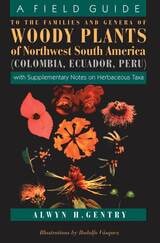
A Field Guide to the Families and Genera of Woody Plants of Northwest South America
With Supplementary Notes on Herbaceous TaxaAlwyn H. Gentry llustrated by Rodolfo Vasquez
University of Chicago Press, 1993
As a consummate field researcher, Gentry designed this guide to be not just comprehensive, but also easy to use in rigorous field conditions. Unlike many field guides, which rely for their identifications on flowers and fruits that are only present during certain seasons, Gentry's book focuses on characters such as bark, leaves, and odor that are present year-round. His guide is filled with clear illustrations, step-by-step keys to identification, and a wealth of previously unpublished data.
All biologists, wildlife managers, conservationists, and government officials concerned with the tropical rain forests will need and use this field guide.
Alwyn Gentry was one of the world's foremost experts on the biology of tropical plants. He was senior curator at the Missouri Botanical Garden, and was a member of Conservation International's interdisciplinary Rapid Assessment Program (RAP) team, which inventories the biodiversity of the most threatened tropical areas. From 1967 to 1993 he collected more than 80,000 plant specimens, many of them new to science.
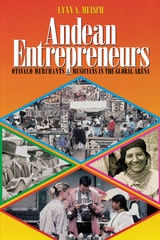
Andean Entrepreneurs
Otavalo Merchants and Musicians in the Global ArenaBy Lynn A. Meisch
University of Texas Press, 2002
Native to a high valley in the Andes of Ecuador, the Otavalos are an indigenous people whose handcrafted textiles and traditional music are now sold in countries around the globe. Known as weavers and merchants since pre-Inca times, Otavalos today live and work in over thirty countries on six continents, while hosting more than 145,000 tourists annually at their Saturday market.
In this ethnography of the globalization process, Lynn A. Meisch looks at how participation in the global economy has affected Otavalo identity and culture since the 1970s. Drawing on nearly thirty years of fieldwork, she covers many areas of Otavalo life, including the development of weaving and music as business enterprises, the increase in tourism to Otavalo, the diaspora of Otavalo merchants and musicians around the world, changing social relations at home, the growth of indigenous political power, and current debates within the Otavalo community over preserving cultural identity in the face of globalization and transnational migration. Refuting the belief that contact with the wider world inevitably destroys indigenous societies, Meisch demonstrates that Otavalos are preserving many features of their culture while adopting and adapting modern technologies and practices they find useful.
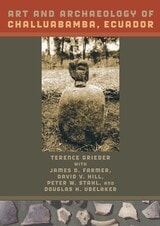
Art and Archaeology of Challuabamba, Ecuador
By Terence Grieder
University of Texas Press, 2009
Challuabamba (chī-wa-bamba)—now a developing suburb of Cuenca, the principal city in the southern highlands of Ecuador—has been known for a century as an ancient site that produced exceptionally fine pottery in great quantities. Suspecting that Challuabamban ceramics might provide a link between earlier, preceramic culture and later, highly developed Formative period art, Terence Grieder led an archaeological investigation of the site between 1995 and 2001. In this book, he and the team of art historians and archaeologists who excavated at Challuabamba present their findings, which establish the community's importance as a center in a network of trade and artistic influence that extended to the Amazon River basin and the Pacific Coast.
Art and Archaeology of Challuabamba, Ecuador presents an extensive analysis of ceramics dating to 2100-1100 BC, along with descriptions of stamps and seals, stone and shell artifacts, burials and their offerings, human remains, and zooarchaeology. Grieder and his coauthors demonstrate that the pottery of Challuabamba fills a gap between early and late Formative styles and also has a definite connection with later highland styles in Peru. They draw on all the material remains to reconstruct the first clear picture of Challuabamba's prehistory, including agriculture and health, interregional contacts and exchange, red-banded incised ware and ceramic production, and shamanism and cosmology.
Because southern Ecuador has received relatively little archaeological study, Art and Archaeology of Challuabamba, Ecuador offers important baseline data for what promises to be a key sector of the prehistoric Andean region.