Results by title
3 books match the query 'Ecumenism'
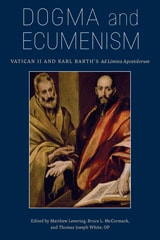
Dogma and Ecumenism
Vatican II and Karl Barth's 'Ad Limina Apostolorum'Matthew Levering
Catholic University of America Press, 2020
The conversation of this book is structured around five major documents from the Second Vatican Council, each of which Barth commented upon in his short but penetrating response to the Council, published as Ad Limina Apostolorum. In the two opening essays, Thomas Joseph White reflects upon the contribution that this book seeks to make to contemporary ecumenism rooted in awareness of the value of dogmatic theology; and Matthew Levering explores the way in which Barth’s Ad Limina Apostolorum flows from his preconciliar dialogues with Catholic representatives of the nouvelle théologie and remain relevant to the issues facing Catholic theology today. The next two essays turn to Dei Verbum, the Dogmatic Constitution on Divine Revelation; here Katherine Sonderegger (Protestant) reflects on scripture and Lewis Ayres (Catholic) reflects on tradition. The next two essays address the Dogmatic Constitution on the Church, Lumen Gentium, which touches upon central differences of Catholic and Protestant self-understanding. Christoph Schwöbel (Protestant) analyzes visible ecclesial identity as conceived in a Protestant context, while Thomas Joseph White (Catholic) engages Barth’s Reformed criticisms of the Catholic notion of the Church. The next two essays take up Nostra Aetate: Bruce Lindley McCormack (Protestant) asks whether it is true to say that Muslims worship the same God as Christians, and Bruce D. Marshall (Catholic) explores the implications of the Council’s reflections on the Jewish people. The next two essays take up the Pastoral Constitution on the Church in the Modern World, Gaudium et Spes: John Bowlin (Protestant) makes use of the thought of Aquinas to consider the promise and perils of the document, while Francesca Aran Murphy (Catholic) engages critically with George Lindbeck’s analysis of the document. The next two essays explore Unitatis Redintegratio: Hans Boersma (Protestant) asks whether the ecumenical intention of the document is impaired by its insistence that the unity of the Church is already present in the Catholic Church, and Reinhard Hütter (Catholic) systematically addresses Barth’s questions regarding the document. The noted ecumenist and Catholic theologian Richard Schenk brings the volume to a close by reflecting on “true and false ecumenism” in the post-conciliar period.
[more]
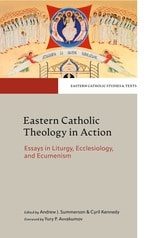
Eastern Catholic Theology in Action
Essays in Liturgy, Ecclesiology, and EcumenismAndrew J. Summerson
Catholic University of America Press, 2024
The Second Vatican Council urged Eastern Catholics to cultivate their share of divine revelation for the benefit of the entire Catholic Church. Yet, more than 50 years later, the Eastern Catholic Churches frequently remain on the margins, both in the theological academy and in the life of the Church more broadly. In an effort to remedy this situation, at least in part, this volume offers a scholarly reflection on the unique patrimony of the Eastern Catholic Churches, divided according to the categories of Liturgy, Theology, Spirituality, Discipline, and Culture. In so doing, it both follows the categories used to define a Church sui iuris in the Code of Canon Law for the Eastern Churches, and builds on the legacy of the Rev. Peter Galadza, to whom the volume is dedicated.
On one hand, the volume and its essays are intentionally introductory, revealing the worlds of Eastern Catholicism and the variety of theological approaches that take place there. Emerging in part from the experience of teaching and preaching by scholars of Eastern Christianity, who are frequently asked for a basic introduction to Eastern Catholic theology, and have little to offer in response, these essays gather an international group of scholars engaging in critical, theological reflection from an Eastern Catholic perspective. This approach is rounded out by contributions from Roman Catholic, Orthodox, and Protestant scholars, who articulate their own reception and appreciation of the Eastern Catholic theological heritage.
At the same time, however, several of the essays in this volume relate the history and current reality of Eastern Catholicism to the Orthodox and Roman Catholic Churches, yet without ignoring how frequently Eastern Catholics live, worship, and theologize without self-conscious regard for their unique ecclesial situation. Indeed, these authors show, Eastern Catholic theology can be unself-consciously grounded in the patristic tradition, and Eastern Catholics can simply “do” theology, without worrying about ecclesial politics. Readers will thus find here the best of both worlds: both an introduction to the unique and frequently ignored patrimony of the Eastern Catholic Churches, and a series of essays that avoids the all-to-common pitfall of reducing these traditions to a parody of other Churches, Eastern or Western. Instead, by engaging with the sources of the Christian tradition – as Eastern Catholics, yes, but first and foremost as Christians – the authors reveal how much their tradition can offer the Catholic Church as a whole.
[more]
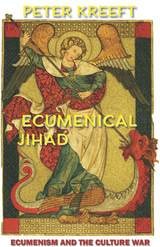
Ecumenical Jihad
Ecumenism and the Culture WarPeter Kreeft
St. Augustine's Press, 2015
Juxtaposing “ecumenism” and “jihad,” two words that many would consider strange and at odds with one another, Peter Kreeft argues that we need to change our current categories and alignments. We need to realize that we are at war and that the sides have changed radically. Documenting the spiritual and moral decay that has taken hold of modern society, Kreeft issues a wake-up call to all God-fearing Christians, Jews, and Muslims to unite together in a “religious war” against the common enemy of godless secular humanism, materialism, and immorality.
Aware of the deep theological differences of these monotheistic faiths, Kreeft calls for a moratorium on our polemics against one another so that we can form an alliance to fight together to save Western civilization.
Aware of the deep theological differences of these monotheistic faiths, Kreeft calls for a moratorium on our polemics against one another so that we can form an alliance to fight together to save Western civilization.
[more]