Results by title
66 books match the query 'Edge' and 9 start with a
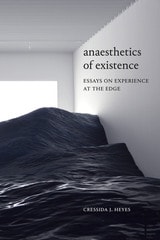
Anaesthetics of Existence
Essays on Experience at the EdgeCressida J. Heyes
Duke University Press, 2020
“Experience” is a thoroughly political category, a social and historical product not authored by any individual. At the same time, “the personal is political,” and one's own lived experience is an important epistemic resource. In Anaesthetics of Existence Cressida J. Heyes reconciles these two positions, drawing on examples of things that happen to us but are nonetheless excluded from experience. If for Foucault an “aesthetics of existence” was a project of making one's life a work of art, Heyes's “anaesthetics of existence” describes antiprojects that are tacitly excluded from life—but should be brought back in. Drawing on critical phenomenology, genealogy, and feminist theory, Heyes shows how and why experience has edges, and she analyzes phenomena that press against those edges. Essays on sexual violence against unconscious victims, the temporality of drug use, and childbirth as a limit-experience build a politics of experience while showcasing Heyes's much-needed new philosophical method.

Apes on the Edge
Chimpanzee Life on the West African SavannaJill Pruetz
University of Chicago Press, 2025
Fongoli chimpanzees are unique for many reasons. Their female hunters are the only apes that regularly hunt with tools, seeking out tiny bush babies with wooden spears. Unlike most other chimps, these apes fear neither water nor fire, using shallow pools to cool off in the Senegalese heat. Up to 90 percent of their home range burns annually—the result of human hunting or clearing for gold mining—and Fongoli chimpanzees have learned to predict the movement of such fires and to avoid them.
The study of Fongoli chimps is also unique. While most primate research occurs in isolated reserves, Fongoli chimpanzees live alongside humans, and as primatologist and anthropologist Jill Pruetz reports, this shared habitat creates both challenges and opportunities. The issues faced by Fongoli chimpanzees—particularly food scarcity and environmental degradation—are also issues faced by their human neighbors. This connection is one reason Pruetz, who has studied Fongoli apes for over two decades, created the nonprofit Neighbor Ape in 2008 to provide for the welfare of the humans who share their landscape with apes. It is also why Pruetz decided to write this book, the first to offer readers a view of these chimps’ lives and to explain the specific conservation efforts needed to help them. Incorporating stories from Pruetz’s time in the field, including the compelling rescue of a young chimp from poachers, Apes on the Edge opens a fascinating window into primate research, conservation, and the inner workings of a very special population of our closest nonhuman relatives.
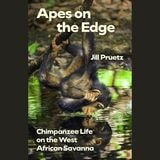
Apes on the Edge
Chimpanzee Life on the West African SavannaJill Pruetz
University of Chicago Press, 2025
A moving story of survival and an eye-opening introduction to an extraordinary community of chimps and people.
Fongoli chimpanzees are unique for many reasons. Their female hunters are the only apes that regularly hunt with tools, seeking out tiny bush babies with wooden spears. Unlike most other chimps, these apes fear neither water nor fire, using shallow pools to cool off in the Senegalese heat. Up to 90 percent of their home range burns annually—the result of human hunting or clearing for gold mining—and Fongoli chimpanzees have learned to predict the movement of such fires and to avoid them.
The study of Fongoli chimps is also unique. While most primate research occurs in isolated reserves, Fongoli chimpanzees live alongside humans, and as primatologist and anthropologist Jill Pruetz reports, this shared habitat creates both challenges and opportunities. The issues faced by Fongoli chimpanzees—particularly food scarcity and environmental degradation—are also issues faced by their human neighbors. This connection is one reason Pruetz, who has studied Fongoli apes for over two decades, created the nonprofit Neighbor Ape in 2008 to provide for the welfare of the humans who share their landscape with apes. It is also why Pruetz decided to write this book, the first to offer readers a view of these chimps’ lives and to explain the specific conservation efforts needed to help them. Incorporating stories from Pruetz’s time in the field, including the compelling rescue of a young chimp from poachers, Apes on the Edge opens a fascinating window into primate research, conservation, and the inner workings of a very special population of our closest nonhuman relatives.
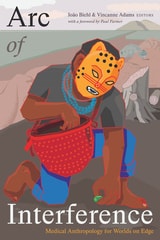
Arc of Interference
Medical Anthropology for Worlds on EdgeJoão Biehl and Vincanne Adams, editors
Duke University Press, 2023
Contributors. Vincanne Adams, João Biehl, Davíd Carrasco, Lawrence Cohen, Jean Comaroff, Robert Desjarlais, Paul Farmer, Marcia Inhorn, Janis H. Jenkins, David S. Jones, Salmaan Keshavjee, Arthur Kleinman, Margaret Lock, Adriana Petryna
Art on the Edge
Creators and SituationsHarold Rosenberg
University of Chicago Press, 1983
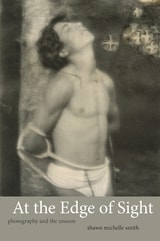
At the Edge of Sight
Photography and the UnseenShawn Michelle Smith
Duke University Press, 2013

At the Edge of the Abyss
A Concentration Camp Diary, 1943-1944David Koker; Edited by Robert Jan van Pelt; Translated from the Dutch by Michiel Horn and John Irons
Northwestern University Press, 2012
Finalist for 2012 National Jewish Book Award in the Holocaust category
David Koker's diary is one of the most notable accounts of life in a German concentration camp written by a Jew during the years of the Holocaust. First brought to attention when the Dutch historian Jacob Presser-Koker's history teacher in high school-quoted from Koker's diary in his monumental history, published in English as The Destruction of the Dutch Jews (1968), the diary itself became a part of the Dutch literary canon when it was published in 1977 as Dagboek geschreven in Vught (Diary Written in Vught). It has remained in print ever since, and is notable for its literary qualities, weaving poetry and powerful observations of the emotional life of a camp prisoner, including reflections after an in-person visit by Heinrich Himmler. Surprisingly, the book has never before been translated into English.
During his time in the Vught concentration camp, the 21-year-old David recorded on an almost daily basis his observations, thoughts, and feelings. He mercilessly probed the abyss that opened around him and, at times, within himself. David's diary covers almost a year, both charting his daily life in Vught as it developed over time and tracing his spiritual evolution as a writer. Until early February 1944, David was able to smuggle some 73,000 words from the camp to his best friend Karel van het Reve, a non-Jew.
With an informative introduction, annotation, and list of dramatis personae by Robert Jan van Pelt, At the Edge of the Abyss offers an immediate and wholly original look into the life of a concentration camp prisoner.
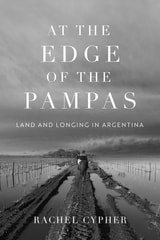
At the Edge of the Pampas
Land and Longing in ArgentinaRachel Cypher
University of Arizona Press, 2027
Industrial agriculture has transformed vast stretches of the Earth, but few places reveal its contradictions more clearly than the Pampas of Argentina.
In At the Edge of the Pampas, anthropologist Rachel Cypher traces the explosive rise of genetically modified soybeans across one of the world’s great agricultural heartlands. Drawing on immersive long-term fieldwork, the book moves from soybean fields and cattle feedlots to dryland forests to show that industrial agriculture takes many forms. Soy—one of the world’s most standardized commodities—must first pass through local ecologies, informal economies, inherited obligations, and intimate relations of trust before it can circulate as a global asset.
Urgent and deeply original, At the Edge of the Pampas offers a major rethinking of how value is gathered within industrial capitalism and how unruly social and ecological life persists inside even the most engineered landscapes.
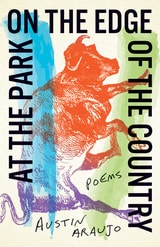
At the Park on the Edge of the Country
PoemsAustin Araujo
The Ohio State University Press, 2025