Results by title

7 books match the query 'Edmund Burke'
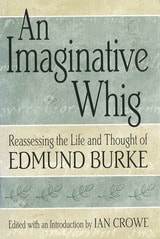
cover of An Imaginative Whig: Reassessing the Life and Thought of Edmund Burke

An Imaginative Whig

Reassessing the Life and Thought of Edmund Burke

Edited & Intro by Ian Crowe

University of Missouri Press, 2005
This collection of essays shifts the focus of scholarly debate away from the themes that have traditionally dominated the study of Edmund Burke. In the past, largely ideology-based or highly textual studies have tended to paint Burke as a “prophet” or “precursor” of movements as diverse as conservatism, political pragmatism, and romanticism. In contrast, these essays address prominent issues in contemporary society—multiculturalism, the impact of postmodern and relativist methodologies, the boundaries of state-church relationships, and religious tolerance in modern societies—by emphasizing Burke’s earlier career and writings and focusing on his position on historiography, moral philosophy, jurisprudence, aesthetics, and philosophical skepticism.
 
The essays in this collection, written by some of today’s most renowned Burke scholars, will radically challenge our deeply rooted assumptions about Burke, his thought, and his place in the history of Western political philosophy.
[more]
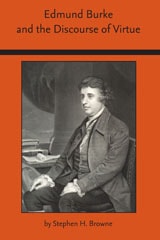
cover of Edmund Burke and the Discourse of Virtue

Edmund Burke and the Discourse of Virtue

Stephen Howard Browne

University of Alabama Press, 2007

"A major accomplishment in the study of Burke." —Choice

More than 200 years after his death, Edmund Burke remains among the most influential conservative writers in the Anglophone world. Burke’s relevance has only grown as the nature of what it means to be a conservative has become hotly contested.

And yet Burke is often discussed more than he is read. Worse, his rhetoric is often pressed into the service of other ideologies. In Edmund Burke and the Discourse of Virtue, Stephen Browne of Pennsylvania State University subjects Burke’s work to the close textual analysis it has never received.

The result of Browne's study is to present Burke and his work in a light that was clearly essential to Burke himself, one that illuminates the link between rhetoric and action that is key to understanding Burke, his career, his work, and his influence on contemporary conservatism.

Readers interested in the development of conversative philosophy, politics, and writing from its earliest roots will value this rare and illuminating work.
[more]
cover of Edmund Burke and the Natural Law

Edmund Burke and the Natural Law

Peter J. Stanlis

University of Michigan Press, 1958
Edmund Burke—brilliant prophet, party leader, and rhetorician—in his defense of the American Colonies as in his opposition to the French Revolution spoke directly to the modern age. Yet he has been, when not neglected, persistently misunderstood: his principles of prudence garbled, his distrust of abstract law misinterpreted, his appeals to nature misrepresented, his concept of the law of nations ignore. This study of his ideas presents at last his true position as a philosopher, relating his convictions to the great tradition of Christian and classical civilization and showing their relevance for today.
[more]
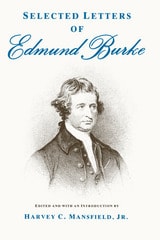
cover of Selected Letters of Edmund Burke

Selected Letters of Edmund Burke

Edmund Burke

University of Chicago Press, 1984

Edmund Burke (1729-97) was a British statesman, a political philosopher, a literary critic, the grandfather of modern conservatism, and an elegant, prolific letter writer and prose stylist. His most important letters, filled with sparkling prose and profound insights, are gathered here for the first time in one volume. Arranged topically, the letters bring alive Burke's passionate views on such issues as party politics, reform and revolution, British relations with America, India, and Ireland, toleration and religion, and literary and philosophical concerns.
[more]
cover of The Correspondence of Edmund Burke, Volume X: Index

The Correspondence of Edmund Burke, Volume X

Index

Edmund Burke

University of Chicago Press, 1978
This, the last volume in the series, provides the keys to all the others. All letters to and from Burke are listed, and the material in the letters themselves analysed in a comprehensive general index.
[more]
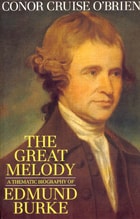
cover of The Great Melody: A Thematic Biography of Edmund Burke

The Great Melody

A Thematic Biography of Edmund Burke

Conor Cruise O'Brien

University of Chicago Press, 1992

Statesman, political thinker, orator, and ardent campaigner, Edmund Burke was one of the most brilliant figures of the eighteenth century. This unorthodox biography focuses on Burke's thoughts, responses, and actions to the great events and debates surrounding Britain's tumultuous relationships with her three colonies—America, Ireland, and India—and archrival France.

"In bringing Burke to our attention, Mr. O'Brien has brought back a lost treasure. The Great Melody is a brilliant work of narrative sweep and analytical depth. Conor Cruise O'Brien on Edmund Burke is a literary gift to political thought."—John Patrick Diggins, New York Times Book Review

"Serious readers of history are in for a treat: a book by the greatest living Irishman on the greatest Irishman who ever lived. . . . O'Brien's study is not merely a reconstruction of a fascinating man and period. It is also a tract for the times. . . . I cannot remember another time when I finished a book of more than 600 pages wishing it were longer."—Paul Johnson, The Independent

"The Great Melody combines superb biography and fascinating history with a profound understanding of political philosophy."—Former President Richard Nixon
[more]
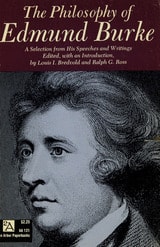
cover of The Philosophy of Edmund Burke: A Selection from His Speeches and Writings

The Philosophy of Edmund Burke

A Selection from His Speeches and Writings

Edmund Burke

University of Michigan Press, 1960

Edmund Burke, the greatest Whig spokesman of his day in the British Parliament, was one of the most forceful and rational political thinkers of all time. This selection from his speeches and writings reveals a political philosophy which is viable, even prophetic, in our own time. Burke's distrust of disembodied reason, his vision of the law of all nations, and his wise pragmatism speak to everyone concerned with maintaining the democratic freedoms in an age when millions are subject to the tyranny of abstract political ideas.
[more]