Results by title
2 books match the query 'Edo period, 1600-1868'
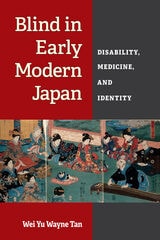
Blind in Early Modern Japan
Disability, Medicine, and IdentityWei Yu Wayne Tan
University of Michigan Press, 2022
While the loss of sight—whether in early modern Japan or now—may be understood as a disability, blind people in the Tokugawa period (1600–1868) could thrive because of disability. The blind of the era were prominent across a wide range of professions, and through a strong guild structure were able to exert contractual monopolies over certain trades. Blind in Early Modern Japan illustrates the breadth and depth of those occupations, the power and respect that accrued to the guild members, and the lasting legacy of the Tokugawa guilds into the current moment.The book illustrates why disability must be assessed within a particular society’s social, political, and medical context, and also the importance of bringing medical history into conversation with cultural history. A Euro-American-centric disability studies perspective that focuses on disability and oppression, the author contends, risks overlooking the unique situation in a non-Western society like Japan in which disability was constructed to enhance blind people’s power. He explores what it meant to be blind in Japan at that time, and what it says about current frameworks for understanding disability.
[more]
Transformations of Sensibility
The Phenomenology of Meiji LiteratureKamei Hideo; Translated, edited, and with an introduction by Michael Bourdaghs
University of Michigan Press, 2002
First published in Japan in 1983, this book is now a classic in modern Japanese literary studies. Covering an astonishing range of texts from the Meiji period (1868–1912), it presents sophisticated analyses of the ways that experiments in literary language produced multiple new—and sometimes revolutionary—forms of sensibility and subjectivity. Along the way, Kamei Hideo carries on an extended debate with Western theorists such as Saussure, Bakhtin, and Lotman, as well as with such contemporary Japanese critics as Karatani Kōjin and Noguchi Takehiko.
Transformations of Sensibility deliberately challenges conventional wisdom about the rise of modern literature in Japan and offers highly original close readings of works by such writers as Futabatei Shimei, Tsubouchi Shōyō, Higuchi Ichiyō, and Izumi Kyōka, as well as writers previously ignored by most scholars. It also provides a new critical theorization of the relationship between language and sensibility, one that links the specificity of Meiji literature to broader concerns that transcend the field of Japanese literary studies. Available in English translation for the first time, it includes a new preface by the author and an introduction by the translation editor that explain the theoretical and historical contexts in which the work first appeared.
[more]