Results by title
76 books match the query 'Educational change' and 7 start with a
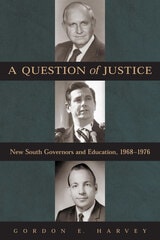
A Question of Justice
New South Governors and Education, 1968-1976Gordon E. Harvey
University of Alabama Press, 2005
The governors who used education to transform the modern South.
In southern politics, 1970 marked a watershed. A group of southern governors entered office that year and changed both the way the nation looked at the South and the way the constituents of those states viewed themselves. Reubin Askew in Florida, John West in South Carolina, Jimmy Carter in Georgia, and Albert Brewer in Alabama all represented a new breed of progressive moderate politician that helped demolish Jim Crow segregation and the dual economies, societies, and educational systems notorious to the Sunbelt South. Historian Gordon Harvey explores the political lives and legacies of three of these governors, examining the conditions that led to such a radical change in political leadership, the effects their legislative agendas had on the identity of their states, and the aftermath of their terms in elected office.
A common thread in each governor's agenda was educational reform. Albert Brewer's short term as Alabama governor resulted in a sweeping education package that still stands as the most progressive the state has seen. Reubin Askew, far more outspoken than Brewer, won the Florida gubernatorial election through a campaign that openly promoted desegregation, busing, and tax reform as a means of equal school funding. John West's commitment to a policy of inclusion helped allay fears of both black and white parents and made South Carolina's one of the smoothest transitions to integrated schools.
As members of the first generation of New South governors, Brewer, Askew, and West played the role of trailblazers. Their successful assaults on economic and racial injustice in their states were certainly aided by such landmark events as Brown v. Board of Education, the civil rights movement, and the expansion of voting rights-all of which sounded the death knell for the traditional one-party segregated South. But in this critical detailing of their work for justice, we learn how these reform-minded men made education central to their gubernatorial terms and, in doing so, helped redefine the very character of the place they called home.

A University for the 21st Century
James J. Duderstadt
University of Michigan Press, 2000
Accountability-Based Reforms
The Impact on Deaf and Hard of Hearing StudentsStephanie W. Cawthon
Gallaudet University Press, 2011
For years, school reform efforts targeted either students in regular education or those with special needs, but not both. As a result of the No Child Left Behind legislation (NCLB) and its focus on accountability, administrators established policies that would integrate the needs of students who previously were served under separate frameworks. Using the NCLB structure as a starting point, Stephanie W. Cawthon’s new book Accountability-Based Reforms: The Impact on Deaf and Hard of Hearing Students discusses key assumptions behind accountability reforms. She specifically examines how elements of these reforms affect students who are deaf or hard of hearing, their teachers, and their families.
Cawthon begins by providing a brief introduction to the deaf education context, offering detailed information on student demographics, settings, and academic outcomes for deaf students. She then outlines the evolution of accountability-based education reforms, following with a chapter on content standards, assessment accommodations, accountability as sanctions, and students with disabilities. The remaining chapters in Accountability-Based Reforms closely examine educational professionals, accountability, and students who are deaf or hard of hearing; school choice policies and parents; and deaf education and measures of success. Each chapter presents an overview of an important component of accountability reform, available research, and how it has been implemented in the United States. These chapters also offer recommendations for future action by educators, parents, researchers, and education policymakers.
American Conversations
Ellen Bigler
Temple University Press, 1999
The impassioned debate that erupted between long-time white ethnic residents and more recently arrived Puerto Rican citizens in the de-industrialized city the author calls "Arnhem" was initially sparked by one school board member's disparaging comments about Latinos. The conflict led to an investigation by the attempts to implement multicultural reforms in the city's schools. American Conversations follows the ensuing conflict, looks at the history of racial formation in the United States, and considers the specific economic and labor histories of the groups comprising the community in opposition. Including interviews with students, teachers, parents, and community leaders, as well as her own observations of exchanges among them inside and outside the classroom, Bigler's book explores the social positions, diverging constructions of history, and polarized understandings of contemporary racial/ethnic dynamics in Arnhem. Through her retelling of one community's crisis, Bigler illuminates the nature of racial politics in the United States and how both sides in the debate over multicultural education struggle to find a common language.
American Conversations will appeal to anyone invested in education and multiculturalism in the United States as well as those interested in anthropology, sociology, racial and ethnic studies, educational institutions, migration and settlement, the effects of industrial restructuring, and broad issues of community formation and conflict.
American School Reform
What Works, What Fails, and WhyJoseph P. McDonald and the Cities and Schools Research Group
University of Chicago Press, 2014
McDonald and his colleagues lay out several interrelated ideas in what they call a theory of action space. Frequently education policy gets so ambitious that implementing it becomes a near impossibility. Action space, however, is what takes shape when talented educators, leaders, and reformers guide the social capital of civic leaders and the financial capital of governments, foundations, corporations, and other backers toward true results. Exploring these extraordinary collaborations through their lifespans and their influences on future efforts, the authors provide political hope—that reform efforts can work, and that our schools can be made better.
An Alternate Pragmatism for Going Public
Jim Webber
Utah State University Press, 2017
An Alternate Pragmatism for Going Public interrogates composition’s most prominent responses to contemporary K–16 education reform. By “going public,” teachers, scholars, and administrators rightfully reassert their expertise against corporate-political standards and assessments like the Common Core, Complete College America, and the Collegiate Learning Assessment. However, author Jim Webber shows that composition’s professional imperative for self-defense only partly fulfils the broader aims of “going public,” which include fostering public participation that can assess and potentially affirm the public good of professional judgment.
Drawing on the pragmatic/democratic tradition, Webber envisions an alternate rhetoric of professionalism, one that not only reasserts compositionists’ expertise but also expands opportunities for publics to authorize this expertise. While this public inquiry and engagement may not safeguard professional standing against neoliberal reform, it reorients composition toward an equally important goal, enabling publics to gauge the adequacy of the educational standardization so often advocated by contemporary reform.
An Alternate Pragmatism for Going Public shows how public engagement can serve composition’s efforts related to “going public.”

Aztlán Arizona
Mexican American Educational Empowerment, 1968–1978Darius V. Echeverría
University of Arizona Press, 2014
The word Aztlán, originally meaning the legendary ancestral home of the Nahua peoples of Mesoamerica, was adopted as a symbol of independence by Chicano/a activists during the movement of the 1960s and 1970s. In an era when poverty, prejudice, and considerable oppositional forces blighted the lives of roughly one-fifth of Arizonans, the author argues that understanding those societal realities is essential to defining the rise and power of the Chicano Movement.
The book illustrates how Mexican American communities fostered a togetherness that ultimately modified larger Arizona society by revamping the educational history of the region. The concluding chapter outlines key Mexican American individuals and organizations that became politically active in order to address Chicano educational concerns. This Chicano unity, reflected in student, parent, and community leadership organizations, helped break barriers, dispel the Mexican American inferiority concept, and create educational change that benefited all Arizonans.
No other scholar has examined the emergence of Chicano Movement politics and its related school reform efforts in Arizona. Echeverría’s thorough research, rich in scope and interpretation, is coupled with detailed and exact endnotes. The book helps readers understand the issues surrounding the Chicano Movement educational reform and ethnic identity. Equally important, the author shows how residual effects of these dynamics are still pertinent today in places such as Tucson.