Results by title
5 books match the query 'Educational exchanges'
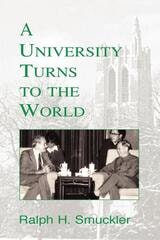
A University Turns to the World
Ralph H. Smuckler
Michigan State University Press, 2003
A University Turns to the World examines the growth of Michigan State University’s pacesetting International program beginning in 1956, when President John Hannah named the nation’s first international dean, Glen Taggart, to head a university-wide effort. In the years that followed, MSU’s technical assistance projects in Asia, Africa, and Latin America were an important contribution to economic growth and development, and they were integral to broad efforts to strengthen the international dimension at home. The faculty members who went to Okinawa, Colombia, Brazil, South Vietnam, and Pakistan in the early years defined important goals and they learned much. As the years passed, their experiences led to increased sensitivity to the complexities of development activity and the need for patience.
Smuckler’s leadership of the international program and intimate involvement in MSU’s work at home and abroad enable him to recapture the dreams and disappointments of the development promise. Ultimately, Smuckler demonstrates that the development programs of the mid-twentieth century paved the way for valuable new research activities and long-term mutually beneficial ties between MSU faculty and institutions and colleagues overseas.

Bridges to Knowledge
Foreign Students in Comparative PerspectiveElinor G. Barber, Philip G. Altbach, and Robert G. Myers
University of Chicago Press, 1984
Practicing Transnationalism
American Studies in the Middle EastEdited Eileen T. Lundy and Edward J. Lundy
University of Texas Press, 2016
Practicing Transnationalism explores the challenges of teaching American studies in the Middle East during a time of tension and conflict between the United States and the region.
In the first decade of the twenty-first century, American studies programs began to spread in the Middle East. During a time of rising anti-American sentiment, ten major programs were established in the region. What impulses propelled universities in the Middle East to establish these centers and programs? What motivated students to take courses and pursue degrees in American studies? In part, American studies programs developed as a way to “know the enemy,” to better understand America’s ubiquitous influence in foreign relations, technology, and culture; however, some programs grew because residents admired the ideals set forth as American, including democracy and free speech.
Practicing Transnationalism investigates these issues and others, using the experiences and research of the editors and contributors, who worked either directly in these programs or as adjunct to them. These scholars seek to understand what American power means to people in the Middle East. They examine the challenge of developing American studies programs in a transnational paradigm, striving to build programs that are separate from and critical of American imperialism without simply becoming anti-American. In the essays, the contributors provide context for how the field of American studies has grown and developed, and they offer views of cultural interactions and classroom situations, demonstrating the problems instructors faced and how they worked to address them.
The Abongo Abroad
Military-Sponsored Travel in Ghana, the United States, and the World, 1959-1992John V. Clune
Vanderbilt University Press, 2017
Merging newly discovered documents from Ghana's armed forces and declassified sources on American military assistance to Africa, this work argues that military-sponsored travel made individual Ghanaians' outlooks on the world more international, just as military assistance planners hoped they would, but the Ghanaian state struggled to turn that new identity into political or economic progress.
U.S.- China Educational Exchange
State, Society, and Intercultural Relations, 1905-1950Li, Hongshan
Rutgers University Press, 2007
U.S.-China relations became increasingly important and complex in the twentieth century. While economic, political, and military interactions all grew over time, the most dramatic expansion took place in educational exchange, turning it into the strongest tie between the two nations. By the end of the 1940s, tens of thousands of Chinese and American students and scholars had crisscrossed the Pacific, leaving indelible marks on both societies. Although all exchange programs were terminated during the cold war, the two nations reemerged as top partners within a decade after the reestablishment of diplomatic relations.
Approaching U.S.-China relations from a unique and usually overlooked perspective, Hongshan Li reveals that both the drastic expansion and complete termination of educational ties between the two nations in the first half of the twentieth century were largely the results of direct and deep intervention from the American and Chinese governments. Benefiting from government support and collaboration, educational exchange succeeded in diffusing knowledge and improving mutual understanding between the two peoples across the divide of civilizations. However, the visible hand of government also proved to be most destructive to the development of healthy intercultural relations when educational interactions were treated merely as an instrument for crisis management.