Results by title
3 books match the query 'Educational fund raising'

Exchange of Ideas
The Economy of Higher Education in Early AmericaAdam R. Nelson
University of Chicago Press, 2023
The first volume of an ambitious new economic history of American higher education.
Exchange of Ideas launches a breathtakingly ambitious new economic history of American higher education. In this volume, Adam R. Nelson focuses on the early republic, explaining how knowledge itself became a commodity, as useful ideas became salable goods and American colleges were drawn into transatlantic commercial relations. American scholars might once have imagined that higher education could sit beyond the sphere of market activity—that intellectual exchange could transcend vulgar consumerism—but already by the end of the eighteenth century, they saw how ideas could be factored into the nation’s balance of trade. Moreover, they concluded that it was the function of colleges to oversee the complex process whereby knowledge could be priced and purchased. The history of capitalism and the history of higher education, Nelson reveals, are intimately intertwined—which raises a host of important and strikingly urgent questions. How do we understand knowledge and education as commercial goods? Who should pay for them? And, fundamentally, what is the optimal system of higher education in a capitalist democracy?
Exchange of Ideas launches a breathtakingly ambitious new economic history of American higher education. In this volume, Adam R. Nelson focuses on the early republic, explaining how knowledge itself became a commodity, as useful ideas became salable goods and American colleges were drawn into transatlantic commercial relations. American scholars might once have imagined that higher education could sit beyond the sphere of market activity—that intellectual exchange could transcend vulgar consumerism—but already by the end of the eighteenth century, they saw how ideas could be factored into the nation’s balance of trade. Moreover, they concluded that it was the function of colleges to oversee the complex process whereby knowledge could be priced and purchased. The history of capitalism and the history of higher education, Nelson reveals, are intimately intertwined—which raises a host of important and strikingly urgent questions. How do we understand knowledge and education as commercial goods? Who should pay for them? And, fundamentally, what is the optimal system of higher education in a capitalist democracy?
[more]
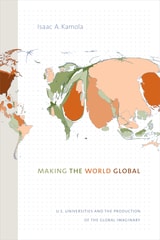
Making the World Global
U.S. Universities and the Production of the Global ImaginaryIsaac A. Kamola
Duke University Press, 2019
Following World War II the American government and philanthropic foundations fundamentally remade American universities into sites for producing knowledge about the world as a collection of distinct nation-states. As neoliberal reforms took hold in the 1980s, visions of the world made popular within area studies and international studies found themselves challenged by ideas and educational policies that originated in business schools and international financial institutions. Academics within these institutions reimagined the world instead as a single global market and higher education as a commodity to be bought and sold. By the 1990s, American universities embraced this language of globalization, and globalization eventually became the organizing logic of higher education. In Making the World Global Isaac A. Kamola examines how the relationships among universities, the American state, philanthropic organizations, and international financial institutions created the conditions that made it possible to imagine the world as global. Examining the Center for International Studies, Harvard Business School, the World Bank, the Social Science Research Council, and NYU, Kamola demonstrates that how we imagine the world is always symptomatic of the material relations within which knowledge is produced.
[more]
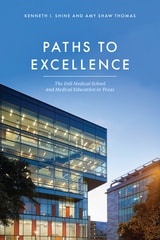
Paths to Excellence
The Dell Medical School and Medical Education in TexasKenneth I. Shine and Amy Shaw Thomas
University of Texas Press, 2021
For more than a century, medical schools and academic campuses were largely separate in Texas. Though new medical technologies and drugs—conceivably, even a vaccine instrumental in the prevention of a pandemic—might be developed on an academic campus such as the University of Texas at Austin, there was no co-located medical school with which to collaborate. Faculty members were left to seek experts on distant campuses. That all changed on May 3, 2012, when the UT System Board of Regents voted to create the Dell Medical School in Austin.
This book tells in detail and for the first time the story of how this change came about: how dedicated administrators, alumni, business leaders, community organizers, doctors, legislators, professors, and researchers joined forces, overcame considerable resistance, and raised the funds to build a new medical school without any direct state monies. Funding was secured in large part by the unique willingness of the local community to tax itself to pay for the financial operations of the school. Kenneth I. Shine and Amy Shaw Thomas, who witnessed this process from their unique vantages as past and present vice chancellors for health affairs in the University of Texas System, offer a working model that will enable other leaders to more effectively seek solutions, avoid pitfalls, and build for the future.
This book tells in detail and for the first time the story of how this change came about: how dedicated administrators, alumni, business leaders, community organizers, doctors, legislators, professors, and researchers joined forces, overcame considerable resistance, and raised the funds to build a new medical school without any direct state monies. Funding was secured in large part by the unique willingness of the local community to tax itself to pay for the financial operations of the school. Kenneth I. Shine and Amy Shaw Thomas, who witnessed this process from their unique vantages as past and present vice chancellors for health affairs in the University of Texas System, offer a working model that will enable other leaders to more effectively seek solutions, avoid pitfalls, and build for the future.
[more]