Results by title
7 books match the query 'Educational innovations'
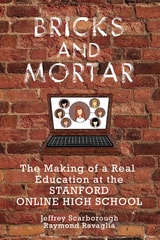
Bricks and Mortar
The Making of a Real Education at the Stanford Online High SchoolJeffrey Scarborough and Raymond Ravaglia
CSLI, 2014
This volume shows how a group of online-learning believers built the best high school in the world without laying a single brick: the Stanford Online High School (SOHS). By chronicling SOHS’s distinctive approach to curriculum, gifted education, and school community over SOHS’s first seven years, Bricks and Mortar makes the case that the dynamic use of technology and the best traditional methodologies in education are not, in fact, mutually exclusive. Indeed, while SOHS has redefined what is possible online, a great education is ultimately the product of an interactive community of teachers and students.
Changing Conceptions, Changing Practices
Innovating Teaching across Disciplinesedited by Angela Glotfelter, Caitlin Martin, Mandy Olejnik, Ann Updike & Elizabeth Wardle
Utah State University Press, 2022
The authors draw on the threshold concepts framework, research in writing studies, and theories of learning, leadership, and change to deftly explore why faculty are often stymied in their efforts to design meaningful curricula for deep learning and how carefully scaffolded professional development for faculty teams can help make such change possible. This book is a powerful demonstration of how faculty members can be empowered when professional development leaders draw on a range of scholarship that is not typically connected.
In today’s climate, courses, programs, and institutions are often assessed by and rewarded for proxy metrics that have little to do with learning, with grave consequences for students. The stakes have never been higher, particularly for public higher education. Faculty members need opportunities to work together using their own expertise and to enact meaningful learning opportunities for students. Professional developers have an important role to play in such change efforts.
WAC scholars and practitioners, leaders of professional development and centers for teaching excellence, program administrators and curriculum committees from all disciplines, and faculty innovators from many fields will find not only hope but also a blueprint for action in Changing Conceptions, Changing Practices.
Contributors: Juan Carlos Albarrán, José Amador, Annie Dell'Aria, Kate de Medeiros, Keith Fennen, Jordan A. Fenton, Carrie E. Hall, Elena Jackson Albarrán, Erik N. Jensen, Vrinda Kalia, Janice Kinghorn, Jennifer Kinney, Sheri Leafgren, Elaine Maimon, Elaine Miller, Gaile Pohlhaus Jr., Jennifer J. Quinn, Barbara J. Rose, Scott Sander, Brian D. Schultz, Ling Shao, L. James Smart, Pepper Stetler

Improving Science Education
International PerspectivesEdited by Barry J. Fraser and Herbert J. Walberg
University of Chicago Press, 1995
This volume offers educators and researchers a glimpse at what peers from around the world have done to help science students achieve high levels of success. The introduction is a concise account of worldwide reform movements, from modernizations in the 1950s that dramatically improved the teaching of chemistry and physics to such changes in the 1980s as the emphasis on the learning-to-learn approach and the trend toward using social issues as a vehicle for teaching science.
The nine essays survey topics that include teaching inquiry skills and other techniques to foster a joy of science; creating an understanding of real-world applications of science; managing course instruction with computers; encouraging teachers to adopt new styles of teaching; cross-national comparisons of science achievement; and the differences between boys and girls in attitude, learning, and degree of participation.
Learning in Depth
A Simple Innovation That Can Transform SchoolingKieran Egan
University of Chicago Press, 2011
For generations, schools have aimed to introduce students to a broad range of topics through curriculum that ensure that they will at least have some acquaintance with most areas of human knowledge by the time they graduate. Yet such broad knowledge can’t help but be somewhat superficial—and, as Kieran Egan argues, it omits a crucial aspect of true education: deep knowledge.
Real education, Egan explains, consists of both general knowledge and detailed understanding, and in Learning in Depth he outlines an ambitious yet practical plan to incorporate deep knowledge into basic education. Under Egan’s program, students will follow the usual curriculum, but with one crucial addition: beginning with their first days of school and continuing until graduation, they will eachalso study one topic—such as apples, birds, sacred buildings, mollusks,circuses, or stars—in depth. Over the years, with the help and guidance of their supervising teacher, students will expand their understanding of their one topic and build portfolios of knowledge that grow and change along with them. By the time they graduate each student will know as much about his or her topic as almost anyone on earth—and in the process will have learned important, even life-changing lessons about the meaning of expertise, the value of dedication, and the delight of knowing something in depth.
Though Egan’s program may be radical in its effects, it is strikingly simple to implement—as a number of schools have already discovered—and with Learning in Depth as a blueprint, parents, educators, and administrators can instantly begin taking the first steps toward transforming our schools and fundamentally deepening their students’ minds.
New Technologies and Renaissance Studies
Edited by William R. Bowen and Raymond G. Siemens
Iter Press, 2008
The first volume of the series, New Technologies and Renaissance Studies, presents a collection of contributions to one ongoing forum for the dialogue which lies at the heart of the book series, the annual "conference within a conference" of the same name which takes place during the Renaissance Society of America gathering, dedicated specifically to the intersection of computational methods and Renaissance studies. Papers in this volume exemplify those fruitful and productive exchanges, from their inception at the 2001 meeting in Chicago to the 2005 meeting in Cambridge.
New Technologies and Renaissance Studies II
Edited by Tassie Gniady, Kris McAbee, Jessica Murphy
Iter Press, 2014
In the fourth volume of the New Technologies in Medieval and Renaissance Studies series, volume editors Tassie Gniady, Kris McAbee, and Jessica Murphy bring together some of the best work from the New Technologies in Medieval and Renaissance Studies panels at the Renaissance Society of America (RSA) annual meetings for the years 2004–2010. These essays demonstrate a dedication to grounding the use of “newest” practices in the theories of the early modern period. At the same time, the essays are interested in the moment—the needs of scholars then, the theories of media that informed current understanding, and the tools used to conduct studies.
New Technologies and Renaissance Studies III
Edited by Matthew Evan Davis and Colin Wilder
Iter Press, 2022