Results by title
4 books match the query 'Edward Said'
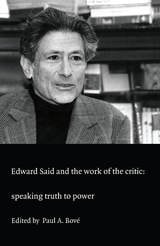
Edward Said and the Work of the Critic
Speaking Truth to PowerPaul A. Bové, ed.
Duke University Press, 2000
In two separate interviews, Said himself comments on a variety of topics, among them the response of the American Jewish community to his political efforts in the Middle East. Yet even as the Palestinian struggle finds a central place in his work, it is essential—as the contributors demonstrate—to see that this struggle rests on and gives power to his general "critique of colonizers" and is not simply the outgrowth of a local nationalism. Perhaps more than any other person in the United States, Said has changed how the U.S. media and American intellectuals must think about and represent Palestinians, Islam, and the Middle East. Most importantly, this change arises not as a result of political action but out of a potent humanism—a breadth of knowledge and insight that has nourished many fields of inquiry. Originally a special issue of boundary 2, the book includes new articles on minority culture and on orientalism in music, as well as an interview with Said by Jacqueline Rose.
Supporting the claim that the last third of the twentieth century can be called the "Age of Said," this collection will enlighten and engage students in virtually any field of humanistic study.
Contributors. Jonathan Arac, Paul A. Bové, Terry Cochran, Barbara Harlow, Kojin Karatani, Rashid I. Khalidi, Sabu Kohsu, Ralph Locke, Mustapha Marrouchi, Jim Merod, W. J. T. Mitchell, Aamir R. Mufti, Jacqueline Rose, Edward W. Said, Gayatri Chakravorty Spivak, Lindsay Waters

Edward Said
A Memorial Issue, Volume 24Patrick Deer, Gyan Prakesh & Ella Shohat, eds.
Duke University Press, 0
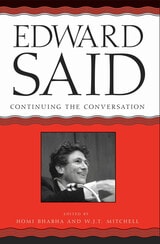
Edward Said
Continuing the ConversationEdited by Homi K. Bhabha and W. J. T. Mitchell
University of Chicago Press, 2005
The essays, imagining and recalling the cadences of Said's conversation, take various forms, including elaborations on his ideas, applications of his thought to new problems, and recollections of the indescribable electricity that made conversation with him intense and memorable. This lively, personal tone is a direct result of editors Homi Bhabha and W. J. T. Mitchell urging contributors to write in the spirit of a conversation interrupted, a call on hold, a letter waiting for a reply, a question hanging in the air. This is a work of immense imaginative and intellectual force and compelling candor, honoring Said's legacy as an activist intellectual.
This collection includes essays by Lila Abu-Lughod, Daniel Barenboim, Akeel Bilgrami, Paul Bové, Timothy Brennan, Noam Chomsky, Ranajit Guha, Harry Harootunian, Saree Makdisi, Aamir Mufti, Roger Owen, Gyan Prakash, Dan Rabinowitz, Jacqueline Rose, and Gayatri Spivak.
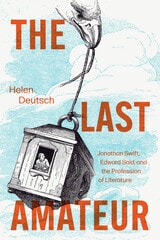
The Last Amateur
Jonathan Swift, Edward Said, and the Profession of LiteratureHelen Deutsch
University of Chicago Press, 2026
Joining the unfinished conversation between the satirist Jonathan Swift and the critic Edward Said, The Last Amateur argues for the transformative potential of literature.
What does “Swiftian” mean to you? For many, the name is synonymous with ingenious satire and an acid, clarifying mix of decorum and outrage. Jonathan Swift was, of course, the author of not only Gulliver’s Travels but also A Modest Proposal, which the columnist Gene Lyons recently called “perhaps the most penetrating anti-racist essay in the English language.” Small wonder, then, that the Anglo-Irish satirist was a lifelong inspiration to the great Palestinian American critic Edward Said, who for many years worked on an unfinished book about Swift and cultivated a Swiftian voice across his career.
Helen Deutsch’s highly personal book explores what Said’s love of Swift—and hers of both—tells us about not only these authors but also the powers of criticism itself. The Last Amateur is about how one comes to love one writer through another. Deutsch scrutinizes Said in relationship to Swift to raise questions of her own about the profession of literary studies. At a time when many in the field have lost faith in critique, Deutsch shows how passion and a refusal of professional propriety—the hallmarks of the amateur—can enliven critique again.
What, then, does it mean to be a Swiftian? The Swiftian hears Swift’s animus and uses it as an incentive for their own freedom of thought. Said was a Swiftian because the experience of reading Swift freed him to speak out, to have something serious to say. Deutsch’s revelatory book is an exercise in hearing Swift’s voice and speaking in her own.