Results by title
4 books match the query 'Edwards, Brent Hayes'

......And the Dogs Were Silent/......Et les chiens se taisaient
Aimé Césaire. Translated and with an introduction by Alex Gil. With a foreword by Brent Hayes Edwards.
Duke University Press, 2024

911 A Public Emergency?, Volume 20
Ella Shohat, Brent Edwards, Stefano Harney, Randy Martin, Timothy Mitchell, and Fred Moten, eds.
Duke University Press, 0
Examining the strengths and shortcomings of area, race, and gender studies in the search for understanding, this issue considers cross-cultural feminism as a means of combating terrorism; racial profiling of Muslims in the context of other racist logics; and the homogenization of dissent. The issue includes poetry, photographic work, and an article by Judith Butler on the discursive space surrounding the attacks of September 11. This impressive range of contributions questions the meaning and implications of the events of September 11 and their aftermath.
Contributors. Muneer Ahmad, Meena Alexander, Lopamudra Basu, Judith Butler, Zillah Eisenstein, Stefano Harney, Randy Martin, Rosalind C. Morris, Fred Moten, Sandrine Nicoletta, Yigal Nizri, Jasbir K. Puar, Amit S. Rai, Ella Shohat, Ban Wang
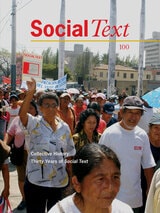
Collective History
Thirty Years of Social Text, Volume 27Brent Hayes Edwards and Anna McCarthy, eds.
Duke University Press, 0
Featuring new interviews with Social Text’s founders and former editors—including Stanley Aronowitz, John Brenkman, Fredric Jameson, Randy Martin, Toby Miller, Bruce Robbins, Andrew Ross, Sohnya Sayres, and Anders Stephanson—the issue reflects on the journal’s legacy as a radical publication that has bridged politics and the academy and has made critical interventions in both arenas. Several contributors revisit the first issue of the journal and describe its lasting impact. Others examine the politics of production at Social Text and detail the hands-on process of putting the journal together. Notably, the issue also features thirty essays by members of the current editorial collective, on key topics that have been crucial to the journal. Ranging from aesthetics to war, and including empire, mass culture, revolution, science, and theory, these essays bring to life the cultural history of the journal and demonstrate how Social Text has shaped the way that these terms are conceptualized and used today.
Contributors. The forty-four contributors include the current members of the Social Text collective and a number of former members. For a complete list of the collective, visit socialtextonline.org.

Global Cities of the South, Volume 22
Ashley Dawson and Brent Hayes Edwards, eds.
Duke University Press, 0
This special issue challenges postcolonial theorists to engage with urban studies and challenges urban analysts to turn their focus to the postcolonial societies where these cities have developed. Gathering well-known scholars in postcolonial theory and urban studies, the collection opens an interdisciplinary exchange through a series of case studies focused on cities in Africa and Asia. One essay argues that the world’s urban spaces are key to the continuance of inequity under capitalist globalization (exemplified by rapidly expanding urban slums), as well as to any possible resistance to that inequity. Another article considers the history and politics of Harlem from the perspective of a well-known academic, activist, and postcolonial theorist whose work here is interwoven with the photographic art of Alice Attie. A third reflects on the politics of representation of Hindu and Muslim populations in Mumbai, evaluating popular media including film and the cosmopolitan fiction of Salman Rushdie.
Contributors. Alice Attie, Mike Davis, Ashley Dawson, Brent Hayes Edwards, Brian Larkin, Rossana Reguillo, Gayatri Chakravorty Spivak, Rashmi Varma, Victor Vich