Results by title
3 books match the query 'Effect of automation on'
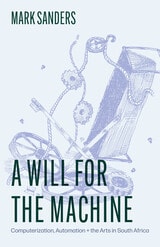
A Will for the Machine
Computerization, Automation, and the Arts in South AfricaMark Sanders
University of Chicago Press, 2026
This study takes up the relations among computerization, labor, and the arts in South Africa.
There are many books about the history and discourses of computerization in the United States but relatively little about these phenomena anywhere in the Global South. In A Will for the Machine, Mark Sanders outlines South Africa’s entry into the computer age in the 1960s and ’70s and explains how it coincided with the high point of apartheid. South Africa’s government viewed automation and computerization as one way of barring Black Africans from skilled work and reserving it for whites. Sanders unpacks this peculiar history, relates it to early twentieth-century struggles around mechanization in mining and telephony in South Africa, and analyzes responses to it by the writers Miriam Tlali and J. M. Coetzee, the artist William Kentridge, and Handspring Puppet Company. Showing how the arts realize ideas about the ethics and politics of automation, Sanders contributes to debates about locally divergent understandings of computer technology and human-computer interaction.
There are many books about the history and discourses of computerization in the United States but relatively little about these phenomena anywhere in the Global South. In A Will for the Machine, Mark Sanders outlines South Africa’s entry into the computer age in the 1960s and ’70s and explains how it coincided with the high point of apartheid. South Africa’s government viewed automation and computerization as one way of barring Black Africans from skilled work and reserving it for whites. Sanders unpacks this peculiar history, relates it to early twentieth-century struggles around mechanization in mining and telephony in South Africa, and analyzes responses to it by the writers Miriam Tlali and J. M. Coetzee, the artist William Kentridge, and Handspring Puppet Company. Showing how the arts realize ideas about the ethics and politics of automation, Sanders contributes to debates about locally divergent understandings of computer technology and human-computer interaction.
[more]
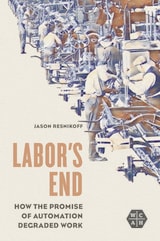
Labor's End
How the Promise of Automation Degraded WorkJason Resnikoff
University of Illinois Press, 2022
Labor's End traces the discourse around automation from its origins in the factory to its wide-ranging implications in political and social life. As Jason Resnikoff shows, the term automation expressed the conviction that industrial progress meant the inevitable abolition of manual labor from industry. But the real substance of the term reflected industry's desire to hide an intensification of human work--and labor's loss of power and protection--behind magnificent machinery and a starry-eyed faith in technological revolution. The rhetorical power of the automation ideology revealed and perpetuated a belief that the idea of freedom was incompatible with the activity of work. From there, political actors ruled out the workplace as a site of politics while some of labor's staunchest allies dismissed sped-up tasks, expanded workloads, and incipient deindustrialization in the name of technological progress.
A forceful intellectual history, Labor's End challenges entrenched assumptions about automation's transformation of the American workplace.
[more]
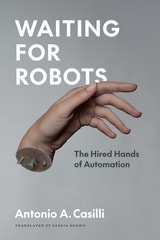
Waiting for Robots
The Hired Hands of AutomationAntonio A. Casilli
University of Chicago Press, 2025
An essential investigation that pulls back the curtain on automation, like AI, to show human workers’ hidden labor.
Artificial Intelligence fuels both enthusiasm and panic. Technologists are inclined to give their creations leeway, pretend they’re animated beings, and consider them efficient. As users, we may complain when these technologies don’t obey, or worry about their influence on our choices and our livelihoods. And yet, we also yearn for their convenience, see ourselves reflected in them, and treat them as something entirely new. But when we overestimate the automation of these tools, award-winning author Antonio A. Casilli argues, we fail to recognize how our fellow humans are essential to their efficiency. The danger is not that robots will take our jobs, but that humans will have to do theirs.
In this bracing and powerful book, Casilli uses up-to-the-minute research to show how today’s technologies, including AI, continue to exploit human labor—even ours. He connects the diverse activities of today’s tech laborers: platform workers, like Uber drivers and Airbnb hosts; “micro workers,” including those performing atomized tasks like data entry on Amazon Mechanical Turk; and the rest of us, as we evaluate text or images to show we’re not robots, react to Facebook posts, or approve or improve the output of generative AI. As Casilli shows us, algorithms, search engines, and voice assistants wouldn’t function without unpaid or underpaid human contributions. Further, he warns that if we fail to recognize this human work, we risk a dark future for all human labor.
Waiting for Robots urges us to move beyond the simplistic notion that machines are intelligent and autonomous. As the proverbial Godot, robots are the bearers of a messianic promise that is always postponed. Instead of bringing prosperity for all, they discipline the workforce, so we don’t dream of a world without drudgery and exploitation. Casilli’s eye-opening book makes clear that most “automation” requires human labor—and likely always will—shedding new light on today’s consequences and tomorrow’s threats of failing to recognize and compensate the “click workers” of today.
[more]