Results by title
5 books match the query 'Effective teaching'
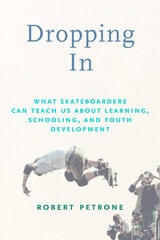
Dropping In
What Skateboarders Can Teach Us about Learning, Schooling, and Youth DevelopmentRobert Petrone
University of Massachusetts Press, 2023
The die-hard local skateboarders of Franklin Skatepark—a group of working-class, Latino and white young men in the rural Midwest—are typically classified by schools and society as “struggling,” “at-risk,” “failing,” and “in crisis.” But at the skatepark, they thrive and succeed, not only by landing tricks but also by finding meaning and purpose in their lives.
In Dropping In, Robert Petrone draws from multiple years of ethnographic research to bring readers into this rich environment, exploring how and why these young men engage more with skateboarding and its related cultural communities than with school. For them, it is in these alternative communities and spaces that they meet their intellectual, literate, and learning needs; cultivate meaningful and supportive relationships; and develop a larger understanding of their place in the world. By looking at what these skateboarders can teach us about what is right and working in their lives, Petrone asks educators and others committed to youth development to rethink schooling structures and practices to provide equitable education for all students.
Effective Teaching of Technical Communication
Theory, Practice, and ApplicationMichael J. Klein
University Press of Colorado, 2021
Drawn from quantitative and qualitative work of practitioners in the field, this edited collection provides an update to the Staples and Ornatowski's influential Foundations of Teaching Technical Communication (1997). The collection is organized around the broad themes of expanding pedagogy, shaping curriculum, incorporating technology, and engaging community. In each section, authors illustrate their experiences with teaching in the university technical communication classroom, addressing topics such as rethinking the role of internships, redesigning student learning outcomes for assessment practices, incorporating ethics into the technical communication classroom, using visual communication in community context, and engaging plain language. These sixteen chapters, taken as a whole or individually, provide readers with insights and examples into teaching technical communication in the 21st century.
Geeky Pedagogy
A Guide for Intellectuals, Introverts, and Nerds Who Want to Be Effective TeachersJessamyn Neuhaus
West Virginia University Press, 2019
Geeky Pedagogy is a funny, evidence-based, multidisciplinary, pragmatic, highly readable guide to the process of learning and relearning how to be an effective college teacher. It is the first college teaching guide that encourages faculty to embrace their inner nerd, inviting readers to view themselves and their teaching work in light of contemporary discourse that celebrates increasingly diverse geek culture and explores stereotypes about super-smart introverts.
Geeky Pedagogy avoids the excessive jargon, humorlessness, and endless proscriptions that plague much published advice about teaching. Neuhaus is aware of how embodied identity and employment status shape one’s teaching context, and she eschews formulaic depictions of idealized exemplar teaching, instead inviting readers to join her in an engaging, critically reflective conversation about the vicissitudes of teaching and learning in higher education as a geek, introvert, or nerd. Written for the wonks and eggheads who want to translate their vast scholarly expertise into authentic student learning, Geeky Pedagogy is packed with practical advice and encouragement for increasing readers’ pedagogical knowledge.
Inclusive Teaching
Strategies for Promoting Equity in the College ClassroomKelly A. Hogan
West Virginia University Press, 2022
Award-winning teachers offer practical tips for addressing inequities in the college classroom and for making all students feel welcome and included.
In a book written by and for college teachers, Kelly Hogan and Viji Sathy provide tips and advice on how to make all students feel welcome and included. They begin with a framework describing why explicit attention to structure enhances inclusiveness in both course design and interactions with and between students. Inclusive Teaching then provides practical ways to include more voices in a series of contexts: when giving instructions for group work and class activities, holding office hours, communicating with students, and more. The authors finish with an opportunity for the reader to reflect on what evidence to include in a teaching dossier that demonstrates inclusive practices.
The work of two highly regarded specialists who have delivered over a hundred workshops on inclusive pedagogy and who contribute frequently to public conversations on the topic, Inclusive Teaching distills state-of-the-art guidance on addressing privilege and implicit bias in the college classroom. It seeks to provide a framework for individuals and communities to ask, Who is being left behind and what can teachers do to add more structure?

Reflective Teaching, Effective Learning
Instructional Literacy for Library EducatorsChar Booth
American Library Association, 2011