Results by title
4 books match the query 'Efficiency'
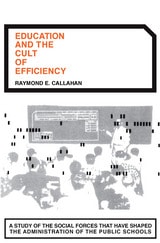
Education and the Cult of Efficiency
Raymond E. Callahan
University of Chicago Press, 1964
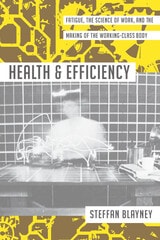
Health and Efficiency
Fatigue, the Science of Work, and the Making of the Working-Class BodySteffan Blayney
University of Massachusetts Press, 2022
A new model of health emerged in Britain between 1870 and 1939. Centered on the working body, organized around the concept of efficiency, and grounded in scientific understandings of human labor, scientists, politicians, and capitalists of the era believed that national economic productivity could be maximized by transforming the body of the worker into a machine. At the core of this approach was the conviction that worker productivity was intimately connected to worker health.
Under this new “science of work,” fatigue was seen as the ultimate pathology of the working-class body, reducing workers’ capacity to perform continued physical or mental labor. As Steffan Blayney shows, the equation between health and efficiency did not go unchallenged. While biomedical and psychological experts sought to render the body measurable, governable, and intelligible, ordinary men and women found ways to resist the logics of productivity and efficiency imposed on them, and to articulate alternative perspectives on work, health, and the body.
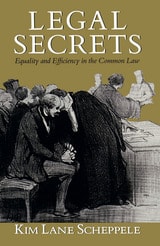
Legal Secrets
Equality and Efficiency in the Common LawKim Lane Scheppele
University of Chicago Press, 1988
Kim Lane Scheppele answers the question, Which secrets are legal secrets and what makes them so? She challenges the economic theory of law, which argues that judges decide cases in ways that maximize efficiency, and she shows that judges use equality as an important principle in their decisions. In the course of thinking about secrets, Scheppele also explores broader questions about judicial reasoning—how judges find meaning in legal texts and how they infuse every fact summary with the values of their legal culture. Finally, the specific insights about secrecy are shown to be consistent with a general moral theory of law that indicates what the content of law should be if the law is to be legitimate, a theory that sees legal justification as the opportunity to attract consent.
This is more than a book about secrets. It is also a book about the limits of an economic view of law. Ultimately, it is a work in constructive legal theory, one that draws on moral philosophy, sociology, economics, and political theory to develop a new view of legal interpretation and legal morality.
The Political Economy of Expertise
Information and Efficiency in American National PoliticsKevin M. Esterling
University of Michigan Press, 2004
More than mere touts for the interests of Washington insiders, these groups encourage Congress to enact policies that are likely to succeed while avoiding those that have too great of a risk of failure. The surprising result is greater legislative efficiency. The Political Economy of Expertise illustrates that this system actually favors effective and informed decision making, thereby increasing the likelihood that new policies will benefit the American public.