Results by title
4 books match the query 'Eichengreen, Barry'
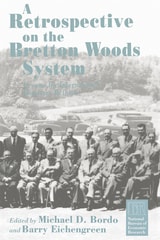
A Retrospective on the Bretton Woods System
Lessons for International Monetary ReformEdited by Michael D. Bordo and Barry Eichengreen
University of Chicago Press, 1993
At the close of the Second World War, when industrialized nations faced serious trade and financial imbalances, delegates from forty-four countries met in Bretton Woods, New Hampshire, in order to reconstruct the international monetary system. In this volume, three generations of scholars and policy makers, some of whom participated in the 1944 conference, consider how the Bretton Woods System contributed to unprecedented economic stability and rapid growth for 25 years and discuss the problems that plagued the system and led to its eventual collapse in 1971.
The contributors explore adjustment, liquidity, and transmission under the System; the way it affected developing countries; and the role of the International Monetary Fund in maintaining a stable rate. The authors examine the reasons for the System's success and eventual collapse, compare it to subsequent monetary regimes, such as the European Monetary System, and address the possibility of a new fixed exchange rate for today's world.
The contributors explore adjustment, liquidity, and transmission under the System; the way it affected developing countries; and the role of the International Monetary Fund in maintaining a stable rate. The authors examine the reasons for the System's success and eventual collapse, compare it to subsequent monetary regimes, such as the European Monetary System, and address the possibility of a new fixed exchange rate for today's world.
[more]

Forging an Integrated Europe
Barry Eichengreen and Jeffry Frieden, Editors
University of Michigan Press, 1998
As European integration has deepened and become more invasive, the tension between the authority of the European Union and the autonomy of member states has increased, while dissatisfaction with the political institutions of the European Union has increased dramatically. How fast and how far European integration will proceed are critical issues for scholars and policymakers in Europe and the United States. Barry Eichengreen and Jeffry Frieden have assembled a group of prominent economists and political scientists to discuss the most important--and most difficult--political and economic issues involved in European integration. The book focuses on three major issues: economic and monetary union, the reform and development of responsive political institutions for the Union, and the enlargement of the Union to include states to the east.
In examining these issues, the writers consider such prob-lems as the trade-off between the benefits of international economic cooperation and the ability to pursue domestic welfare policies; how to increase the political accountability of the institutions of the EU; and how the EU can both be enlarged in membership and deepened in terms of the powers given community institutions.
The contributors are Steven Arndt, Peter Bofinger, Christian de Boisseu, Michele Fratianni, Geoffrey Garrett, Jurgen von Hagen, Ander Todal Jenssen, Ken Kletzer, Lisa Martin, Jonathan Moses, Jean Pisani-Ferry, and Michael Wallerstein, in addition to the editors.
Barry Eichengreen is Professor of Economics, University of California, Berkeley. Jeffry Frieden is Professor of Government, Harvard University.
[more]
Other People's Money
Debt Denomination and Financial Instability in Emerging Market EconomiesEdited by Barry Eichengreen and Ricardo Hausmann
University of Chicago Press, 2005
Recent crises in emerging markets have been heavily driven by balance-sheet or net-worth effects. Episodes in countries as far-flung as Indonesia and Argentina have shown that exchange rate adjustments that would normally help to restore balance can be destabilizing, even catastrophic, for countries whose debts are denominated in foreign currencies. Many economists instinctually assume that developing countries allow their foreign debts to be denominated in dollars, yen, or euros because they simply don't know better.
Presenting evidence that even emerging markets with strong policies and institutions experience this problem, Other People's Money recognizes that the situation must be attributed to more than ignorance. Instead, the contributors suggest that the problem is linked to the operation of international financial markets, which prevent countries from borrowing in their own currencies. A comprehensive analysis of the sources of this problem and its consequences, Other People's Money takes the study one step further, proposing a solution that would involve having the World Bank and regional development banks themselves borrow and lend in emerging market currencies.
Presenting evidence that even emerging markets with strong policies and institutions experience this problem, Other People's Money recognizes that the situation must be attributed to more than ignorance. Instead, the contributors suggest that the problem is linked to the operation of international financial markets, which prevent countries from borrowing in their own currencies. A comprehensive analysis of the sources of this problem and its consequences, Other People's Money takes the study one step further, proposing a solution that would involve having the World Bank and regional development banks themselves borrow and lend in emerging market currencies.
[more]
Reconstructing Europe's Trade and Payments
The European Payments UnionBarry Eichengreen
University of Michigan Press, 1993
This title was formally part of the Studies in International Trade Policy Series, now called Studies in International Economics.
[more]